
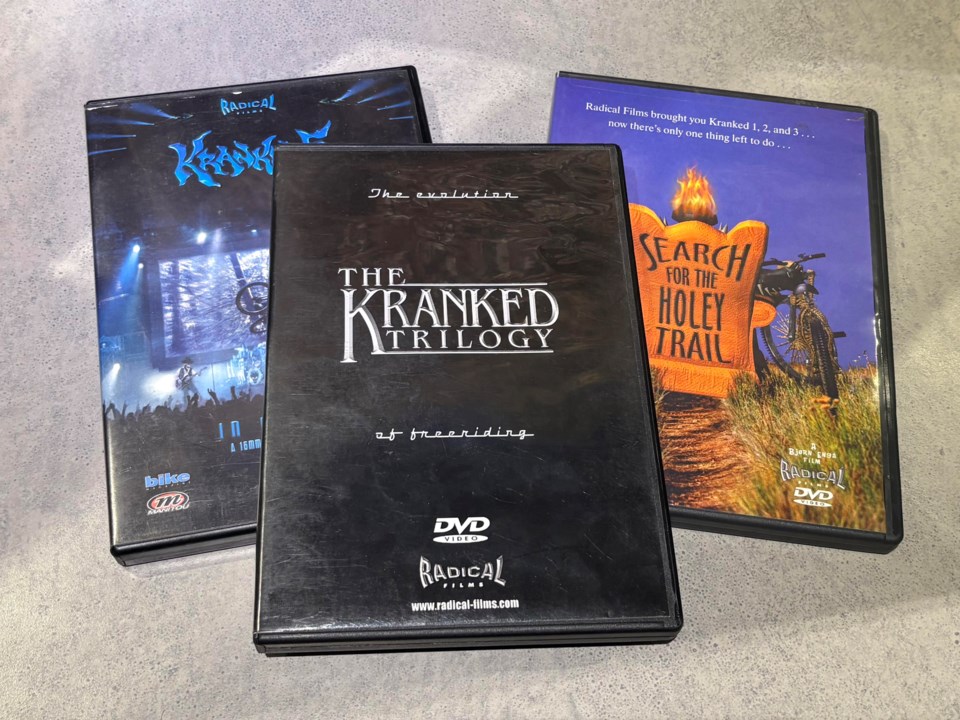
Featured Image: Kranked 1 to 5 on DVD. Photo Whistler Museum Collection.
Today, mountain bike media and Whistler are almost inseparable. From 1990s freeride films, coverage of Crankworx and viral videos such as I Only Ride Park and Ferda Girls, Whistler has played a central role in how mountain biking is documented, promoted, and experienced.
A key milestone in Whistler’s connection to the mountain bike media landscape came on April 11, 1999, when Kranked II: Trail from the Crypt premiered at the World Ski and Snowboard Festival in Whistler. The Kranked series would become one of the most influential MTB film franchises of its era, helping document the rise of freeride mountain biking and introducing audiences around the world to British Columbia’s trails and riders.
Shot on 16mm film, the early Kranked movies captured a rapidly evolving sport. Their footage showcased everything from Kamloops’ sandy steeps to the wooden ladder bridges and elevated features of North Shore Vancouver, which would go on to influence trail-building around the world. The films helped establish B.C. riders such as Ryan Leech, Wade Simmons, Brett Tippie, and Richie Schley as international stars.

Image: Rowles Collection
The driving force behind the series was filmmaker Bjørn Enga. Raised in Granthams Landing and North Vancouver, Enga discovered mountain biking in the early 1980s. Seeking adventure, he moved to Whistler in the early 1990s, where he embraced the ski-bum lifestyle and worked as a taxi driver between 1990 and 1992. Although he briefly returned to university, the pull of mountain culture eventually led him back to British Columbia’s mountain towns.
By the mid-1990s, Enga had launched Freak Radical, an interactive journal dedicated to mountain culture. Teaming up with Christian Begin, at age 28 Enga shifted to film production, starting Radical Films. Their first feature-length production, Kranked: Live to Ride, was released in 1998, laying the groundwork for what would become one of mountain biking’s defining film series. This period in the sport’s history is explored in detail in Darcy Turenne’s 2017 documentary The Moment.
Whistler played an important role in the development of the Kranked films. The world premiere of Kranked II was held at the Fairmont Chateau Whistler and drew approximately 1,000 attendees. The event was organized by Shauna Hardy, a former North Vancouver schoolmate of Enga’s, who would later found the Whistler Film Festival in 2001.
Another local connection came through Whistler-based artist and designer Stu MacKay-Smith of Toad Hall Studios. MacKay-Smith, who had previously collaborated with Enga on Freak Radical, created most of the distinctive graphics and animation featured in the early Kranked productions.
How audiences consumed MTB media, at the time, was very different from today. Films were distributed through bike shops, first on VHS and later on DVD. Eager mountain bikers often waited for copies to arrive at their local bike shop.
In 2000, while promoting Kranked III: Ride Against the Machine, Radical Films posted a video trailer online, something virtually unheard of in the action sports industry at the time. While filming in Mexico, Enga received an unexpected message from the company’s internet provider that exclaimed that they could not support the amount of traffic. In short, Kranked III’s trailer was blowing up the internet.
“Apparently they were using more data than the usual high-volume content,” Enga later recalled. “I got this message at a pay phone in a remote place in Copper Canyon, Mexico. Our plan with the internet site did not include that much data… Early days!!!”
The trailer’s popularity suggested there was a strong appetite for online video distribution and viewing. What is taken as a given today was groundbreaking 25 years ago.

The influence of the Kranked films extended beyond riders and audiences. The series also served as a training ground for a generation of filmmakers and photographers who would go on to shape MTB media. Among them was Darcy Wittenburg, who worked on Kranked films before co-founding The Collective with Jamie Houssain and later establishing Anthill Films. Anthill Films is a production company that has continued to push the creative and technical boundaries of action sports cinematography (see Brandon Semenuk’s unReal Segment).
Today, action sports photography and filmmaking have become an important part of Whistler’s cultural identity. The groundwork laid by early innovators such as Bjørn Enga helped transform MTB media from a niche pursuit into a global industry, with Whistler often at its centre.