Category: Arts & Artists

Art and artists made in Whistler.

Icons Gone — brought back centre-stage!Icons Gone — brought back centre-stage!

0 Comments

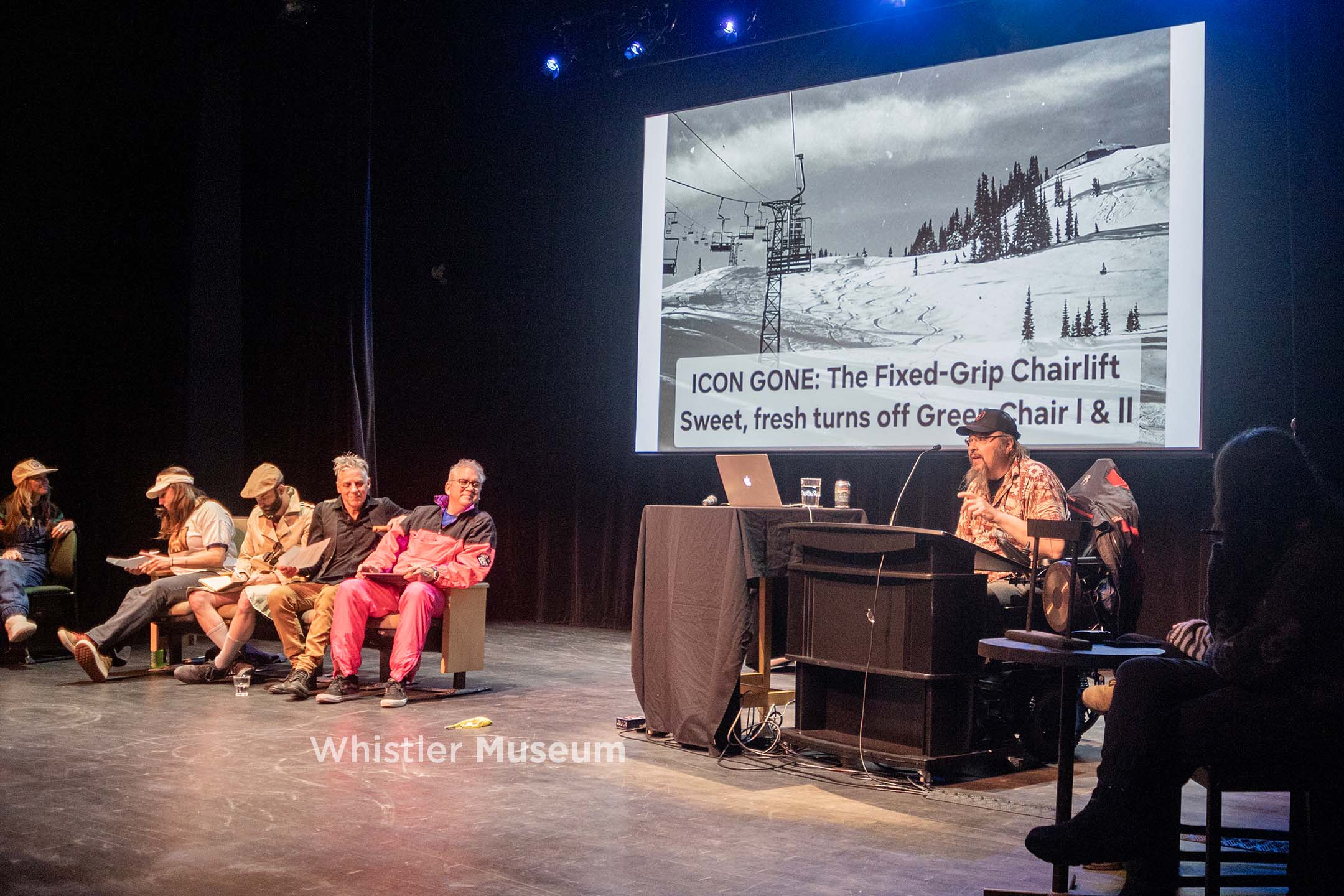
Featured Image: Keven “Big Kev” Mickelsen presents at last year’s Icon Gone. Whistler Museum Collection.

It could be argued that a signpost or a benchmark of a town’s maturity can be tabulated by how many significant symbols/things/happenings/elements-uniquely-local that have come to be associated with it, can now be referred to in the past tense… measuring a community’s forward trajectory by its ‘icons gone’.

Lamenting the legacy of legends-left-behind is the focus of next week’s ‘ICON GONE’ event put on by the Whistler Museum at the Maury Young Arts Centre/Millenium Place. The event began in 2008 and ran for many years up until 2013. It was resurrected last year with yet another all-star cast.

In a lively evening of friendly competition (tinged with debaucherous debate…it is, after all, 19+), six notable locals will take to the stage and argue for what they think is the largest loss in the landmark of Whistler-specific icons. The audience (through applause-and-yell-o-metre) along with a panel of equally notable judges will crown a champion. Nudity was the winner of last year’s debate. Citta’ (pronounced Cheetah’s, for those who don’t know), the runner up.

This year’s panel promises to deliver on all levels, covering the extremes from the raunchy to the contemplatively serious. Past topics have included everything from Fixed-Grip Chair Lifts to A-Frames, Squatters Cabins to The Boot Pub, the Passenger Train and Toonie Races to the Toad Hall Poster; from the Snow, Water, Earth Race to the Party Barge, Mountain Man Beards to Beavers. Gravity – as a topic, as a subject — even won one year.

The purpose of the evening is two, even three-fold. Undeniably, entertainment and community-fun are a major focus. However, the event also serves as a way to highlight the Museum’s local archive – and remind people of its absolute essential relevance. Through the eyes of the present we are given tools to reflect upon our past. ICON GONE serves to illustrate the value of preserving our stories, our legacies, our legends and some of the many ways which we can keep them alive. Humour is one of them, a method of honour. The archive is not a dusty, musty collection – it is active, vital and alive – infused only by our present perspectives.

In a December 5, 2025 editorial titled ‘Who remembers Whistler?’ Pique Newsmagazine editor Braden Dupuis deftly articulated the value of the Museum. ICON GONE offers the opportunity to showcase Dupuis’ points, worth repeating anew:

“If we don’t invest in institutions that collect, preserve, archive, and explain, we lose more than objects and photographs. We lose context. Identity. A sense of place beyond postcards and ski packages.

Left unchecked, the version of “Whistler history” that remains will be curated by marketing budgets: sleek, sanitized and built for outside consumption. It’s cultural erasure in its most casual, passive form.

[…]

By preserving history, we don’t resist change, we anchor it in respect. We ensure Whistler doesn’t forget it is more than a ski-lift and slopes, a playground for the rich or an ATM for faceless corporations—that it is a real community built by people, labour and continuity.”

In the spirit of continuity – through raucous reverence — let us celebrate the cornerstones of this community…

On Friday, April 17 – at 7:00 pm – join judges Ace MacKay-Smith, Julia Murray and Brandon Barrett as together we applaud debaters Feet Banks, Princess Stephanie, Stinky, Laugh Out Live’s Rebecca Mason, lawyer Tanya Kong — as they set to historically hammer home their iconic topic of choice!

For more information and Tickets, please visit www.whistlermuseum.org

Boarder Bob: Whistler-based 1990’s Comic StripBoarder Bob: Whistler-based 1990’s Comic Strip

0 Comments

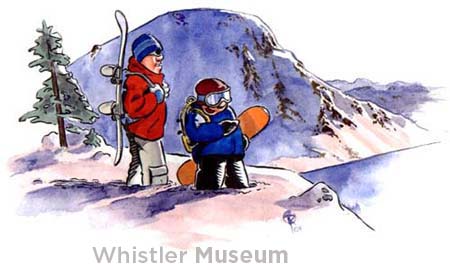
Featured image: Boarder Bob comic illustrated by Olivier Roy, published in Snowboard Canada Magazine (starting somewhere in the mid-nineties!)

Olivier (Oli) Roy is “an artist snowboarder” who first came to Whistler “right after high school in 1990” to attend a Craig Kelly Camp. He moved here, three years later, after art college. 

Now, with a career of more than thirty years of ongoing coaching and creating under his belt, he holds a Lifetime Whistler Blackcomb Pass in one hand, a paintbrush in the other and continues to ride the endless canvas offered up by the mountain: artistically and athletically.

The early/mid-nineties has been referred to as the ‘golden age of snowboarding.’ It was fresh, edgy and still relegated to counter-culture status. In Whistler, it was synonymous with a lifestyle and a community. 

During this era, the Ontario-based Snowboard Canada Magazine was born. Broadening their output, they enlisted Roy, as he describes,  a “cool artist.” 

Thus, Boarder Bob – the character and comic strip – were born. Border Bob “moves to Whistler to pursue [his] dream of being a pro snowboarder, but he’s very delusional … ​​he thinks he’s a big shot…” But, he’s not. After a season or two,  “he gets a sidekick, Jed Shred.”  

Jed is a devoted fan: “he’s all like, ‘Oh, Boarder Bob, you’re so epic’. But, as is proven – through Bob’s trials, tribulations and failed attempts at ease and epicness – he is anything and everything, but. 

Roy collaborated with local Glenn Rogers – known for his comic panels in The Whistler Question (a former, local publication started in 1976) – to produce the strip. The two worked together for eight years (“if I remember correctly”, states Roy), producing the 8 panel, 2 row, half-page ‘Boarder Bob’ strip. Published four times a year, “we had a lot of fun” poking fun at the “life of snowboarding in Whistler and on the West Coast.” 

The stresses of balancing the desire to shred while staying fed, being able to board while needing to find literal board-ing to trying to be the bawler at the bar were all fodder for the two creative duos: Roy and Rogers, Bob and Jed. Moral quandaries were occasionally tackled through the ink of these stories: “should we risk everything to be in the shot?!” Arguably, Boarder Bob was 90% total fun, 10% tackling that ‘the stakes are real’.

Boarder Bob Comic. Illustrated by Olivier Roy, written by Glenn Rogers: featured in Snowboard Canada Magazine. The comic strip ran between 1995-2002 approximately.

The comic ran from about 1995 to 2002, or thereabouts. The pinpointing of specifics is about as precise as Bob’s technique, working more with the “ish” verb. However, when it comes to the technical hows of developing the strip, the collaborative process between Roy and Rogers was fine tuned. 

Rogers would usually come up with the story. Admittedly, Roy states “I was never good at writing the stories, I was more the artist and inker.” He would receive the script and then sketch it, all by hand, on an 11 x 17 piece of cardboard:

“I would pencil it and then use China ink [for] the black and white and use markers, like alcohol markers and a bit of watercolor.” It was all hand-lettered.  “And then I would send it by FedEx back to Snowboard Canada magazine. And I, I remember a few times where the FedEx guy would ring the bell and I would still be finishing … after an all nighter.” Each strip took between 10-20 hours. “It was a labour of love,” Roy reminisces. “I loved it.”

Boarder Bob eventually got abducted by aliens (I mean, why not?) – or this is insinuated, but never confirmed for the reader. “There’s a UFO and he disappears.”

Boarder Bob carved out a seminal space in the culture and history of snowboarding art, taking its place in the local legacy of slope-inspired comic strips. The Peak Bros ran from 1979-2002 (in The Whistler Answer and Whistler Review), poking fun at 80s ski culture, whereas Boarder Bob tackled the snowboarding shenanigans of the nineties. 

Roy continued, and continues, to flourish on and off the slopes: the line between his art and sport overlapping. 

He has illustrated for Snowboarder Magazine (the prominent US publication), been Whistler Blackcomb’s online illustrator, designed top sheets for such companies as Prior, Luxury and Option Snowboards; been sent to Ottawa as a Whistler Art Ambassador in 2010 for Canada Day and continues to regularly produce art that showcases the mountains and its vibrant culture. 

The born-in-Montréal skateboarding kid who first came out to join Craig Kelly’s summer camps on the glacier, to then gain accolades as a competitive snowboarder in “half pipe contests, some slope styles, some boarder cross” to now working for Whistler Blackcomb’s Alpine Program and holding the title of being Whistler Valley Snowboard Club’s longest-running coach, working with the program since its inception almost 30 years ago – has literally drawn together the lines of on and off-mountain creativity. 


Boarder Bob Comic. Illustrated by Olivier Roy, written by Glenn Rogers: featured in Snowboard Canada Magazine. The comic strip highlighted and poked fun at the Whistler snowboarding scene of the nienties.

Interpreting WhistlerInterpreting Whistler

0 Comments

When traveling to a new place, or even exploring your own town, interpretive panels are a great way to learn about local history, wildlife, and the natural environment. These little pop-ups of information can feel a bit like VH1’s Pop-Up Video from the 2000s, which offered quick, engaging insights that added depth and context to a song or music video, much like how interpretive panels help you better understand your surroundings or see a familiar place in a new light.

Over the Whistler Museum’s 38-year history, we’ve had the opportunity to help develop many of the interpretive panels throughout the Whistler Valley. Most recently, we’ve been involved in the creation of the panels that have appeared along the Valley Trail network and throughout the Village starting in 2018, in collaboration with the Resort Municipality of Whistler. These installations have become a wonderful way to share Whistler’s stories in the very places where they unfolded, such as the history panels in Rainbow Park.

Interpretive panel located along the cultural connecter.

Beyond traditional panels, newer forms of interpretation have used technology to share stories in different ways. A great example is the Squamish Lil’wat Cultural Centre’s Cultural Journey, a self-guided audio tour and series of kiosks along the Sea to Sky Highway. Developed in 2010, it weaves together oral histories, traditional place names, and cultural knowledge from the Líl̓wat Nation and the Sk̲wx̲wú7mesh Nation. By pairing the region’s views with first-hand stories, it turns the drive between Squamish and Whistler into a richer cultural experience. More information about the tour can be found here: https://slcc.ca/cultural-journey/

Whistler’s first interpretive panels date back to 1987. Created by accomplished artist Isobel MacLaurin for the Whistler Rotary Club, these early works depicted Whistler’s landscapes, flora, and fauna. While simple in scope, mostly identifying local species, they set the foundation for what would become a long tradition of place-based interpretation in the valley.

Isobel and her husband Don MacLaurin moved to Whistler in 1961. Don, a forester and educator at BCIT, was instrumental in preserving several of Whistler’s cherished recreational areas, including Lost Lake Park. When timber licenses in the area were set to expire, developers were poised to move in. Recognizing its ecological and community value, Don worked with BC Parks to ensure the area was protected for public use, a vision that continues to benefit residents and visitors today.

One of Isobel’s hand painted signs on the Riparian trail in the Whistler Interpretive forest. 

Don also helped establish the Whistler Interpretive Forest (WIF) in the Cheakamus area during the late 1980s and 1990s. With Isobel’s distinctive artwork, the pair developed and installed interpretive signage throughout the forest. Some of these original hand-painted panels can still be found along the Riparian Trail, which was later updated and expanded with support from the Whistler Rotary Club in 2018.

At the Whistler Museum, we continue to enjoy contributing to interpretive panels throughout the valley. Each panel is a chance to build on the work started by the MacLaurins and the Rotary Club, helping residents and visitors alike deepen their understanding of this place and the stories that shape it.

The Sound of “Music ’91”The Sound of “Music ’91”

0 Comments

From May to September 1991, towns and cities across British Columbia hosted large-scale performances with acts such as Rita MacNeil, Colin James, Bachman Turner Overdrive, Joan Baez, John Denver and more drawing crowds around the province. These performances were all part of Music ’91 RoadShow weekends, one of which took place on Blackcomb Mountain in July.

From July 12 to 14, 1991, the mainstage on Blackcomb Mountain next to the Rendezvous Lodge saw headling performances by Linda Ronstadt, Smokey Robinson and Natalie Cole, and Boz Scaggs. The mainstage, however, was just one part of the Music ’91 RoadShow. RoadShows also included two BC Tel Centennial Community ShowCase stages featuring amateur and lesser-known acts, Musicians’ Workshops with some of the performers, merchandise and food vendors, and the KidsOwn area, which included the DRUMASAURUS (a dinosaur made of drums), workshops, storytelling, face painting and a “Walk-On-Synthesizer.” RoadShow attendees could also take part in Blackcomb’s summer activities and go hiking, biking, or skiing on the glacier.

Boz Scaggs performs on the RoadShow mainstage on Blackcomb Mountain. Blackcomb Mountain Collection, Unknown Photographer, 1991.

Despite less than ideal weather, a ticket price that some people thought was too expensive ($36), and a few stopped chairlifts while downloading, Blackcomb Mountain named the event a success, with over 14,000 tickets sold to the three mainstage performances, and one Blackcomb spokesperson even said that “the RoadShow has given the mountain a number of new ideas about similar events in future summers.” Those who attended also praised the staff and management for their work hosting the event.

Todd & Laurence offer a Musicians’ Workshop after performing at one of the smaller stages. Audience members show off their Music ’91 merchandise. Blackcomb Mountain Collection, Unknown Photographer, 1991.

Music ’91 was not without controversies, both centred on the Whistler RoadShow and the program as a whole. Music ’91 was a tourism marketing initiative put on by the province that aimed to increase tourism and encourage residents to stay and spend money in BC instead of going across the border after the introduction of the GST at the beginning of the year. That spring, the Social Credit party leader and premier Bill Vander Zalm resigned amidst a conflict of interest controversy surrounding the sale of his Fantasy Gardens flower garden and theme park. Following this, some saw Music ’91 as an effort to gain support for the SoCred party in the upcoming election, though the program had been in development for quite a while.

The location of the Music ’91 RoadShow on Blackcomb Mountain also raised some questions. According to Whistler Mountain president Charles Young, the RoadShow was originally supposed to take place on Whistler Mountain not far from the gondola-accessed Roundhouse Lodge. However, as the mountain and Music ’91 were finalizing the details, Whistler Mountain switched its food-service taps from Pepsi to Coca Cola. As Pepsi was a sponsor of Music ’91, the venue was soon switched to Blackcomb Mountain, a move that was confirmed by Music ’91 executive vice-president James Conrad. Though Whistler Mountain was “surprised” at the change, Young told the Whistler Question that they did not regret switching brands as “Pepsi has never shown the initiative in working with us that it’s shown in working to take Music ’91 away from us.”

Mainstage audience members watched with umbrellas and ponchos. Blackcomb Mountain Collection, Unknown Photographer, 1991.

Across the province, Music ’91 was connected to around 700 summer concerts and festivals; co-produced additional events such as First Night on New Year’s Eve, the DuMaurier Jazz Festival, and the Labatt’s Canada Live concert series; sold about 129,000 tickets; and, according to the report of Auditor General George Morfitt, cost $26 million to put on, with $19 million coming from gaming profits. Some did not consider Music ’91 as a whole to be success, with questions about tendering and contracts, the use and costs of international contracts, and the increase in budget from the original estimate of $12 million.

In the provincial election that fall, the SoCred party won only seven seats, 40 fewer than they had held previously, and the NDP became the governing party of BC. In May 1992, the new NDP Tourism Minister Darlene Marzari stated that Music ’91 had been a failure in its goal of increasing tourism. In his report, Morfitt wrote that “The government did not effectively monitor or control the scope of the project” and recommended that “any future commitment of public money be preceded by an assessment of risk and a cost-benefit analysis” and “that any project have a clear definition of objectives and how those objectives will be achieved and assessed.”

The crowd on Whistler Mountain for the Vancouver Symphony Orchestra. Blackcomb Mountain Collection, Unknown Photographer.

Despite these criticisms, Blackcomb’s Music ’91 RoadShow seems to have been well received in Whistler. While it was certainly well advertised, the RoadShow was not, however, the only musical performances taking place in Whistler in 1991. In August, the Vancouver Symphony Orchestra performance on Whistler Mountain drew just over 5,00 attendees and both the Arts Council and the Whistler Centre for Business and the Arts had performances lined up throughout the year, including the Music in the Mountains concert series.