Category: Mountain Biking

Because you can do more than ski and snowboard in Whistler… you can also bike.

The Four-Wheel ForceThe Four-Wheel Force

0 Comments

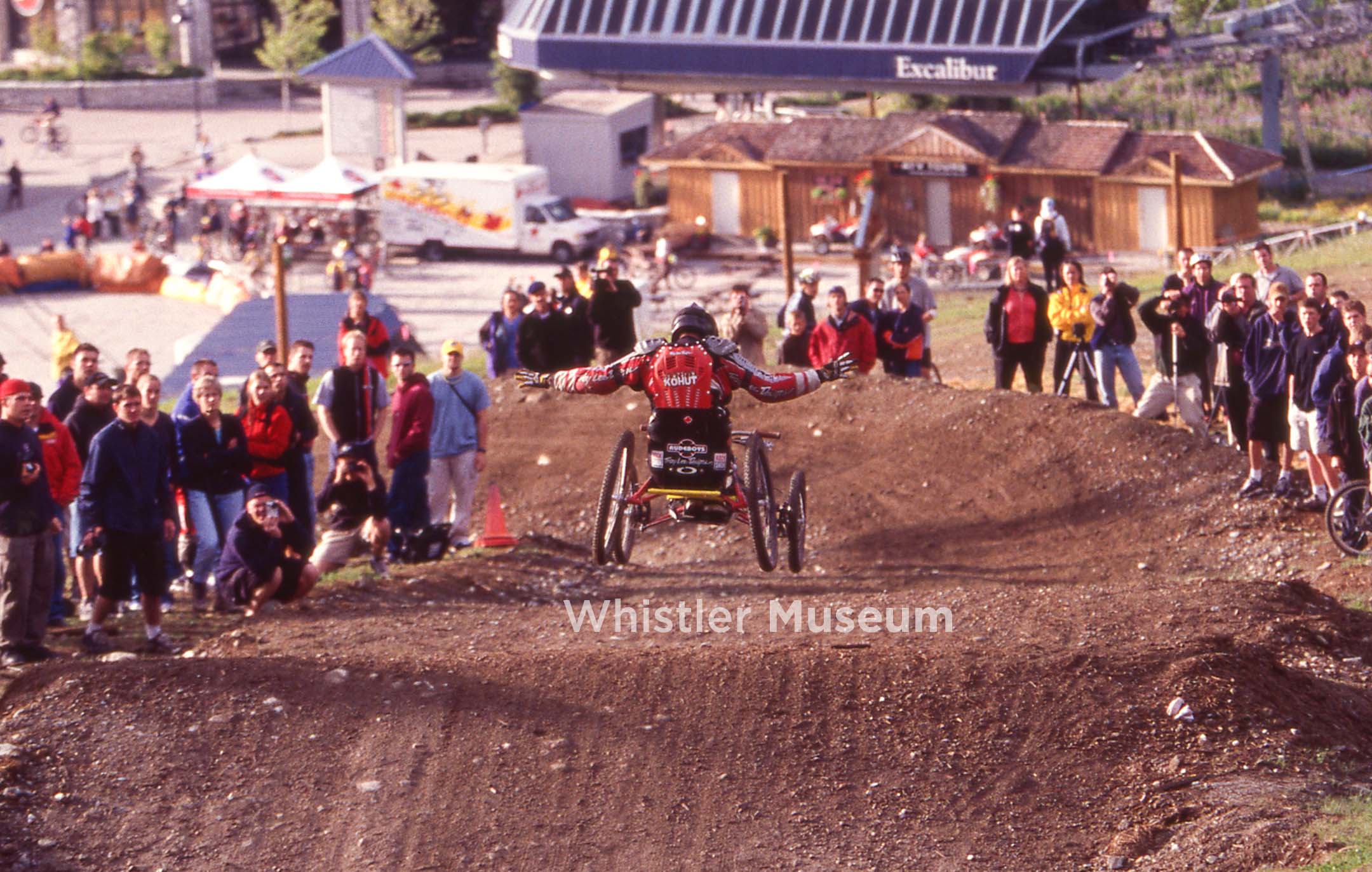
Featured Image: Kohut in the Whistler Bike Park, in 2000. Whistler Museum/Insight Photography Collection.

May 15 marks Opening Day of the Whistler Bike Park. For Kohut, the day marks the start of his 26th season riding the park.

“In ‘92, I originally saw a picture of someone riding a four-wheel bike.” Kohut wanted one. Badly.

“I had to wait until 1999 to get my first four-wheel bike. Seven years it took. Seven years of winning gold medals. Seven years of being in the paper. Seven years of being on the TV. Seven years of pouring my heart into just being a real, true, integrated individual.”

Those seven years followed a life-changing accident. At age 21, Kohut broke his back attempting a “super-loop” on a swing set. Within a year, he was back skiing. By 23, he had become “Canada’s first-ever gold medalist in sit-skiing”. In 1996, he won the World Championship of Disabled Skiing in Austria, followed by three silver medals at the 1998 Paralympic Winter Games in Nagano.

“It’s all about being quick. And looking good. Being good.” Following that, Kohut came to Whistler and spent almost a month just shredding the snowboard park and half pipe. “You gotta pay your dues with pain, blood, tears, and a tremendous amount of determination to attempt the trick, fall, get up. Attempt the trick, fall, to get up. That method is exactly why I’m successful.”

In 1999, Kohut also quit the National Ski Team. He did return for one last Paralympics in 2002 in Salt Lake, but has not been on snow since 2003. His focus since then has been solely on biking. In 2017, Red Bull called him “the world’s fastest mountain biker on four wheels.” The year following the acquisition of his bike, he was competing in an American national downhill race. Without question, an able-bodied one.

 In 2000, he was competing in Whistler.  “ it’s announced that starting next year, the bike park is going to be open for five and a half months. … Well, all the dudes that were sitting with me were like, holy @#$%. We can do it. We can become the world’s first bike bums.” And that’s exactly what Kohut proceeded to become when he moved full-time to Whistler.

“That’s what I am. I’m a bonafide park rat. I was a skate park rat. I was a BMX track park rat. I’m a downhill park rat.” He continues, “We don’t adaptive bike. We don’t handicap bike. We have bikes that are four wheels. You can call it a four-wheel bike or a four-cross and that’s that.”

Kohut is a pioneer. Not by choice, but by default, he is also an advocate. “I’m anti adaptive. I can’t do any of it. … I’m a big proponent of having no more Paralympics. I just think the Paralympics should be blended into the Olympics. … Same day. Same discussion.” Locally, “the people that I owe so much to is people like Phil Chu and Linda Chizik,” prominent Whistler athletes.

The 55-year-old Kohut was born and raised in Calgary, Alberta. “My heroes are like dirtbags… They’re rock and roll musicians. They’re punk rockers.” Kohut fondly reflects,  “Daddy was a Top Fuel drag racer, Mama was bleach blonde. My whole life has never been normal, everything was cool, I didn’t miss out on anything.”

With 25 previous seasons in the bike park, Kohut knows a thing or two about preparation and approach. “I do 100 B-Lines every year before I go on any other trail.” He rides a minimum of three-and-a-half days a week – sometimes seven – and aims for 10 runs a day.

“it’s so fun to race yourself,” he claims. “I don’t work on my weak skills. I cash in on my strengths.”

Kohut is both motivated and a motivator. “I’m pulling the rope that everyone else should be pulling and that’s to make this town as best as it can, as inclusive as it can, as friendly as you can, and let’s just get people from all over the world to come here to shred and be stoked.” 

40 years from now, “I’m going to be the 95-year-old guy that’s doing one run a day.” He will likely also be the first in line.

Losing the UCI MTB Triple CrownLosing the UCI MTB Triple Crown

0 Comments

Back in 2001, Whistler was slated to host the UCI (Union Cycliste Internationale) MTB World Cup Triple Crown event, but it did not go ahead. According to The Province, the UCI had received 11 bids to host the event from various Whistler groups between 1991 and 1999. Only one was successful.

In 1998, Marika Koenig and Claire Bonin founded TEAM Management, an events and festivals company focused on mountain biking. That same year they executed the inaugural Whistler International Classic, an internationally-sanctioned race where pro riders could build up UCI points. Over the next two years, TEAM added the race to their new event, Summer Session, a multi-day festival that revolved around mountain biking, cycling, skateboarding, and general summer fun. From fun and competitive races to bachelor auctions, the week was jam packed with events. Through this, TEAM showcased Whistler’s capability of hosting a World Cup event.

Mountain biker Dave Wastson competes in the 1999 Summer Session. He later won the 2001 Joyride Bikercross. Bruce Rowles Collection

TEAM invested their time and funds to submit an extensive bid to UCI in September 1999. It was endorsed by Cycling BC, the Canadian Cycling Association (CCA), and W3 – Whistler Blackcomb, Tourism Whistler and the Resort Municipality of Whistler.

Four months later, UCI awarded the bid to Whistler. Unfortunately, the dream of hosting a World Cup in Whistler did not come to fruition, as W3 wanted to take over ownership from TEAM, but did not have the expertise to do so. In December 2000, 7 months out from when the Triple Crown event was supposed to take place, W3 and TEAM withdrew their intention to host the World Cup.

The Whistler community expressed disappointment, outrage, and confusion, writing letters to the local papers in support of TEAM’s role and success with other MTB events. Many questioned the real reason for backing out. The fallout caused TEAM to cancel their events planned for the summer, including the third-annual Summer Session, and end their business.

Promotional video for Summer Session (2000). Koenig Collection

There were also concerns that this fallout would affect Whistler’s bid for the 2010 Olympic and Paralympic Winter Games, since UCI President, Hein Verbruggen, sat on the International Olympic Committee (IOC) and was not too pleased with the outcome. The Olympic bid, however, remained unaffected and was awarded to Vancouver and Whistler in 2003.

In the meantime, two other resorts competed to take on this opportunity – Sun Peaks and Grouse Mountain. In March 2000, Grouse Mountain was confirmed to take on the Triple Crown from July 4 – 8, 2001, as well as events in the 2002 and 2003 World Cups. There were concerns initially with lack of on-mountain facilities and accommodations, but the Vancouver mountain assured UCI that the Skyride could transport 1,200 people per hour to make access for athletes and spectators easier. They also brought in Gestev Inc., an experienced organization who did World Cup races at Mont-Ste-Anne (Quebec) and Mazatlan (Mexico). Though the event was successful, mountain biking on Grouse died down after these World Cups, until this year when their new Bike Park opened this summer.

The podium for the cross-country event at the 2002 World Cup on Grouse Mountain. That year the downhill and four-cross events were cancelled. Makarewicz Collection

Back in Whistler, this left a void that needed to be filled by a large summer event. Since the 1980s, mountain biking had become a staple of Whistler summers, with several attempts at hosting annual events, so what was next?

Paddy Kaye and Chris Winter formed Joyride Productions in 1997 with the goal of bringing freeriding MTB events to Whistler. They helped build many of the trails on Whistler Mountain prior to Whistler Blackcomb taking over the park, and assisted with events and trail maintenance during the Summer Session festival. With the lack of major events in the summer of 2001, they brought Joyride Bikercross to the forefront and it was a massive success. The event took place a day prior to Grouse Mountain’s World Cup, a strategic choice on their end since pro riders would be close by to attend both events.

This homegrown event got bigger and better, and the slopestyle competition was introduced in 2003 when Joyride was incorporated in the Whistler Gravity festival. A year later, the festival was rebranded to Crankworx – Whistler’s largest summer festival that now has a multi-stop world tour.

40 Years of Conferences40 Years of Conferences

0 Comments

This year, the Resort Municipality of Whistler (RMOW) will be recognizing a significant milestone when it turns 50 on September 6. The following day will also mark a pretty big milestone; September 7 will be 40 years since the official opening of the Whistler Conference Centre.

Although construction began on the site in March 1980, an economic downturn meant that it was five years before the facility was completed and the finished product was very different from the plans of 1980. The original plan for a Resort Centre included an Olympic-sized ice rink, 3×20 metre swimming pool, whirlpool, saunas, racquetball courts, squash court, locker rooms, Golf Pro Shop, and restaurant. After the project was taken by Whistler Land Co. Developments (WLC; the Crown corporation that took over the liabilities and assets of the Whistler Village Land Company) in 1983, studies reportedly found that it would be more profitable to run the facility as a conference centre than a resort recreation centre.

Drawings of the original Resort Centre design. Whistler Question Collection, 1980

Architects Edward Friederichs and Don Jewel were brought in to design “a building within a building” and reconfigure the partially built structure into a conference facility. Although construction had previously stopped in 1982, work resumed in June 1984 when WLC hired Smith Bros. and Wilson Ltd. One of the first things they did was remove the shake roof that had been put on and replace it with a steel roof with fourteen dormers, which were reportedly meant to help distribute the snow and make the building blend in more with the rest of the Village. The project was expected to be completed by June 1985.

As the completion date approached, expectations rose that the Conference Centre would bring in more visitors during Whistler’s slow months; in May 1985, three Whistler employees told the Whistler Question that they thought the Conference Centre would “even out trade throughout the year,” especially in the fall months that were “always dead.” With the ability to host events for up to 2,000 people, the Conference Centre was one of the largest such facilities in British Columbia, topped only by the Peach Bowl in Penticton. In addition to the main ballroom area, it also boasted break-out rooms on the lower level, an attached theatre, a full-service kitchen, the offices of the Whistler Resort Association (today Tourism Whistler) and a memorable atrium.

The Conference Centre atrium set up for an event in January 1990. Insight Photography Collection, Greg Eymundson

The Whistler Conference Centre opened, as expected, in June 1985 with a performance by the Anna Wyman Dance Theatre on Saturday, June 8 followed by its first convention, a 175-delegate meeting of Fibreglas Canada, beginning on Sunday, June 9. The public was invited to look around the building in early July and, according to the editorial in the Question, “they came, they saw, and they liked.”

Though it had hosted events and meetings throughout the summer, the official opening ceremony for the Conference Centre did not take place until September 7, 1985. That weekend Whistler hosted the retreat of provincial cabinet ministers, meaning that government officials were on hand for both the opening ceremony and the tenth anniversary of the RMOW.

A meeting takes place in part of the Conference Centre ballroom. Whistler Question Collection, 1995

In his address, premier Bill Bennett told the crowd that “Today, the opening of the Conference Centre is more a tribute to your optimism, your vision, and to knowing the kind of community you want” and describing the importance of Whistler as an introduction to British Columbia. His speech was followed by remarks from Chester Johnston, the chairman of WLC Developments Ltd., who thanked those who had worked on the project. The ceremony also included a performance by the Beefeaters Brass Band and a salmon barbecue.

By the time of the official opening ceremony, the Conference Centre had 50,000 delegate-days booked in 1985 and 120,000 booked for 1986, with expectations that those numbers would grow. Today, though it looks a little different than it did at its opening, the Whistler Conference Centre continues to be operated by Tourism Whistler and welcomes conferences, meetings and events to town.

Bringing the Arizona Heat: the 1994 Cactus CupBringing the Arizona Heat: the 1994 Cactus Cup

0 Comments

In 1991 at Pinnacle Peak in Arizona, a group of locals called Team Aware started the Cactus Cup, a mountain bike racing event. The Cactus Cup attracted 100 riders in its inaugural year and then grew quickly, with the goal of promoting the sport and broadening the pool of racers and recreational riders.

Specialized Bicycles became the title sponsor and the event toured other locations across the United States. In 1994, the Arizona event had 1,900 participants and 20,000 spectators. That same year, the organizers partnered with Blackcomb Mountain to host their first international event in Whistler.

The base of Blackcomb Mountain during the 1994 Cactus Cup. Blackcomb Mountain Collection, Randy Lincks

By this time, Whistler had a strong mountain bike culture and had shown its capacity to host large, multi-day events through the Can-Am and BRC races. The second stop in the Cactus Cup Series took place from Friday, July 22 to Sunday, July 24. There were over 300 riders, which was half the expected attendance. Though many pro athletes were in attendance, for many there were more important races going on. For example, The Province reported that BC’s top women Lesley Tomlinson and Alison Sydor would not be attending as they qualified for the Tour de France.

The weekend was packed with competitive racing, a bike expo, a kids rodeo and race, a fun dual slalom, and a “Meet the Pros” hoe-down party at Merlin’s.

Kicking off the competition on Friday morning was the Time Trial, an individual race against the clock. Later in the day was the Fatboy Criterium, where racers took to the Village Stroll riding a quarter-mile loop on Specialized’s slick Fatboy tires. Saturday’s race was the Dirt Criterium, a 1.5 km multi-lap course starting at the base of Blackcomb Mountain. The last and biggest race, the Circuit Race, took place on Sunday with a 13 km course with single tracks and up and downs.

Kids take part in a tricycle challenge at the Cactus Cup. Blackcomb Mountain Collection, Randy Lincks

Points from these four races would determine riders’ overall score for the event. There were four categories for the races (citizens, novice, sport, and expert and pro). While all classes could enter the last two races, only the experts and pros could compete in the Time Trial and Fatboy Criterium.

Throughout the weekend, the top spot in the men’s pro category was between Kansas’ Steve Tilford and Vancouver’s Bruce Spicer, who won the 1992 Cactus Cup in Arizona. It was a 30° C day for the last race, and Tilford left Spicer in the dust. As Spicer told the Whistler Question, “I’m not sure if it was the heat or what, but my legs were never quite there today. I was surprised.” In the women’s pro class, Victoria’s Melanie McQuaid took first place in what was considered her first international race.

One racer, Kevin Murray, recalls that water hoses were placed at the end of the finish line to cool off riders. However, that was not the most memorable part of his weekend. During the Saturday race, he pretzeled his front rim and had to drop his bike off at the Glacier Shop for repair. Unfortunately, the shop was broken into that evening and his Norco Rampage was stolen. Specialized provided a loaner so Murray could still compete in the last race. Despite these issues resulting in Murray giving up racing, he fondly remembers how exciting it was to see world class racing at home.

Ultimately, the Cactus Cup saw success in Whistler. Kris Burchard from Specialized told the Question that the lack of turnout was to be expected as it takes time for an event to establish a reputation, but the “weather was great, support for the volunteers was excellent and the venue was first class.”

The Cactus Cup occurred in Whistler the next two years, but the main event had its last race in 1999. In 2017, it was revitalized back in Arizona and still continues today.