Category: Mountain Culture

Life in the mountains.

New insights on the 1956 CT-133 RCAF Callaghan Plane CrashNew insights on the 1956 CT-133 RCAF Callaghan Plane Crash

0 Comments

Written by Oliver Matisz

After logging 20,900 square miles, 800 flight hours, and involving over a dozen search aircraft, The Royal Canadian Air Force suspended a search for a downed CT-133 jet in April 1956. The search was conducted by sea and air across Vancouver Island, where civilian reports of the crash were made. Two pilots, Flight Officer Gerald Stubbs, 32, and Flight Officer James Miller, 23, went missing on March 22nd while conducting a regular training flight after departing from Comox, British Columbia, intending to fly across the Georgia Strait and then return back.

In March of 2026, the Whistler Museum received photographs and correspondence associated with an August 1997 military recovery mission of the aircraft’s fuselage, which was spotted by a private helicopter pilot fighting fires near Callaghan Lake.  At the time, the Royal Canadian Navy stated publicly that despite four decades having passed since the plane’s disappearance, “aviators have kept a watchful eye over the known flight route throughout the years.” This more substantial 1997 recovery added clarity to a 1974 discovery of the jet’s canopy approximately two kilometers from the original crash site. 

A military helicopter flying over a forested area with mountains in the background.
A military helicopter hovers will conducting recovery operations near Callaghan Lake.

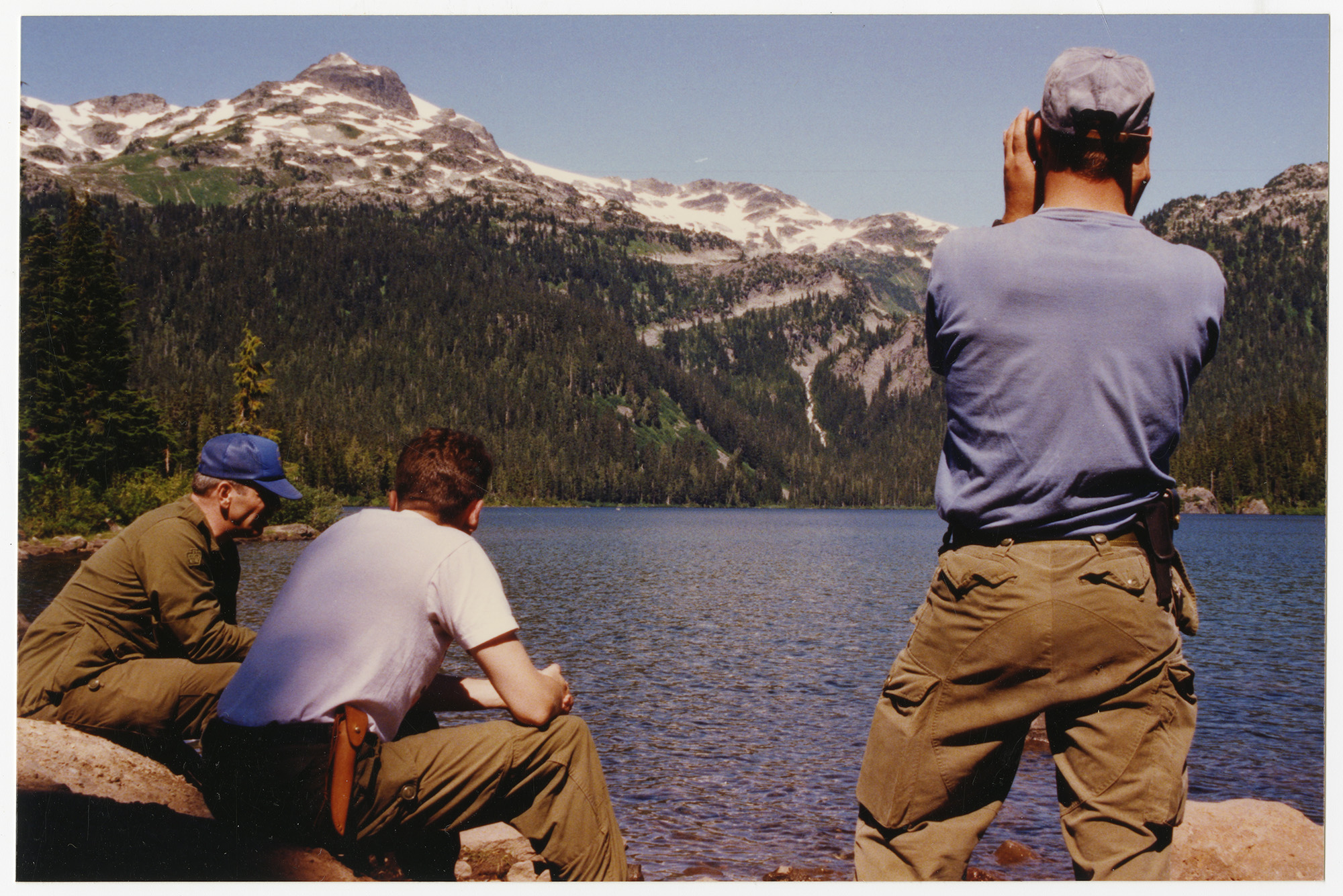
Sergeant Edith Cuerrier was a military photographer dispatched alongside a Flight Crash and Salvage Crew who were flown to Callaghan Lake, about 20 km southwest of Whistler Village, in the first week of August 1997. The lake then served as a base point for military search and rescue helicopter recovery flights to and from the crash site; after initial site inspection of the fuselage it was established that in the absence of ejected aircraft seats, there was no likelihood of finding remains. 

The photography collections donated by Cuerrier encompass a wide array of images, including  technical crash site documentation, salvage crew members actively reviewing flight paths, takeoffs and landings of aircraft, and activities partaken during downtime. The Whistler Museum additionally possesses a fragment of the aircraft’s canopy, some of the plane’s metal tubing, and a helmet of one of the pilots, all of which we received through donation from the Royal Canadian Mounted Police in 2010.  However, for the two pilots’ families, obtaining information on the crash has been a more tedious and complicated process.

In 1987, the late widow of Flight Officer James Miller, Mary Ford, filed a request under the Access to Information Act with the Federal Government, seeking additional closure on her husband’s disappearance. At the time, neither she nor the family of Flight Officer Gerald Stubbs held knowledge of the plane’s canopy being recovered. Ford received a response that included the T 33’s serial number and record that the canopy had indeed been recovered in September 1974, with no further recovery action being warranted at the time. A friend of Gerald Stubbs’ widow noted after the fuselage’s recovery in 1997 that “the history of this has not been one where the family is advised.”

In light of these circumstances, the acquisition of Edith Cuerrier’s work is an important step for our collections in enabling public access to a variety of crash records. With a combination of physical artefacts from the crash site, and newly acquired photographical and textual material; these records will facilitate increased transparency on investigations into the crash.

As a community museum and archives, we endeavour to foster an open collection policy in building knowledge bases and to impartially maintain records. This has aided us in gaining custody of collections surrounding the crash’s history since the early 2000s from a diverse set of donors including both law enforcement agencies and private individuals. These acquisitions  also tie into our broader institutional mandate in considering certain relevant regional history beyond Whistler’s municipal boundaries. 

We further recognize how a historic absence of answers has negatively impacted the lost pilots’ families, and hope that our stewardship of these records can serve to preserve the memory of Flight Officers Gerald Stubbs and James Miller.

Oliver Matisz is one of two Collections Coordinators at the Whistler Museum this summer, supported through the Young Canada Works Program.
Train Wreck turns 70!Train Wreck turns 70!

0 Comments

Combine a speeding train going more than twice the speed limit with a heavy load of logs and a narrow section of track and one might say you have a recipe for disaster. Seventy years ago on Aug. 11, 1956, that’s exactly what happened on a portion of rail near Function Junction.

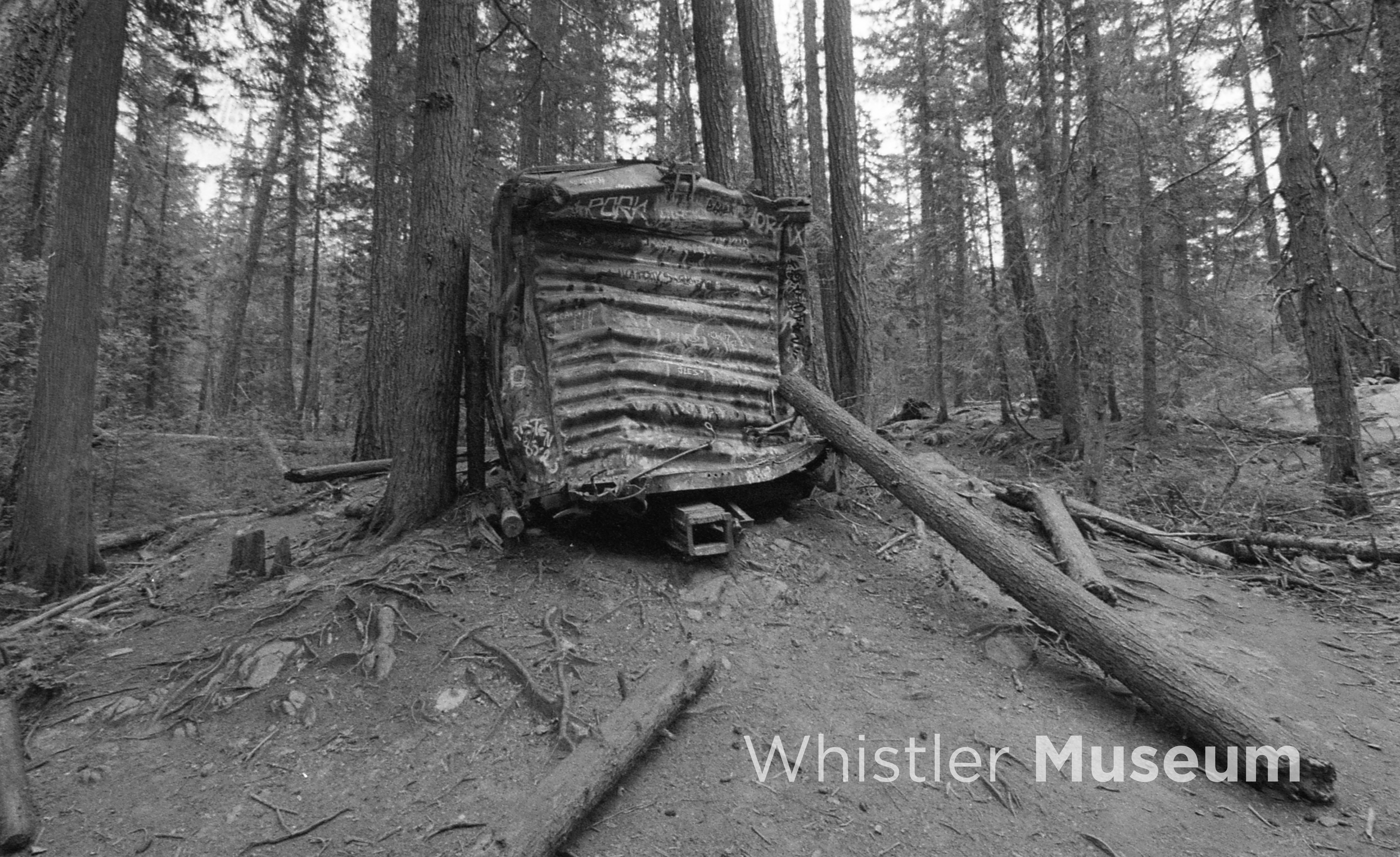
Today, the Train Wreck is one of Whistler’s most popular and family-friendly attractions: a site accessed by a one-kilometre-long trail through forest and over a Cheakamus River suspension bridge, where one happens upon a scattering of derelict, rusting railway cars all covered in bright and ever-changing graffiti. A suite of ruin, also very much alive!

The story of what actually happened that fateful day seems to have remained quite hush-hush for some time. The reasons for this can only be speculated: was it because the Pacific Great Eastern Railway (PGE) tried to deflect attention from the matter? This is neither confirmed nor dismissed—but what we do know now, from first- and second-hand accounts, is that not only was the PGE responsible for the accident, the company also could not clean it up itself.

Train wreck in 2013. Photo: Kristina Swerhun

In 2013, the Whistler Museum’s executive director Sarah Drewery published a piece in the Whistler Question about the “mysterious” Train Wreck. The piece served as a public query and resulted in two members of the Valleau family—who ran a large logging operation based out of Mons—reaching out to the museum and sharing what they knew.

In honour of the anniversary, we share an excerpt from Drewery’s article “Train Wreck Mystery Revealed,” the piece we subsequently published in 2014 about the conversation had with the two Valleaus. Rick Valleau remembered his father talking about the wreck. Rick’s uncle Howard actually remembered the incident first-hand.

“The crash occurred in 1956 shortly after the Valleau family had moved to the area. The wreck happened on an area of track constricted by rock cuts, and there were three boxcars loaded with lumber jammed in there, blocking the line. The PGE Railway’s equipment couldn’t budge them so the company approached the Valleau family,” Drewery wrote.

“The Valleaus took their logging machinery (a couple of D8 Cats) down to the site, put a hitch (luff) on with two moving blocks to the boxcar and pried them out. They then dragged the cars up the track and into the forest, where they lie today. To all those who were confused by the fact that there is no damage to the trees around the wreck, this is because the train did not come off the rails at this point, but the boxcars were moved there after the fact.

“The train had been assembled in Lillooet by John Millar, a conductor for the PGE. Millar told the story to Howard Valleau, as follows: The train had four engines. There was a mistake made on the tonnage of the train, making it too heavy, and they had to split the train to get up the grade to Parkhurst (on Green Lake). This put them behind schedule, and they tried to make up time by travelling a little faster than usual. The speed limit on that section of rail was only 15 m.p.h. (24 km/h). The fourth engine turned a rail, causing the train wreck. They checked the tape in the engine, which told how fast they were going—the crew had thought the speed was 15 m.p.h., but in fact it was 35 m.p.h. (56 km/h).

“Millar told Howard Valleau that had they known the actual speed, they would have taken the tapes out. The engineer and crew were subsequently fired after the investigation into the wreck.”

Ted Tempany riding Train Wreck [1999]. Insight Photography Collection.

It just so happens that the week of the Train Wreck’s 70th anniversary also coincides with the Whistler Museum’s 30th annual Building with Lego Bricks Competition! To celebrate both, this year’s competition theme is “Build Your Best Rescue Machine.”

On Sunday, Aug. 16, the museum invites children ages three to 12 to register for the exciting event, held in Florence Petersen Park: blending imagination, colour and innovation! There will be prizes and activities. For more info click here.

Kayakers as Glacier GaugersKayakers as Glacier Gaugers

0 Comments

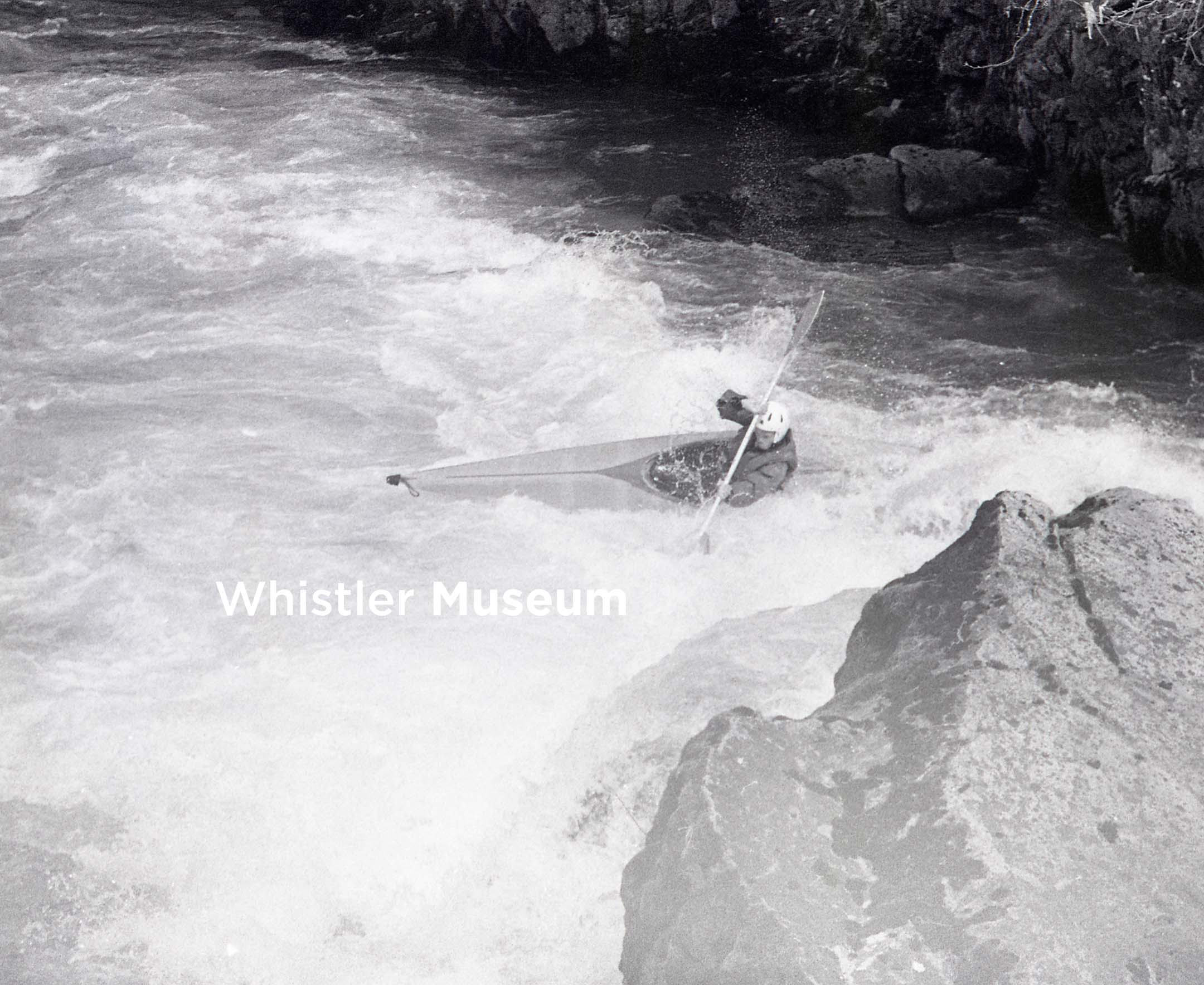
Featured Image: Lyall Featherstonehaugh paddles the Cheakamus River on May 11, 1980, during a demonstration organized for the Whistler Chamber of Commerce to showcase kayaking opportunities in the Whistler area as part of their May Day celebrations. Whistler Question Collection.

Longtime Whistler kayaker Shawn ‘Puddles’ Hughes left me with an interesting concept: he said he viewed his paddling as a way of “recycling the snow.” In the winter he skis, in the summer, he rides the snowmelt down the rivers – sporting an intimate balance with the hydrological cycle. However, the notion of balance is perhaps, now, better replaced with the term ‘dance’ or ‘positioning’…because, as Hughes has experienced firsthand, over the decades, the waterflow levels and patterns have been changing.

I was fascinated. The impact of glacial recession on local skiing and snowboarding has garnered attention with the closing of the Horstman Glacier on Blackcomb for summer camps in 2023, however this was the first time I had had reason to consider the impact on other non-on mountain sports. As the Whistler Museum actively continues to gather oral histories from a generational cross-section of local kayakers, I extended the question to Archer McLeay, a pivotal advocate within and for the paddling community: a relative newcomer on the scene, having lived in the Sea to Sky for 5 years, moving here, however, for the kayaking.

I asked McLeay, if in his handful of years here, he had witnessed the impact of glacier recession in the waters. He unequivocally answered: “It’s drastic.”

This aligns with Hughes’ deduction that “after 40 years of visually watching this, we’re in some trouble.”

McLeay elaborates “ideally … you get a huge snow base, and that’s what’s traditionally happened. […] Normally, there’s just a massive amount of snow up here. It all melts pretty consistently throughout the year, and you should get like a nice long season.” But that has been changing.

“The Cheakamus has got a way bigger glacial head bond, so that one tends to flow all year, regardless of what’s happening,” McLeay remarks. Hughes concurs, “Cheakamus is pretty safe because it does have a fairly big pack, but no, it’s still shrinking as quickly as everything else.”

McLeay continues, “But for all of our snowmelt rivers [the Callaghan is the main one], the snow will melt, and then after that, it’s just feeding on the glacier. So if you have a big heat wave, it’ll come through, and then the snow melts a lot faster than the glacial water, and then you’ll end up with just glacial melt running for the rest of the year. And so the season’s shorter. There’s less water to go along, and then if there’s a heat wave, it’ll just shorten the season just, boom, just in half.”

Hughes breaks it down simply: “when you take a big piece of ice and you keep shrinking [it] down, there’s some part of the day when it’s not going to flow as much as it did when the ice is big. So what’s happening is there’s a thing that I’ve diagnosed as looping…” Hughes premise on looping is based on discovering what the main source of the flow is. His curiosity was sparked after a section of water that he would consistently launch into a 1 pm every day, only became ‘attackable’ at 4 am. He wanted to understand the fluctuation: “Where’s the water really coming from? Cause there’s three rivers that feed this and the gauges we’re reading, it goes up at midnight and then peaks at four in the morning and then starts dropping and it’s gone by like 11.” He had noticed it going from a “concrete amount of water” to dribbles by August. “I did 31 four in the morning attacks on that to really investigate what was going on.”

Observations persist around many of our waterways, bringing a whole new meaning to rapid and rapidly (e)racing.

The Callaghan “tends to flow out”, McLeay notes. He speculates, “a few years ago, I imagine there would be a big enough glacier to feed the river, but now it’s just melted.”

The ‘Fitz’, too, is affected. “Last couple of years we’re running off the glacier.” Hughes points to its dwindling headwaters. Fitzsimmons Creek feeds the Green River. It also is the source for snowmaking – and that demand is steadily increasing. “Imagine what’s going to happen when this thing really tails out because, man, it’s not that far off…” 

Just, imagine.

For kayakers, glaciers are more than distant icefields—they’re the source of every rapid downstream. As the Whistler Museum continues documenting the history of paddling in the Sea to Sky, these oral histories are becoming more than stories about sport. They are records of a landscape changing within a single generation.

Whistler’s Whitewater River Runners:Whistler’s Whitewater River Runners:

0 Comments

Dipping our toes into the rushing waters of the local kayaking history

 
Featured Image: B.C. Kayak Championships on the Cheakamus River September 21, 1980. Whistler Question Collection.

Whistler and the Sea to Sky boast some of the best Class 4 and 5 whitewater river runs in the world. However, this facet of our local sports history/destination is often overlooked or underpublicized. Our ‘Triple Crown’ of the Callaghan, the Soo and the nucleus of it all: the Cheakamus, draw people from near and far. As do the Ashlu and Elaho. Whistler is speckled with stories of people who came here to kayak and stayed here to kayak.

The Whistler Museum has begun gathering oral histories from local kayakers and will be running several pieces related to the history of the local scene – dating back to the inception of the Whistler Kayak Club (Kayaklub) in the 1980s – to the river and water changes witnessed over the decades. Kayakers are firsthand gaugers of glacial recession… because, as Whistler’s whitewater scene grows, simultaneously, we are losing our flows….

Shawn ‘Puddles’ Hughes moved to Whistler in 1977. He has been kayaking here for 40 years, bitten, as the expression goes, “by the river vampire.” Hughes was first exposed to the sport in 1986, when the Nationals were held on the Cheakamus. Prior to that, there were a select few locals running and racing on the rivers, but not many.

Hughes was a founding member of the Kayak Club, formed in 1988 by a handful of riverrats in order to acquire the necessary funds to clear a choked-up part of the Upper Cheakamus. Hughes points to Don Butler, of Captain Holiday’s Kayak, as being one of the key instigators of the idea to clean up the “dodgy” section. As Hughes explains, riparian regulations were different then (this, pre-the BC Forest Practices Code) and logging would take place right up to the water’s edge. Logs and debris had no buffer and rolled right into the river, leaving jammed messes of snags, snarling passage. Such as was the case with the Cheakamus.

The extremely unofficial ‘official’ Club was successful: procuring $2500 from the municipality and the same amount from the logging company, to clear the river; an amount which Hughes animatedly relays “was like $20 000” today. It was more like $11 000 in the present-day economy – but suffice to say, it was enough to rent equipment, rig a Tyrolean Traverse and pay people for 10-12 days to clear the canyon (just below the MacLaurin’s Crossing Suspension Bridge, connecting the Farside and Riverside trails). “To this day, I’ve never seen anyone lowered down with a chainsaw … cutting …  off a rope in this like hostile environment,” recalls Hughes.

The excavation of the Cheakamus by river-suspended aerials, along with wild water maneuvering, undertaken by this crew not only cleared the way for the river (and prompted a subsequent flood of attention), but it also became the start of new careers for these talented few. “We all went into the movie business and ended up doing safety and rigging” and kayak stunt work. The Cheakamus would become a destination site not only for river navigators, but for Hollywood filmmakers, too.

“All of a sudden … word gets out, you know, there’s people from Washington, there’s people from all over the world that are actually honing in on this thing. And our little group would act as liaisons and people would call and that’s how we did it.”

How they did it and what they did in the late eighties, was they helped plant the seeds for a rich, supportive culture to begin to take hold in the valley. “Kayaking has a camaraderie … it’s strong,” reflects Hughes – upheld as one of the few remaining OGs still paddling and mentoring younger generations. “Like most of our crew has passed away. The ones that were kayakers, they’re just gone.”

At 68, Hughes paddles daily. At the time this piece went to press, he was on Day 90-something-and-counting of river runs this season.