Category: Mountain Culture

Life in the mountains.

The Dual Mountain Duel: 7th Heaven and Peak ChairThe Dual Mountain Duel: 7th Heaven and Peak Chair

0 Comments

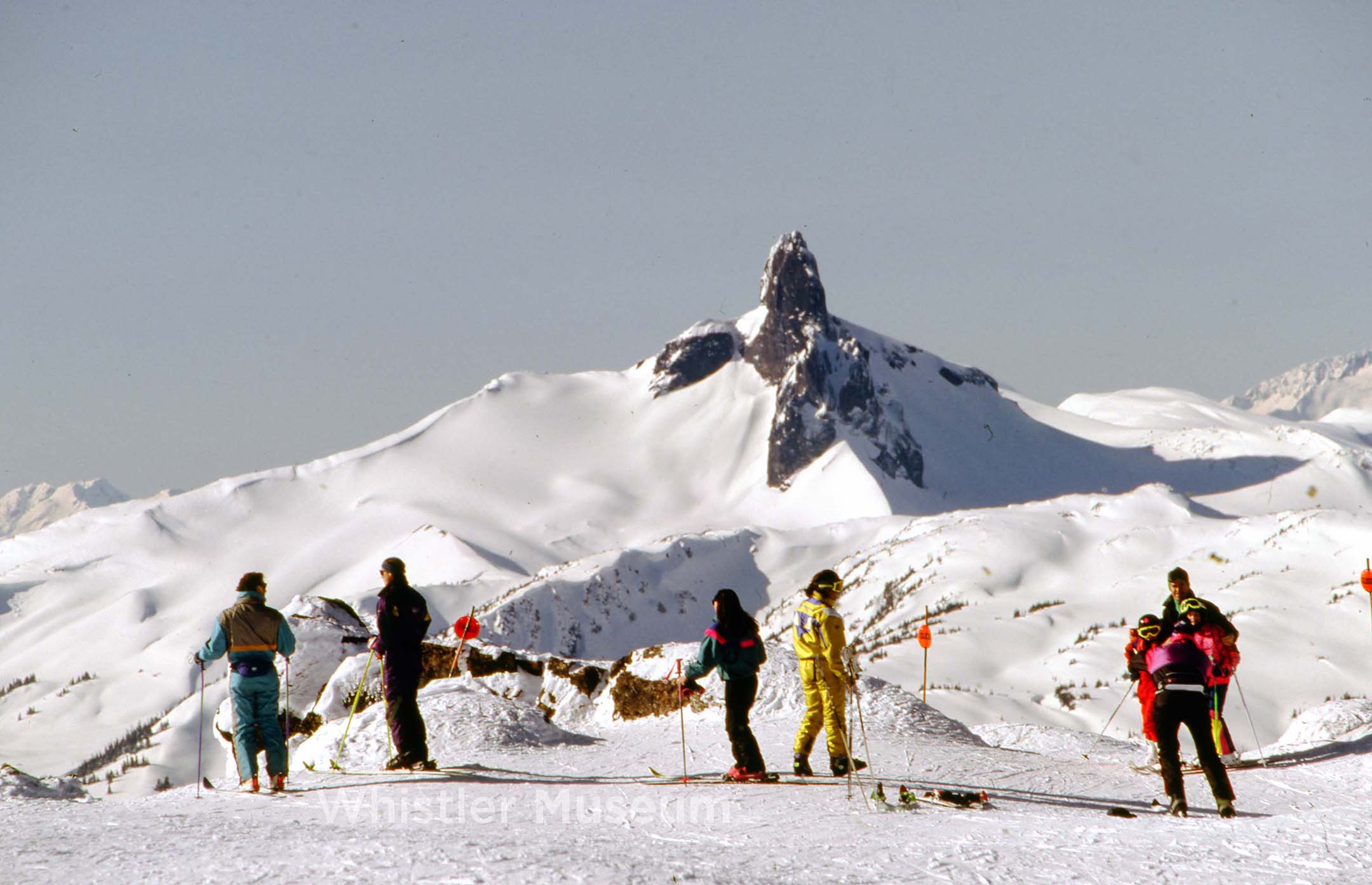
Top Image: Skiers atop Whistler Peak. 1990s. Griffith Collection.

This week marks the 60th anniversary of Whistler Mountain’s opening. Blackcomb Mountain opened in 1980. Whistler’s runs were designed more to side-run the mountain, whereas Blackcomb’s followed more of the fall lines. 

Up until 1997, the two mountains operated separately. There was, however, a Dual Mountain Pass that could be purchased, granting access to both mountains. The pass was one of the only points of collaboration between the two competitors, whose rivalry was best showcased in their alpine lift duel.

In 1985, Blackcomb installed the 7th Heaven T-Bar: at the time, becoming the continent’s first, and only, “Mile High Mountain.” A vast amount of new terrain was opened up by this development – expansive glacial access and four powder bowls – extending Blackcomb’s skiable area by almost two-thirds. The significant upgrade served to dispel its previous uniformity in design. Skiers now could  travel down runs covering 1160 acres, a substantial increase over the previous 420. 

The alpine world had been opened up. 

The mid-1980s, short-lived 7th Heaven T-Bar. Griffith Collection.

A young Mike Douglas (“Godfather of Freeskiing”, filmmaker and founder of the Canadian chapter of Protect Our Winters) described the experience of arriving at the top of 7th Heaven as being “dropped off at the edge of the world.” Nancy Greene (Olympic gold medalist voted Canada’s Female Athlete of the 20th Century) declared “The enormous variety of slopes and spectacular views are unequalled in North America.” In the forefront of those views was Whistler Mountain. 

Whistler responded by countering a year later with the opening of the Peak Chair, a three-seater, one kilometre long lift depositing people just beneath the summit of the mountain at 2182 metres. The bar had literally just been raised (in every sense of the word!), one upping Blackcomb in the process.

Peak Chair was initially restricted to just advanced skiers. Snowboarders, at this time, were still not welcome on the mountain. 

Whistler’s original Peak Chair. Griffith collection.

Challenging, cliffed, corniced and steep terrain characterized the area off the peak. Glaciated bowls and bouldered outcrops earmarked the summit’s geologic geography; whereas, its demography was being populated by seekers-of-skiing’s-extreme.

Blackcomb was not to be outdone. Riding 7th Heaven, arguably, remains the pinnacle of the Blackcomb experience.  The following year, in 1987, 7th Heaven Express opened, replacing the two-year existence of the T-bar. The new four person chair, running along a longer and new lift line is the same one in operation today. Much like the Peak Chair, only skiers were permitted, when both first opened. 

Blackcomb was the first to welcome snowboarders in 1988/89. Whistler followed suit; however, in this case, the mountain was much more reluctant to follow this trend, only opening their slopes to shredders a full year later.

In 1996, the two mountains joined forces, merging under the banner ‘Whistler Blackcomb.’ Continuing the streak of earning international accolades, the united front earned the Number One spot in SKIING Magazine’s ranking of the ‘Top 25 Resorts in North America’ (Tourism Whistler, 2019).

Two years later, Whistler further upgraded access to its alpine summit, with the unveiling of the four-seater, Peak Express. This same high speed, detachable chairlift remains in operation today.

And every morning, the eager and the energetic mingle and gather at the bases of 7th Heaven and Peak Express, awaiting Ski Patrol to finish their avalanche clearance protocols, in a bid to carve fresh tracks through unparalleled terrain.
The duel of the dual mountains – the rivalry of lifts and runs –  may have ended on a financial and marketing level, but preferences ran – and still run – strong between slope-sliders and stylers  as to which side of the mountain they prefer… along with their preferred method of flying down their chosen hill!

The original Black Tusk Snowmobile ClubThe original Black Tusk Snowmobile Club

0 Comments

Feature Image: Snowmobilers take a break in front of Black Tusk. Judging by the sleds, this is probably from the early 1970s: however, unfortunately we do not have any details about this archival photograph.

This year 60 is a big number. 

Whistler Mountain is celebrating its ‘diamond jubilee’. 

Another sixtieth anniversary of note is the formation of the first local snowmobile club, on the opposite shores of Alta Lake.

The inaugural meet-up and race of the lower mainland-based BC Snow Vehicle Association was also held on Alta Lake, at the end of January, sixty years ago. 23 people competed in the event and the winner of the 20 gate, large machine slalom course was won by local Dick Fairhurst: completing the run in a whopping 39.9 seconds.

Dick Fairhurst was one of the ‘westside gang’ – a band of early residents – who called themselves the Black Tusk Snowmobile Club. The club (whose numbers are hard to confirm) would venture out and among the surrounding peaks, including Rainbow, Sproatt and up into the Callaghan. 

From R-L, Dick Fairhurst, Gray Mitchell, Stephan Ples, and Don Gow take a break on Callaghan Lake, March 1970. The entire upper Callaghan Valley, including Callaghan Lake, is now a non-motorized zone to avoid conflicts with backcountry and nordic skiers.

Dick – a logger and trapper of Cypress Lodge fame (now the site of the Point Artist-Run-Centre) and creator of the valley’s first ski ‘tow rope’ in 1960 – was one of the three founding members of the snowmobile club, along with Don Gow and Glen Creelman. Together, the three became the area’s first distributors of Bombardier Ski-Doos.

Don Gow moved here in 1955. He stayed and was the station agent at Alta Lake for four years, up until the train’s scheduled stop (in operation since 1914) was demoted to simply a ‘flagstop’ in 1959. However, the area’s appeal and pull was strong, and Don returned to Alta Lake in 1965 (along with his wife, who became the postmaster and their two children). They lived here until 1975.

Glen Creelman was a microwave technician. In 1957, BC Telephone Co. installed a double copper line around Alta Lake. Glen was responsible for establishing an open circuit/party line – linking lodges and homes with this new thread of communication. One was able to lift the receiver of the old crank telephones and listen in on your neighbour’s conversations. 

And surely, at that time, part of the talk of the town was the growing popularity and access to motorized sleds…

From up the Callaghan Valley. Fairhurst Collection.

Bombardier pioneered the development of the snowmobile. In 1966 – the year the Black Tusk club was formed; the year Dick won the inaugural BC Snow Vehicle Association race; and the year Don, Glen and Dick began selling the machines to the Alta Lake Community – the Canadian company released a line of three machines with “new, super slick styling.” The models included the ‘New Alpine,’ the ‘Olympique’ and the ‘Super Olympique.’ The latter was what Dick won the race on. The 250 lb machine had a roller chain in oil bath drive, the patented Bombardier track and was 2.36 metres in length. It was also bright yellow. 

Dick Fairhurst with sled-groms in front of Cypress Lodge (now The Point Artist Run-Centre) — on a neighbour’s sled, Ron Dent’s “Dentmobile” in 1965.
Fairhurst Collection.

Snowmobiling – or sledding, as it is more colloquially referred – remains as popular as ever as a thrill-seeking, backcountry sport. Handling has been honed and the horsepower hiked… but the same spirit seeking freedom, fast movement and further access prevails.  

Not all who sled are members of a club, but other regional groups now exist. The Powder Mountain Snowmobile Club has been operating since 1990. The Pemberton Valley Snowmobile Club was officially incorporated in 2000, but sledding stories in the area far precede that date, too

As for the Black Tusk Snowmobile Club, it ‘still’ exists, however its base now operates out of the Brohm Ridge former ‘Rat-Pack’ chalets. This particular incarnation of the club dates their inception to 1971. Records of how the Alta Lake-based group either entirely dissolved or transitioned to the current location are perhaps best described as being frozen in two-stroke time…

The ‘Skin’ny on Whistler’s Ski Touring HistoryThe ‘Skin’ny on Whistler’s Ski Touring History

0 Comments

Top Image: Pip Brock and Don Munday walking down Whistler’s tracks, packing skis.
Photo taken by Phyllis Munday and from the BC Archives.

Ski touring and split-boarding continue to grow in popularity as people strive to extend their range into the backcountry of the local Coast Mountains. However, it is nothing new.

In 1933, the first documented ski ascent and descent from the top of London Mountain – now known as Whistler Mountain – was made by Pip Brock. With “terrible” skis purchased from a Vancouver department store, the feat of the intrepid 19-year-old was at first disbelieved by locals. His claim was, however, confirmed by binoculars which showed his tracks: the first top-to-bottom run of Whistler, sited and sighted, 92 years ago.

Pip recalls “Most mountaineers thought that skiing was impure and indecent. But a few of us being frivolous, realized the fin and value of ski for winter touring.” Pip was later joined by celebrated, nationally-treasured mountain adventurers Don and Phyllis Munday, skiing up Wedge Creek as means to summit Wedge Mountain.

Initially, local ski touring converts were few and far between. Pioneering prospector Harry Horstman (whom the glacier on Blackcomb and hut are named after) indignantly heckled the young Pip Brock, chastising him with: “What the hell you got them planks fur? I can get around twice as fast on my snowshoes as you can on them slitherin’ boards!”

But it was “slitherin’ boards” that George Bury, along with three others, chose to use for their 1939 expedition: the first to assess the potential for ski development in the area. The four men began their explorations from Cheakamus Lake and over the period of 10 days, skinned and skied their way around. The tour ended by way of skiing down ‘The Barrier’ to the railroad tracks and flagging down the southbound train headed for Squamish. The development idea was sidetracked with the start of World War II. The group never revisited the idea post-war.

Members of the Bury expedition in 1939.
Bury collection.

In the 1960s, Stefan Ples became actively involved with Garibaldi Lifts Ltd. in their development of Whistler as a ski area. Stefan was incredibly familiar with the mountain, having been touring up and down it for years.

There is a story of when Stefan first met Franz Wilhelmsen (‘The Father of Whistler’), President of Garibaldi Lifts, fittingly on top of the mountain. Franz had arrived by helicopter, Stefan by skis. Franz is reputed to have said “What are you doing on my mountain?” to which Stefan replied “What are you doing on mine?” It is ironic that Stefan became so involved with the ski resort’s development given that it is said he truly could not conceive why people would choose to take a lift up the mountain, just to ski just a short distance down. Though eventually awarded a lifetime pass, Stefan’s preferred method of access was by skinning. It took Stefan approximately 3 hours to reach the peak.

Members of the Bury Expedition in 1939 at Black Tusk.
Bury collection.

The Spearhead Traverse is now the area’s most popular ski touring mission, linking Blackcomb and Whistler by way of an approximately 34 km horseshoe-shaped route across the peaks of the Fitzsimmons and Spearhead ranges. The traverse crosses 13 glaciers, and depending on routing 9-11 mountain passes. In 1964, the first successful tour of the circuit was completed by four UBC Varsity Outdoor Club members. It took the group nine days, starting from the base of Blackcomb.

Today, the Spearhead Traverse is regarded as beginning at the backcountry gates atop of Blackcomb and ending in Whistler Village. The Spearhead Huts Society built a state-of-the-art 38-bunk backcountry accommodation in 2019, with two more huts planned along the route. A strenuous endeavour, most take 2-4 days to complete the trek, however the fastest known times currently hover around the 2 hour mark for both men and women.

The Spearhead Traverse is undertaken by approximately 4000 people per year, skinning their way into the storied tracks of this place.Ski touring and split-boarding continue to grow in popularity as people strive to extend their range into the backcountry of the local Coast Mountains. However, it is nothing new.

***

(*Please note that the version of this article that was published in The Pique Newsmagazine on December 26, 2025 had the wrong photo credit with the Brock/Munday photo. Credit is correct here.)

Santa Slays the Mountain!Santa Slays the Mountain!

0 Comments
Santa on the Slopes of Whistler, 1994. Insight Photography Collection

He sprang to his sleigh, to his team gave a whistle …

Their hundreds of eyes— oh! how they twinkled! 

Their dimples, how merry!

Their cheeks were like roses, their noses like cherries!

Their droll little mouths were drawn up like bows, 

as, together, they rode up the gondola in droves

Sporting beards on their chins as white as the snow …

Then away they all flew, down the slopes with skis and boards,

all donned up in red and white…

(some outfits loose and baggy, others mighty tight!)

The annual Dress Like Santa Day: another sleighing sight!

For more than twenty years, Whistler Blackcomb has been hosting this colourful, costumed and cheer-fuelled Christmas tradition. Just as its name suggests – every year on one mid-December day , this year on Friday, December 19 – snowboarders and skiers are encouraged to dress up like Mr. or Mrs. Claus and take to the slopes.

Merriment and holiday-spirit spread amongst ‘Ho, Ho, Ho’ing participants as they gather at the base of Whistler Mountain. From the young to the still-young-at-heart, the all-ages event has steadily grown in popularity since its inception (exactly what year that was is hard to pinpoint, as it remains a glorified extension of previously established on-mountain Santa-spotting happenings) … but, the early 2000s seems to be the general consensus.

Once at the top, the Santa slope stylers travel together from the Roundhouse-cum-North Pole to the base of Emerald Chair – where a group photo is taken. 

As per tradition, a free lift ticket has been awarded to the first 100 people who arrive in full attire. This number has grown from an original 50 free tickets, to 75, to its now 100: handed out to the pipe-toting, black-belt bulging, and boot-wearing crew. With great Whistler flair, custom costume-modifications have made this a Santa Spectacle, sanctioned under a ‘Creative Claus’ (with… “A wink of his eye and a twist of his head/Soon gave me to know I had nothing to dread!)”

Mountain Hostesses follow Santa down the Slopes. Greg Griffith Collection.

The Whistler Mountain Hostesses definitely skied with St. Nick. Beginning in the 1974/75 season, the program “specialized in fun” … and dressing up as elves and touring the slopes with Santa was a part of their ‘mandate’. “We had the greatest job in the world,” recalls founding Hostess Leanne Dufour.

The program morphed into the Ski Friends (also Santa’s helpers!) in the late 80s and then further into the present-day Mountain Host program. 

Off the slopes, Santa has announced his arrival in other less-than-conventional ways throughout Whistler’s history. In 1980, the “jolly old elf” cruised in by chopper, dropping down from the skies – heralded by helicopter – only to be mobbed by a group of candy-covetting children.

After a dramatic arrival by helicopter, Santa is mobbed at the Rainbow Ski Village Saturday as he tries to distribute candy canes.

Dating back even further… The children of the one-room Alta Lake schoolhouse (first opened in 1933) would also receive an annual visit from Father Christmas. It is fair to speculate that trapper and railway section-gang worker, Billy ‘Santa’ Bailiff, likely arrived by horse or on foot. Remembered as a ‘gentle man.’ Billy – famed for his ‘Stellar Jay Pie’ and ‘potato water bread’ – was the unanimous choice as the Santa stand-in with his plump figure and round rosy cheeks.  

Billy died in 1958 and the baton of community Kris Kringle seems to have been passed onto to Jack Biggin-Pound, who settled in McGuire (an old mill town from the 1930s, two kilometres north of Brandywine Falls), staking a claim there on Crown Land in 1961. Jack recalled, “Never again will Myrtle Philip [Founder of Rainbow Lodge, the first tourist attraction in the Whistler area, opened in 1915] undo my flies, to the great amusement of everyone, to stuff a pillow in to make me a more portly Santa Claus for the school children. They all tried hard but I don’t think ever found out who Santa was”…

The mystery of who Santa was, or is, either singularly in our schools – or in plural, plummeting down the hill –  remains part of this town’s mountain magic … 

Santa spotted on Blackcomb. Blackcomb Mountain Collection.