Category: Archives

“Mr Showbiz” Ivan Ackery “Mr Showbiz” Ivan Ackery 

0 Comments

Feature Image: Ivan Ackery (R) and Alex Philip drinking beer. The reverse is annotated “The two bad boys ?”. [1950s]

Some of the earliest photographs donated to the Museum’s archival collection capture the heyday of Rainbow Lodge, Whistler’s first tourist destination, during the 1920s and 1930s. These images have become invaluable tools for understanding both the atmosphere of the resort and the people who helped shape its story. Fortunately, Alex and Myrtle Philip took care to identify many of the individuals who appeared in their photographs.

One name appears time and again: Ivan Ackery.

Today, Ackery is remembered as one of the most influential figures in British Columbia’s entertainment industry. For more than fifty years, he worked in theatres and film promotion, witnessing the transition from vaudeville to silent films and eventually to talking pictures. Yet long before he became known as “Mr. Showbiz”, a nickname referenced in his 1980 autobiography Fifty Years on Theatre Row, Ackery was a regular visitor to Alta Lake and a close friend of Rainbow Lodge owners Alex and Myrtle Philip.

Ivan Ackry audiobiography “Fifty years if Theatre Room” 1980.

Born in Bristol, England, Ackery immigrated to Canada in 1914. After serving in the First World War, he entered the theatre business, working his way up from usher to theatre manager. By the late 1920s, when he was spending time at Rainbow Lodge, Ackery had established himself as one of western Canada’s leading theatre promoters, known for his creativity and flair for publicity.

Photographs in the museum’s collection show Ackery participating in lodge life and outdoor activities. Like many visitors, he was drawn by the Philips’ hospitality and the area’s natural beauty. Unlike most guests, however, his friendship with Alex Philip would eventually connect him to a small but significant chapter in Canadian film history.

In 1933, filmmaker Kenneth Bishop arrived in Victoria with plans to produce motion pictures in British Columbia. Taking advantage of British Empire film quotas that required a portion of films shown in U.K. theatres to be produced within the Empire, Bishop established Commonwealth Productions. One of its first projects was Crimson Paradise, an adaptation of a novel by Alex Philip that became Canada’s first talking-picture feature film.

The production was ambitious for its time. Financial support came from Kathleen Dunsmuir, daughter of former British Columbia Premier James Dunsmuir, who also appeared in the film. scenes were filmed at the Dunsmuir family residence in Victoria, while a studio was established at the old Willows Exhibition Grounds in Oak Bay. Additional filming took place at Beacon Hill Park and Cowichan Lake.

When the film was completed, Ackery found himself at the center of its historic premiere.

As manager of Victoria’s Capitol Theatre, he was entrusted with presenting the world premiere of Crimson Paradise on December 14, 1933. Looking back decades later, Ackery recalled the event as one of the proudest moments of his career. Floodlights illuminated the theatre, bands played outside, and distinguished guests arrived for the gala screening. Hollywood actors Nick Stuart and Lucille Browne travelled north to attend, bringing a touch of glamour to Depression-era Victoria.

Ackery personally introduced the cast, producers, and special guests from the stage before the film began. The audience included politicians, military officers, business leaders, and prominent members of Victoria society. The premiere generated tremendous local interest, and Ackery later noted that Crimson Paradise earned more money at the Victoria box office that week than any other theatre attraction in Canada.

Although the film was not a lasting commercial success, it demonstrated that motion pictures could be produced in British Columbia and helped pave the way for additional productions in Victoria during the 1930s.

Ackery’s own career continued to flourish. In 1935, he became manager of Vancouver’s Orpheum Theatre, a position he held for more than three decades. Following his retirement, he played a leading role in the campaign to save the Orpheum from demolition in 1973, helping preserve one of Vancouver’s most important historic landmarks.

Pictured here is Ivan Ackery leading a group exercise session with chorus girls at Rainbow Lodge around 1930. Philip Collection

Today, Ackery’s name survives in Vancouver’s Ackery’s Alley. The photographs preserved in the Whistler Museum’s collection reveal a lesser-known side of his life: summers spent at Rainbow Lodge, friendships formed around Alta Lake, and a connection to Alex Philip that linked a small fishing lodge to one of the earliest milestones in Canadian cinema.

Sometimes the names written on the backs of old photographs lead to remarkable stories. Ivan Ackery is one of them.
Just because it was documented, doesn’t mean we have it…Just because it was documented, doesn’t mean we have it…

0 Comments

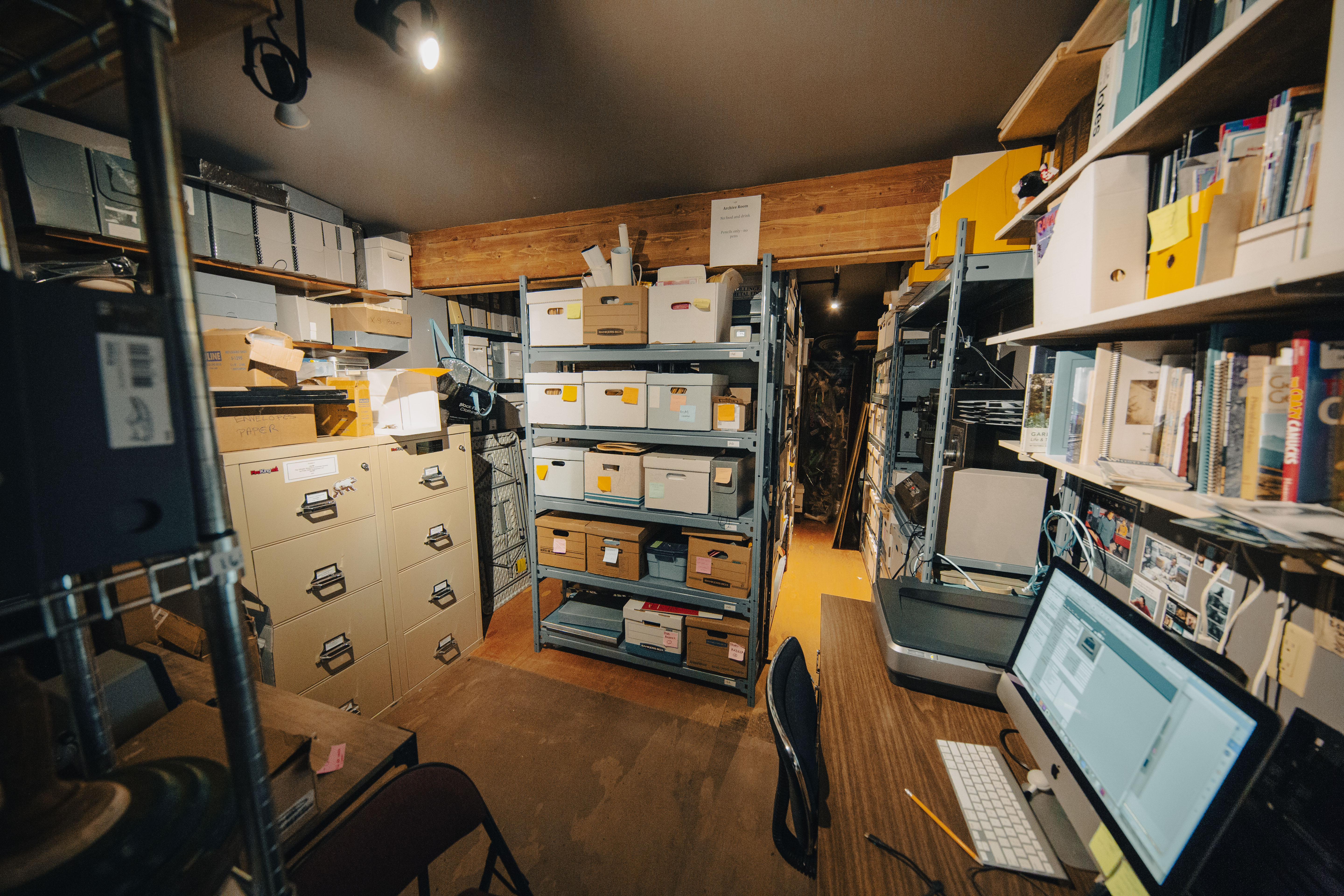
The archives depends on you: dispelling some misconceptions about the process of building the Museum’s collection

 “Archives are the documentary by-product of human activity retained for their long-term value. […] Like people, archives are diverse,” explains the International Council on Archives.

In simple terms, the archives is a euphemism for a ‘collection of story parts.’

In a recent Pique article, I, the Whistler Museum’s Events and Community Manager, was quoted as saying, “an archive is a living, breathing, exciting thing. ‘Archive’ is a verb.”

The action of the archive, however, is only expanded by donations of materials; adding chapters, pages, periods and punctuation to the make-up of a place… and herein, lies one of the major misunderstandings on how the broadening of our museum collection works.* Just because an event happened and it was photographed, or a document was produced relating to the town in some way – does not automatically mean that we have it.

In short, the archive is infused by gifting. We are dependent on donations This can also mean that the archive can be disproportionately reflective of a place’s demographic. This, too, is true for our Whistler archive.

The Museum’s archive can be viewed as an ever-expanding puzzle; whilst we try to configure matching pieces and identify those missing. The process is equally as diverse as the people and collections who breathe life into it: a reciprocal exchange between gifting and receiving.

The local archive is only made broader — more reflective of those who have, and still do, live here – by donations of material: from physical elements (text, photographs, video/film assets) to non-physical ‘oral histories’ that people come in and record. The Museum’s repository is expanded by people contributing to being part of place-making and meaning. Please never underestimate the value of your experience. The Museum does not have an age limit.

Speakers Series are also a valuable way of documenting reflections and past events, recording our stories through the power of conversations — which add to the record — becoming platforms for thought. Again, I was cited in the same March 20th article by Luke Faulks as saying: “…a museum is an exciting place. Your history sheds light on your present, and it’s a springboard for how we inform our future.”

The Museum invites you to become an active participant and co-creator of our storied happenings by attending one of our events, by volunteering to record your tale or by donating relevant items you may have.

This segues into another often misunderstood element of how the Museum is able to process items received. It’s not instantaneous.

 We are a not-for-profit organization that operates with a small staff of three. Currently, we have an additional person added to the team, hired under contract for the sole purpose of inventorying, appraising, processing (arranging and describing) the donation of the Bruce Rowles 70,000+ photographic collection. This entire process has already taken seven months, working full time, and is still ongoing. Ideally, the last step for archivists is to digitize our collections, which is important for preservation of degrading materials and for easy access to these images. The process is time and labour-intensive. A collection of 20,000 images could take one year to digitize, ensuring it meets Canadian archival standards. It is, however, a donation we are exceedingly happy and grateful to receive: a benefit to the entire community. Bruce wanted to ensure his life’s work would be remembered and appreciated. A selection of his photography will be exhibited at the Whistler Museum from April 24th to June 14th.

As further means of perspective, the Whistler Museum’s entire photographic collection currently exceeds 300, 000 items.  With the addition of the Rowles collection, it will be nearing 400, 000. We have approximately 90, 000 of those items digitized. We try to make many of those items available through a variety of means: from special exhibitions, to being posted on our social media networks, online on our archival database to highlighting them through articles and being featured in events.

The local archives is an expansive and immersive space: infused by your continuous contributions into the building of a pastiche-of-place.

*

*It would be remiss of us not to acknowledge the past wrongs associated with many colonial museum practices: with a legacy of taking, extracting without permission and stealing from Peoples. The Whistler Museum has participated in the repatriating of some items that were donated, that we did not feel were ours to have. Together, we learn through the past how to co-create collaborative futures…