
Kayakers as Glacier GaugersKayakers as Glacier Gaugers
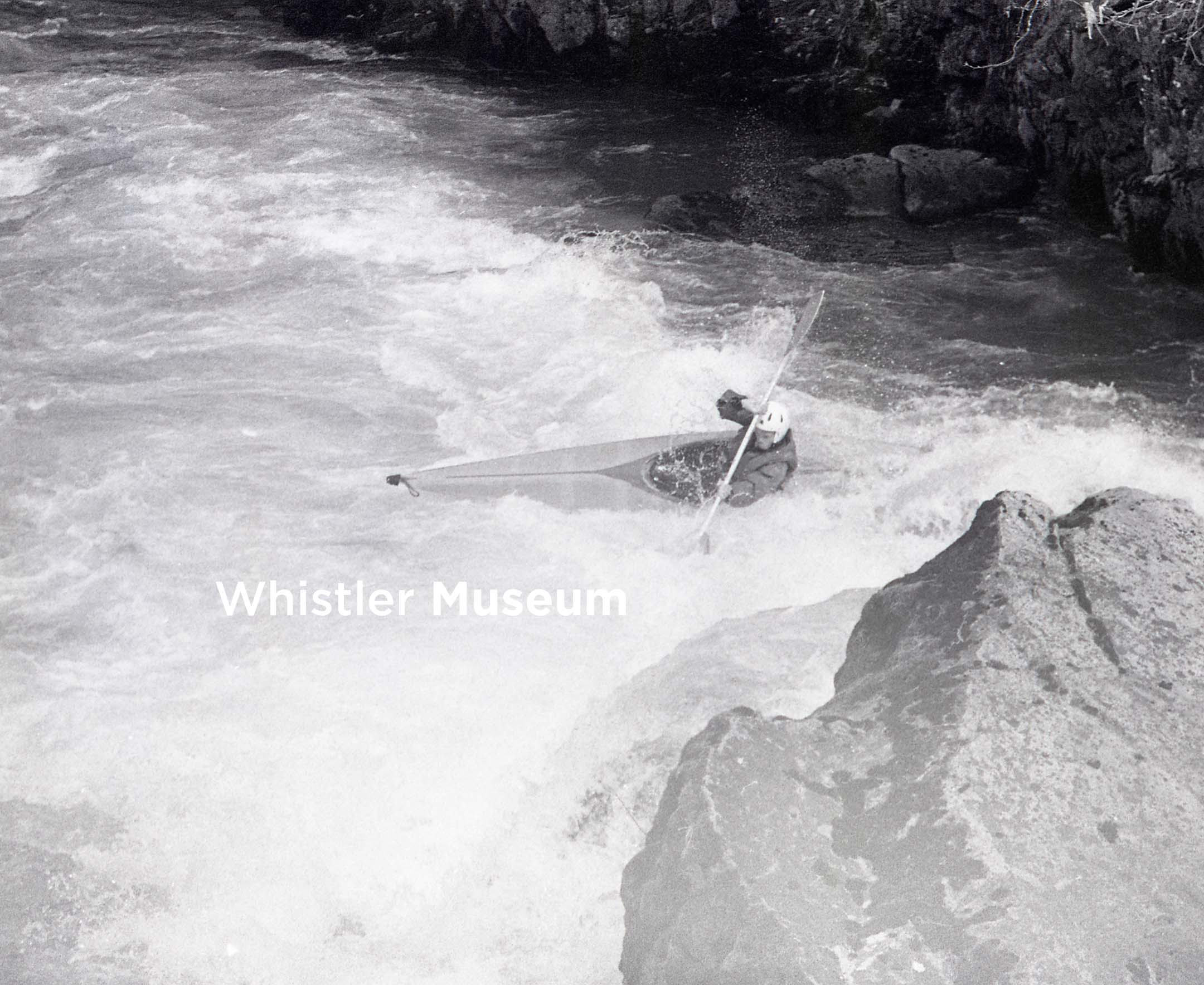
Featured Image: Lyall Featherstonehaugh paddles the Cheakamus River on May 11, 1980, during a demonstration organized for the Whistler Chamber of Commerce to showcase kayaking opportunities in the Whistler area as part of their May Day celebrations. Whistler Question Collection.
Longtime Whistler kayaker Shawn ‘Puddles’ Hughes left me with an interesting concept: he said he viewed his paddling as a way of “recycling the snow.” In the winter he skis, in the summer, he rides the snowmelt down the rivers – sporting an intimate balance with the hydrological cycle. However, the notion of balance is perhaps, now, better replaced with the term ‘dance’ or ‘positioning’…because, as Hughes has experienced firsthand, over the decades, the waterflow levels and patterns have been changing.
I was fascinated. The impact of glacial recession on local skiing and snowboarding has garnered attention with the closing of the Horstman Glacier on Blackcomb for summer camps in 2023, however this was the first time I had had reason to consider the impact on other non-on mountain sports. As the Whistler Museum actively continues to gather oral histories from a generational cross-section of local kayakers, I extended the question to Archer McLeay, a pivotal advocate within and for the paddling community: a relative newcomer on the scene, having lived in the Sea to Sky for 5 years, moving here, however, for the kayaking.
I asked McLeay, if in his handful of years here, he had witnessed the impact of glacier recession in the waters. He unequivocally answered: “It’s drastic.”
This aligns with Hughes’ deduction that “after 40 years of visually watching this, we’re in some trouble.”
McLeay elaborates “ideally … you get a huge snow base, and that’s what’s traditionally happened. […] Normally, there’s just a massive amount of snow up here. It all melts pretty consistently throughout the year, and you should get like a nice long season.” But that has been changing.
“The Cheakamus has got a way bigger glacial head bond, so that one tends to flow all year, regardless of what’s happening,” McLeay remarks. Hughes concurs, “Cheakamus is pretty safe because it does have a fairly big pack, but no, it’s still shrinking as quickly as everything else.”
McLeay continues, “But for all of our snowmelt rivers [the Callaghan is the main one], the snow will melt, and then after that, it’s just feeding on the glacier. So if you have a big heat wave, it’ll come through, and then the snow melts a lot faster than the glacial water, and then you’ll end up with just glacial melt running for the rest of the year. And so the season’s shorter. There’s less water to go along, and then if there’s a heat wave, it’ll just shorten the season just, boom, just in half.”
Hughes breaks it down simply: “when you take a big piece of ice and you keep shrinking [it] down, there’s some part of the day when it’s not going to flow as much as it did when the ice is big. So what’s happening is there’s a thing that I’ve diagnosed as looping…” Hughes premise on looping is based on discovering what the main source of the flow is. His curiosity was sparked after a section of water that he would consistently launch into a 1 pm every day, only became ‘attackable’ at 4 am. He wanted to understand the fluctuation: “Where’s the water really coming from? Cause there’s three rivers that feed this and the gauges we’re reading, it goes up at midnight and then peaks at four in the morning and then starts dropping and it’s gone by like 11.” He had noticed it going from a “concrete amount of water” to dribbles by August. “I did 31 four in the morning attacks on that to really investigate what was going on.”
Observations persist around many of our waterways, bringing a whole new meaning to rapid and rapidly (e)racing.
The Callaghan “tends to flow out”, McLeay notes. He speculates, “a few years ago, I imagine there would be a big enough glacier to feed the river, but now it’s just melted.”
The ‘Fitz’, too, is affected. “Last couple of years we’re running off the glacier.” Hughes points to its dwindling headwaters. Fitzsimmons Creek feeds the Green River. It also is the source for snowmaking – and that demand is steadily increasing. “Imagine what’s going to happen when this thing really tails out because, man, it’s not that far off…”
Just, imagine.
For kayakers, glaciers are more than distant icefields—they’re the source of every rapid downstream. As the Whistler Museum continues documenting the history of paddling in the Sea to Sky, these oral histories are becoming more than stories about sport. They are records of a landscape changing within a single generation.
