
Dairy Delivery by Dugout: Local Cream and Cow’s Milk Carted by CanoeDairy Delivery by Dugout: Local Cream and Cow’s Milk Carted by Canoe
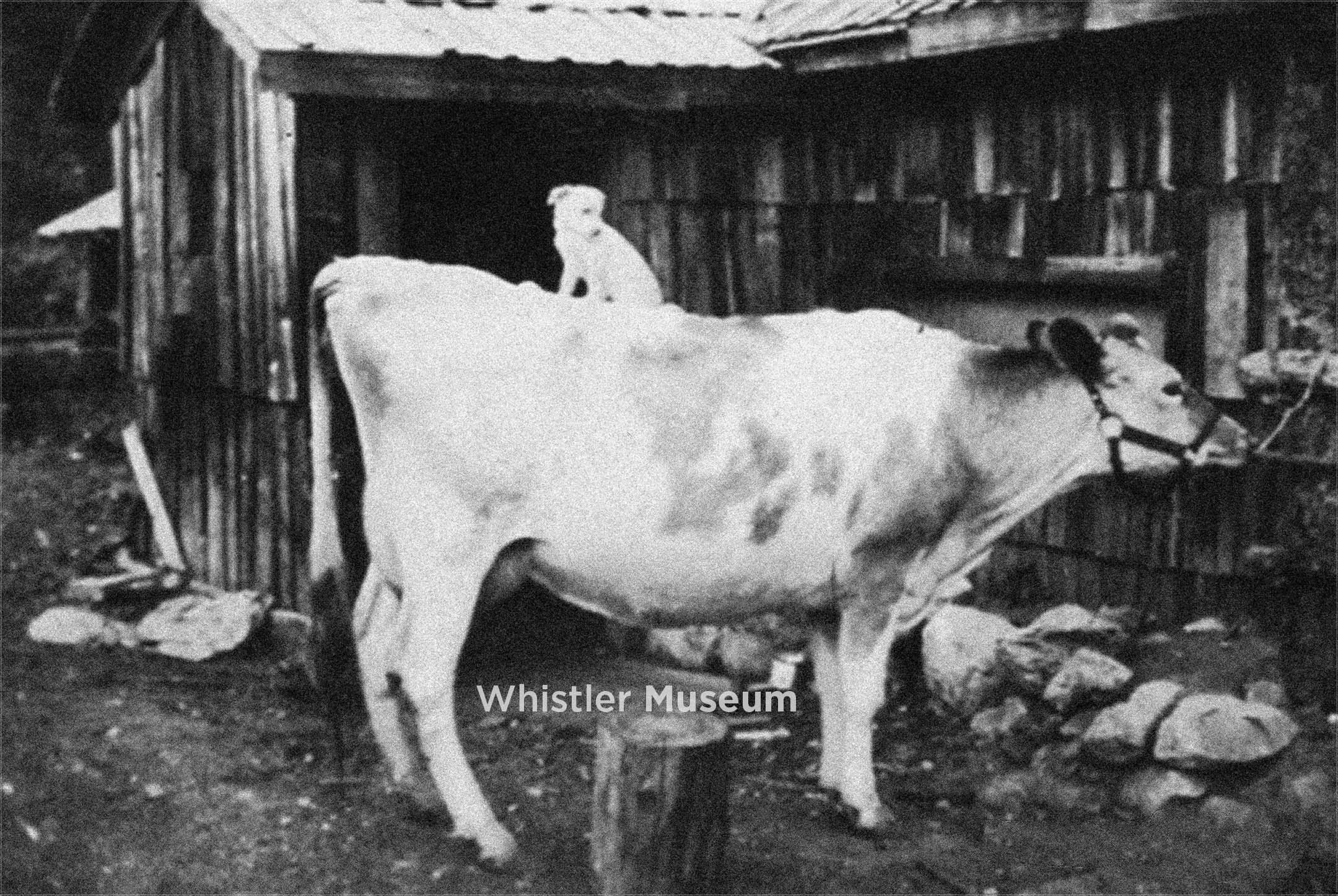
Featured Image: A dairy cow at the Barnfield Farm [1920s]. Whistler Museum Collection.
The lay of the local landscape was much different in the early 1900s. The area’s epicentre was Alta Lake. Prospecting, trapping and logging, followed by fishing and later farming dominated, giving reason and rise to the development of a small community and a handful of lodges in the valley beneath London Mountain.
London Mountain (since renamed Whistler) likely earned the named due to a group of original prospectors who formed The London Group in 1903. One of those early prospectors was Alfred Barnfield.
Barnfield left London, England, arriving in Squamish in 1886 or 1887. He was later hired to inspect the length of the Pemberton Trail. The rough route ran from Burrard Inlet to Squamish up through the area now known as the Whistler Valley northward to Pemberton and onto Lillooet. First developed with the intention to access the Interior’s goldrush and as a cattle trail, the route was completed in 1887. It remained the only way to access Alta Lake (then called Summit, but renamed for the purposes of mail delivery, for there were too many Summit Lakes in the province, with the establishment of the area’s first Post Office in 1915) up until the arrival of the Pacific Great Eastern Railway in 1914. It was through Barnfield’s inspection that he first came to visit the shores of the lake where he would establish a farm some years later.
Barnfield returned to Alta Lake, pre-empting 160 acres of Crown Land on its northeast end, in 1905. Pre-emption was a practice common in British Columbia in the late 1800s to early 1900s, which allowed settlers to acquire Crown Land for development and agriculture. After improving it, the land could be purchased at a low price. As per the agreement with the government, Barnfield was required to build a cabin and clear a portion of the land. To do so, he backpacked building supplies over the Pemberton Trail from Squamish.
Barnfield continued to prospect with the London Group, staking claims in the Garibaldi/Black Tusk area.
On August 1, 1910 Alfred Barnfield married Daisy Hotchkiss. He was 42, she was 19. Despite the age difference, the marriage appeared to be a loving one and the two raised four children.
The Barnfield Farm had 14 cows at the peak of its production, chickens and a few pigs. Alta Lake was becoming a fishing destination with the opening of Rainbow Lodge in 1915 and subsequent establishments opening up around Alta lake. The Barnfield family’s farm was able to fulfill a local much-appreciated-niche: daily fresh milk and cream delivery. They fulfilled orders by dugout canoe. Groceries and dry staples were able to be delivered by train, coming north from Vancouver; however, fresh dairy demanded local production. In a 1993 interview with the Museum, Alfred’s daughter Vera, reminiscessed about how he made his deliveries every day, even when the weather was questionable. “He never missed a morning and sometimes it would be so stormy he just couldn’t hardly make that canoe go.” Whatever the weather, Alfred would end his deliveries with a visit to Rainbow Lodge, where he would be brought up to date on all the local gossip of the burgeoning lake community … which would then be repeated and rowed around!
Rainbow Lodge was the largest customer of the Barnfield Farm, reputedly purchasing 80 quarts of milk, four quarts of whipping cream and two quarts of table cream daily for their guests.
The Barnfields moved their farm operation to Brakendale in 1926. However, every summer, they continued to load their cows and chickens onto the Pacific Great Eastern Railway (PGE) and travel north to Alta Lake. How long they continued this practice is unconfirmed, however the Barnfields did maintain full ownership of their quarter-section up until the 1970s.
Alfred Barnfield passed away in 1960, shortly after celebrating his 50th wedding anniversary to Daisy, who passed in 1980.
In the early 1970s, the bulk of the property was sold for the development of the Whistler Cay subdivision and Adventures West. Small lots were left to the three remaining Barnfield children (one died in WWII). The remaining 1 ⅓ acres was sold in 1988, becoming ‘Barnfield Place’, a nod to the legacy of initial local land development.