
Written by Oliver Matisz
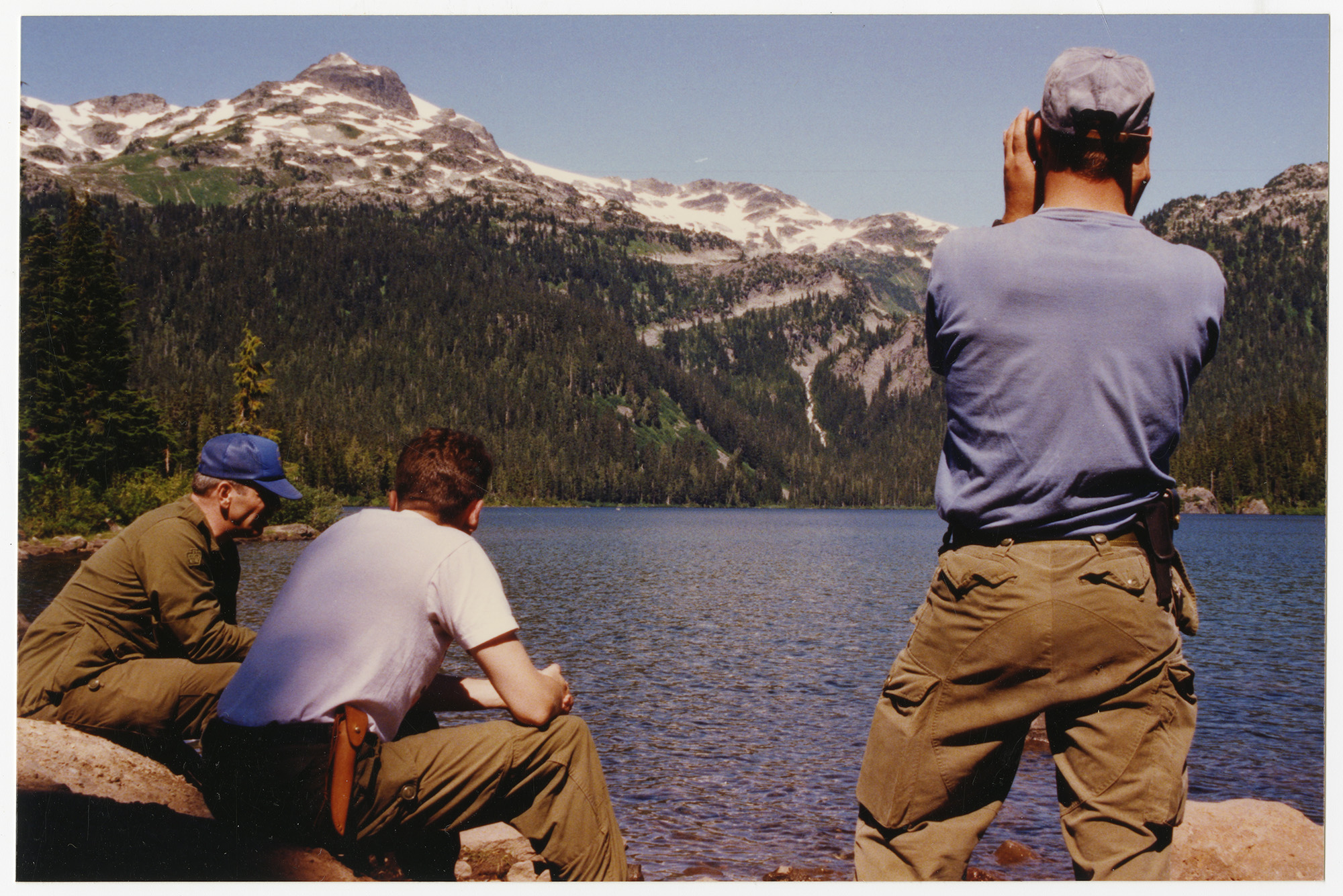
Featured photo: Military Search and Rescue members from the 442 Air Transport and Rescue Squadron (Comox) gather by Callaghan Lake in August 1997.
After logging 20,900 square miles, 800 flight hours, and involving over a dozen search aircraft, The Royal Canadian Air Force suspended a search for a downed CT-133 jet in April 1956. The search was conducted by sea and air across Vancouver Island, where civilian reports of the crash were made. Two pilots, Flight Officer Gerald Stubbs, 32, and Flight Officer James Miller, 23, went missing on March 22nd while conducting a regular training flight after departing from Comox, British Columbia, intending to fly across the Georgia Strait and then return back.
In March of 2026, the Whistler Museum received photographs and correspondence associated with an August 1997 military recovery mission of the aircraft’s fuselage, which was spotted by a private helicopter pilot fighting fires near Callaghan Lake. At the time, the Royal Canadian Navy stated publicly that despite four decades having passed since the plane’s disappearance, “aviators have kept a watchful eye over the known flight route throughout the years.” This more substantial 1997 recovery added clarity to a 1974 discovery of the jet’s canopy approximately two kilometers from the original crash site.

Sergeant Edith Cuerrier was a military photographer dispatched alongside a Flight Crash and Salvage Crew who were flown to Callaghan Lake, about 20 km southwest of Whistler Village, in the first week of August 1997. The lake then served as a base point for military search and rescue helicopter recovery flights to and from the crash site; after initial site inspection of the fuselage it was established that in the absence of ejected aircraft seats, there was no likelihood of finding remains.
The photography collections donated by Cuerrier encompass a wide array of images, including technical crash site documentation, salvage crew members actively reviewing flight paths, takeoffs and landings of aircraft, and activities partaken during downtime. The Whistler Museum additionally possesses a fragment of the aircraft’s canopy, some of the plane’s metal tubing, and a helmet of one of the pilots, all of which we received through donation from the Royal Canadian Mounted Police in 2010. However, for the two pilots’ families, obtaining information on the crash has been a more tedious and complicated process.
In 1987, the late widow of Flight Officer James Miller, Mary Ford, filed a request under the Access to Information Act with the Federal Government, seeking additional closure on her husband’s disappearance. At the time, neither she nor the family of Flight Officer Gerald Stubbs held knowledge of the plane’s canopy being recovered. Ford received a response that included the T 33’s serial number and record that the canopy had indeed been recovered in September 1974, with no further recovery action being warranted at the time. A friend of Gerald Stubbs’ widow noted after the fuselage’s recovery in 1997 that “the history of this has not been one where the family is advised.”
In light of these circumstances, the acquisition of Edith Cuerrier’s work is an important step for our collections in enabling public access to a variety of crash records. With a combination of physical artefacts from the crash site, and newly acquired photographical and textual material; these records will facilitate increased transparency on investigations into the crash.
As a community museum and archives, we endeavour to foster an open collection policy in building knowledge bases and to impartially maintain records. This has aided us in gaining custody of collections surrounding the crash’s history since the early 2000s from a diverse set of donors including both law enforcement agencies and private individuals. These acquisitions also tie into our broader institutional mandate in considering certain relevant regional history beyond Whistler’s municipal boundaries.
We further recognize how a historic absence of answers has negatively impacted the lost pilots’ families, and hope that our stewardship of these records can serve to preserve the memory of Flight Officers Gerald Stubbs and James Miller.
Oliver Matisz is one of two Collections Coordinators at the Whistler Museum this summer, supported through the Young Canada Works Program.