Obituaries in Ice…Obituaries in Ice…
“Hope plays a crucial role in how we notice and respond to glacial recession—not as a naïve optimism, but as a motivating force that helps communities stay engaged rather than overwhelmed. But hope reframes that experience. It reminds us that while change is happening, our actions still matter…”
– Alison Jenkins, executive director of AWARE
Alpine Club of Canada (ACC) member and longtime Whistler resident Doug Wylie has helped monitor two of our local glaciers consistently for the past two decades.
He has been visiting Wedgemount Glacier since 1984.
“I have a nice picture, actually, standing there. And ice was right in the lake. Quite a ways in the lake,” he says.
In 2011, Wylie began active annual monitoring of Wedge, joining Karl Ricker—an honorary member of the ACC, the highest rank bestowed by the esteemed organization, and part of the first team to complete the Spearhead/Fitzsimmons Traverse in 1964.
“I was really just a chain man. I would hold the end of the tape,” he recalls. “It was all very rudimentary, building with rock cairns and measuring by tape to the edge of the ice … we had no way to measure the depth and see how it was thinning. That has only happened in recent years with modern instruments.”

The Museum has an extensive collection of photographs and meticulous records gathered over the years from the accumulated observations. Records of loss, reading like obituaries.
“I think the thing that stands out is how [glacier recession has] accelerated,” remarks Wylie.
The Overlord Glacier has been another focus of long-term monitoring. Ricker first measured it in 1986, and Wylie joined him in 2006.
“Every glacier’s different,” notes Wylie, “but … the amount of recession and depth loss in the last half a dozen years has been really dramatic.”
Wylie has also photographed Blackcomb’s Horstman Glacier from the same location each September since the 1980s. “I’ve got a series of these,” he says. “It’s just a mess now … It’s all been happening quicker and quicker. That’s where hope becomes hopeless.”
I am struck hard by his remark. This from a man who continuously has a smile on his face. This from a man I first met in the backcountry, near Russet Lake. This from a man who, at the time of publication, was a week away from his 82nd birthday, and had biked in to meet me, leaving his hybrid vehicle at home: a home designed with a heat exchanger and passive solar system. This from a man who actively practices engaged activism. A man who I suspected, from his actions, was likely motivated by some form of “hope.”
Does he feel hope is hopeless? Is there any way we can reverse this? Or is he just monitoring a downward trajectory? I asked.
“You could be an optimist. You could be a pessimist. Somewhere in there is a realist,” Wylie says. When it comes to global warming and receding glaciers, “I’m a pessimistic realist,” he adds. “Or am I a realistic pessimist? Anyway, take your pick. On a global scale, we’re just not going to fix this. My grandchildren are going to suffer, right? But we still have to behave on a local scale.”
According to Alison Jenkins of AWARE, when people believe their choices can influence outcomes—even in small ways—they’re more likely to participate in climate solutions.
“Hope fuels community behaviours like choosing active transportation, reducing waste, protecting habitats, and advocating for policy change,” she says.
Both AWARE and Wylie point towards the necessity for action and advocacy from the local through to provincial, national and global changemakers. As the ice melts away and river flows dwindle, there is no one glacial recession doesn’t affect.
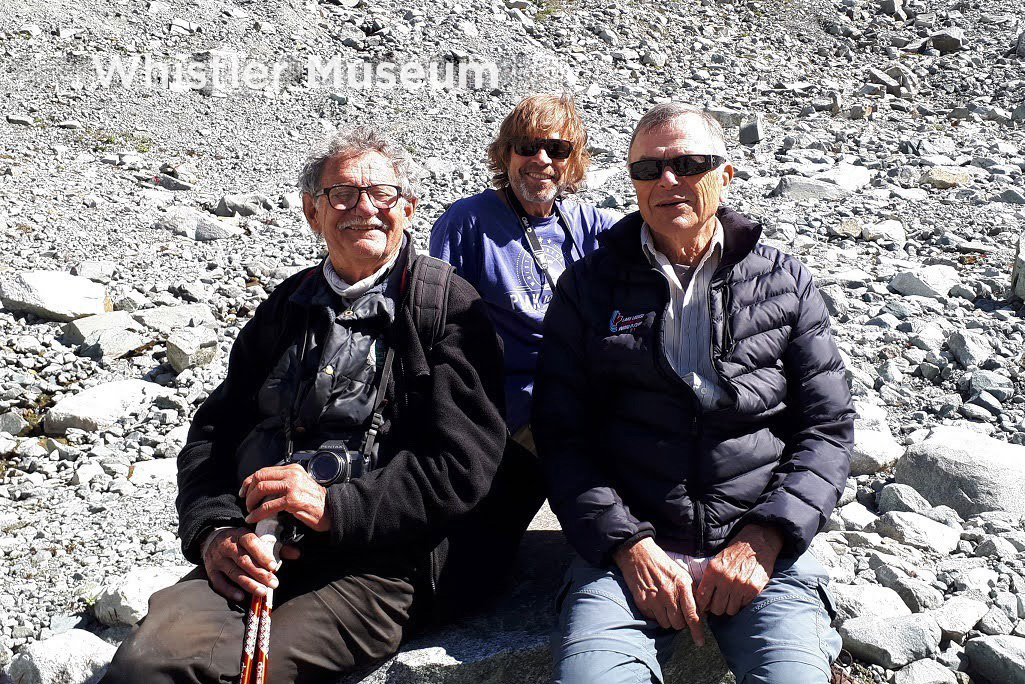
Photo: Karl Ricker, Bob Brett, and Doug Wylie September 6, 2020. Wylie Collection.