Tag: Don MacLaurin

We almost lost Lost Lake Park!We almost lost Lost Lake Park!

0 Comments

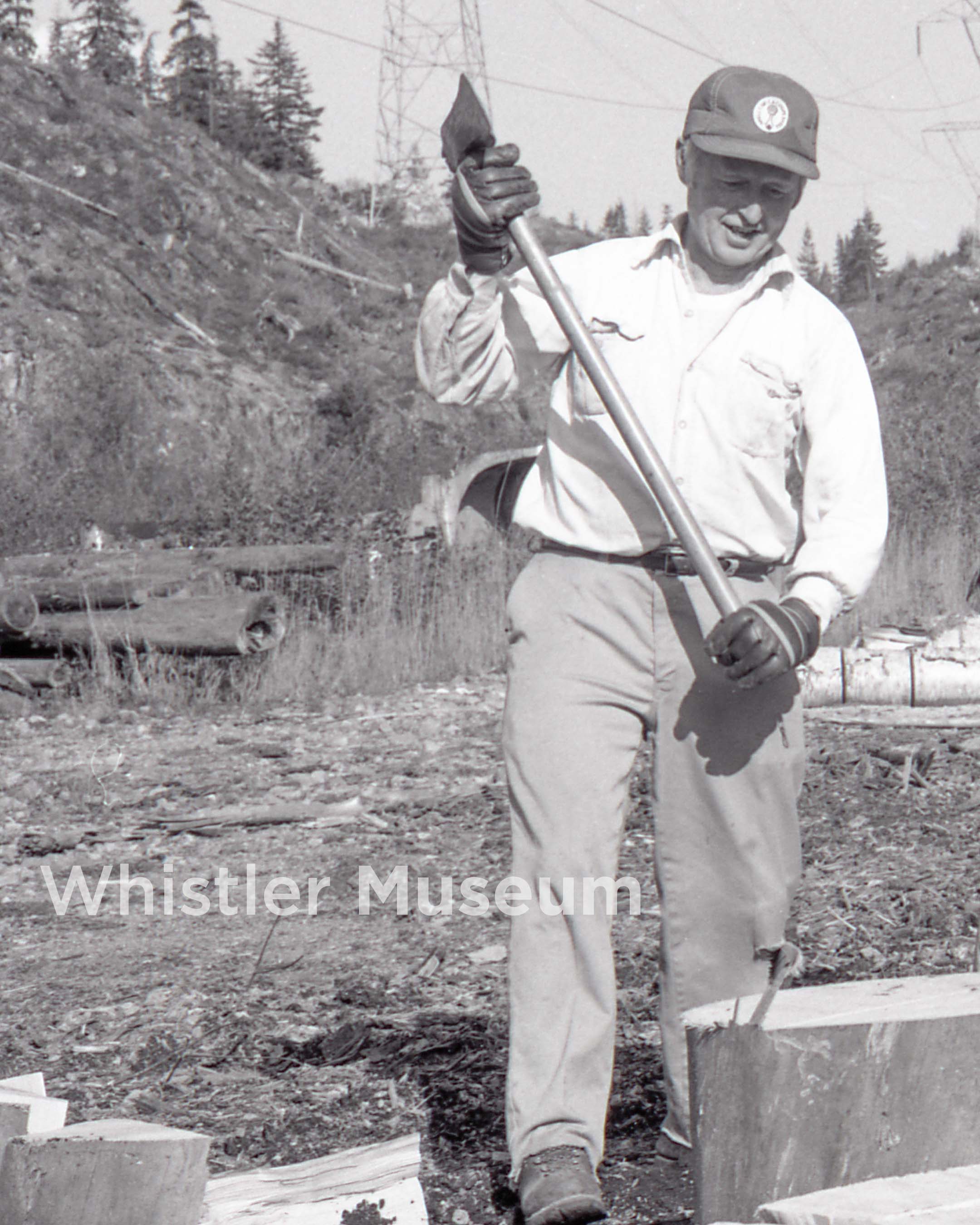
Photo credit: Don MacLaurin volunteering with the Whistler Rotary Club. 1984. Whistler Question Collection

If you want to believe that the world is terrible, watch the news. If you want to believe that the world is incredible, spend time in nature.” – Austin Perlmutter

It’s hard to imagine Whistler without Lost Lake Park, our largest and most natural municipal park. However, the creation of the park was not a certainty. In the 1930s, as tourism in Whistler (then Alta Lake) grew, guests at Rainbow Lodge (located at what is now Rainbow Park) were taken on excursions to Lost Lake for swimming, fishing, and picnics. However, in the 1940s the Lost Lake area shifted from recreational to industrial. During the next twenty years most of the surrounding forest was logged, while the Great Northern Mill operated on the north shore of Lost Lake.

In the early 1960s residential development was proposed. The timber licenses straddling Lost Lake were about to expire, and developers started staking out lots and preparing to apply for waterfront property. Keep in mind: this was 15 years before the Resort Municipality of Whistler (RMOW) was created, so it took someone with vision and determination to ensure this beautiful natural playground could be enjoyed by the entire community and visitors.

Don MacLaurin: Bridge builder

Whistler was very fortunate that Don MacLaurin (1929-2014) made Alta Lake his summer home in the 1960s. Don was a forester for the BC Forest Service and later an instructor at BCIT (British Columbia Institute of Technology), teaching courses in forestry and parks management. He was also a tireless volunteer and mentor. Don strongly believed in the value of getting into the mountains, and he championed the summer enjoyment of Whistler’s landscape.

Don was able to navigate the complicated relationship between industry and recreation. “Don was living and teaching sustainability before the term was invented. [He] was the bridge builder, the guy who looked at both the economics and the ecology,” recalled Arthur DeJong in a 2014 Pique article.

Don was the driving force behind preserving the Lost Lake area as a park. With the help of his contacts at BC Parks, he was instrumental in ensuring Lost Lake Park was designated as a park, preventing privatization and preserving the space in perpetuity. Lost Lake Park opened officially in 1982.

It’s no surprise that today, Lost Lake Park is cherished for opportunities to conserve and appreciate nature. Every year I am filled with hope when I see how the community comes together to protect thousands of tiny Western Toads as they migrate from Lost Lake to the forest. The RMOW leads toad stewardship with permanent features such as signage, fencing, underpasses (for the toads!), and staff expertise. The Museum runs the Discover Nature program at Lost Lake Park, and we often hear that learning about and moving toads away from danger is a favourite activity. I know Don would be pleased!

Lost Lake trails today. RMOW map.

We can thank Don for more than Lost Lake Park

Don worked as an advisor to the RMOW in the 1980s. When the forestry industry planned to clearcut the south side of Whistler Mountain, which is the first thing everyone sees when driving to Whistler from the south, Don and the council of the day fought back and got that logging license moved. Similarly, when the Ancient Cedars (just north of Whistler) were threatened with logging in 1988, that license was also moved due to Don’s persistence, persuasion and advocacy by the Western Canada Wilderness Committee.

Don also worked tirelessly on planning the Whistler Interpretive Forest. He mapped and developed the trails and helped people understand the forest and its importance. The suspension bridge spanning the Cheakamus River is called MacLaurin’s Crossing, a fitting tribute to this influential bridge builder.

Framing WhistlerFraming Whistler

0 Comments

Today you are less likely to come across and A-frame in Whistler than you would have been a few decades ago. However, the once widely popular structure can still be spotted throughout Whistler’s older neighbourhoods and found in many photographs of Whistler’s mountain resort past in the Whistler Museum’s archival collections.

While A-frames have historically been used for various purposes around the world, the A-frame did not become widespread in North America until after the Second World War. It then became a popular vacation home for affluent middle class households, especially in the mountains. A-frames were relatively simple to build and were soon available in prefabricated kits. This popularity continued through the 1960s when Whistler Mountain was first being developed as a ski resort, so it is no surprise that A-frames began to appear throughout the area soon after development began.

The Whistler Skiers’ Chapel at the base of Whistler Mountain. Whistler Mountain Ski Corporation Collection.

Some of the A-frames built in Whistler at the time were constructed right at the base of the Whistler Mountain lifts, including the Whistler Skiers’ Chapel, the first interdenominational chapel in Canada. The Whistler Skiers’ Chapel was constructed in 1966 after the first shortened season of skiing on Whistler Mountain. It was inspired by the memories of lift company president Franz Wilhelmsen who recalled small chapels in the ski villages of Norway where he had skied as a child. The lift company donated land near the gondola base and the A-frame design of the Chapel was provided free of charge of Asbjorn Gathe. Like Wilhelmsen, Gathe had been born in Norway. He studied architecture at the Federal Institute of Technology at the University of Zurich and then immigrated to Vancouver in 1951, where he worked as an architect. The Chapel was easily identifiable at the gondola base thanks to both its A-frame structure and its stained glass windows designed by Donald Babcock.

One of the A-frames built by the lift company to house their managers. Wallace Collection.

In 1966, the lift company also built two A-frames at the gondola base to serve as staff housing for its manager and their families (at the time, the Bright and Mathews families). The houses were situated right on the hill and Lynn Mathews, whose husband Dave was operations manager, recalled that their A-frame had seventeen steps up to the deck in the summer but only three in the winter when snow built up around them.

The Burrows’ A-frame on Matterhorn, where the first editions of the Whistler Question were created. Burrows Collection.

A-frames were popular away from the gondola base as well. When Don and Isobel MacLaurin built what at the time was their holiday home in the 1960s, they chose to build an A-frame themselves with help from local residents such as Murray Coates and Ron Mackie and beams from a 1915 school in Squamish that was being torn down. Similarly, when Paul and Jane Burrows moved to Whistler full-time in the 1970s they decided to build an A-frame in Alpine Meadows. Like many of the A-frame homes in Whistler, both these A-frames and the managers’ houses at Whistler Mountain later had extensions added onto them, changing the A-frame shape.

These are just a few of the A-frames pictured in the museum’s collections and while they may no longer look quite like the classic A-frame, some of them are still standing in Whistler today.

Rudi’s Famous StrudelRudi’s Famous Strudel

0 Comments

In Whistler today you have your pick of restaurants catering to all tastes, including many fine dining options. Unsurprisingly, the options were more limited in 1970 when Rudi and Merrilyn Hofmann’s Mountain Holm Steakhouse opened at Nesters. Later known simply as Rudi’s Steakhouse, it was an instant favourite often requiring reservations weeks in advance.

Rudi had trained as a chef in his home country of Germany and got his start in Whistler in 1969, working as the head chef at the Christiana Inn. In an interview with the Whistler Question, Rudi said, “When I was at the Christiana, I quadrupled the turnover. I was just serving different food than they were used to. In those days the general fare in ski areas was hotdogs, hamburgers, chilli.” At the time the Christiana Inn and L’Après were the main restaurants in Whistler. Seeing that there was a market in Whistler for finer dining, Rudi set out to start his own restaurant. He purchased Tony’s Hamburger Heaven, a late night eatery running out of a former Pacific Great Eastern railway tool shed, and the rest is history.

While it may not look like much from the outside, Rudi’s Steakhouse was the venue of choice for a fancy meal. Whistler Question Collection.

With appetisers including escargot, goose liver pate, prawns and scallops (’Coquilles Saint Jacques a la Parisienne’) all for under $6 a dish, flipping through a menu is likely to make anyone long for restaurant prices from the 1986 as their mouth begins to water (and when Rudi first opened in 1970 the prices were even lower). The main dishes include additional information to help diners choose. The 8 oz. Filet Mignon Par Excellence includes the claim, ‘You can cut it with a fork!’.

Nello and Jenny Busdon pose for promotional photos in Rudi’s Steakhouse with owner and chef Rudi Hofmann. Greg Griffith Collection.

With loyal customers returning again and again, Rudi’s became the venue of choice for wining and dining. Franz Wilhelmsen, President and Founder of Garibaldi Lift Co., could often be spotted in the Steakhouse. He did not hold back his praise for Rudi’s, saying, “I don’t think I ever had better food anywhere in the whole world.” It was a regular venue for events including the weekly Rotary Club meetings and birthdays, and they would hold an annual traditional European Christmas Dinner on Christmas Eve, featuring goose, dumplings and homemade Christmas pudding.

The glowing reviews were global. According to the August 1972 issue of Ski Magazine, ‘While Whistler’s nightlife would rate three on a one-to-one hundred scale, its feeding potential would rate about 92. The main reason is the Mountain Holm Steakhouse, known as Rudi’s because of its bearded proprietor, a master chef from Germany. Rustic, warm, personal; magnificent beef for $6.’ To cater to the demand, Rudi’s was renovated in 1974 to expand the lower seating area and increase the kitchen space, yet the 60 seat restaurant still filled up.

Rudi’s Steakhouse closing party in 1986, featuring left to right – Don and Isobel MacLaurin, Rudi Hofmann, Franz and Annette Wilhelmsen. Petersen Collection.

It has been argued that Rudi’s was more about dessert than dinner. Former local Bob Penner said in an oral history interview, “Rudi wasn’t famous for steak, he was famous for strudel. That was his undoing. The strudel came off of Rudi’s strudel press on Thursdays, and anyone who knew anything in the Valley was lining up on Thursdays to buy Rudi’s strudel. Rudi believed to have a good strudel you had to be able to read a newspaper through it and if it had any breaks he went into an absolute tirade.”

Despite the rave reviews, Rudi was unsuccessful selling the restaurant in 1977, and instead leased the building. This led to a rotating door of restaurants in the space – Vallee Blanche, Madame’s, Le Chalet. Eventually Rudi’s opened back up in 1984 to the excitement of Whistler locals, however, the changing times were hard on Rudi’s Steakhouse. The new town centre kept tourists in Whistler Village and increased competition, and the downturn in the economy meant fewer people were eating out. Rudi’s closed for good in 1986 but is still remembered fondly throughout the community.

Rudi’s was burnt for fire practice after closing in 1986. The next year Nesters Market opened on the same site. Whistler Question Collection.

The Lost Lake DebateThe Lost Lake Debate

0 Comments

For residents and visitors alike, Whistler’s parks are a favourite place to spend a summer day. Each park offers something different, whether it’s the playground at Alpha Lake Park or a history lesson from the cabins at Rainbow Park. Lost Lake Park offers swimming, biking, nature walks, and even disc golf. Back in 1982, when the park was still being developed, there was a debate about whether Lost Lake Park should offer even more than it does today.

Lost Lake Park almost didn’t become a park at all. In the 1960s the two timber licenses in the area were set to expire and developers, who knew the licenses were about to expire, had already started preparing to apply for the waterfront property. Don MacLaurin saw what was happening and contacted his friend Bill in the Parks Branch. With help from Bill and other contacts, the area around Lost Lake was assessed and set aside by the provincial government as a potential Use, Recreation and Enjoyment of the Public (UREP) site.

A jumper unfolds their flip into Lost Lake. Whistler Question Collection.

By 1980, residents were regularly using Lost Lake for recreation. In summers freestyle skiers were training and even holding competitions on the ski jump. In the winters the Alta Lake Sports Club was cross-country skiing in the area, having begun work on their first course in 1976. The Resort Municipality of Whistler (RMOW) received official approval for the transfer of the UREP surrounding Lost Lake to the municipality for the purposes of creating a municipal park in August 1980 and plans were made to clear a beach area at the south end of the lake and to further develop the trails already in place.

Their plans were still underway in June 1982, when Municipal Parks Planner Tom Barratt was creating a five-year plan for Lost Lake and the surrounding area (500 acres of Crown Land surrounding the lake was also transferred to the RMOW in 1982). Like before, this plan included clearing the beach area and upgrading the trail system while retaining the area’s “wilderness character.” Most people seemed to have accepted these parts of the plan but the idea of including a permanent concession stand offering snacks, drinks, and paddleboard rentals at Lost Lake Park evoked differing opinions from residents.

Grant Cooper cuts through bush on shores of Lost Lake. Miles of X-country trails are being cut as well as a dock and beach for the south end of Lost Lake. Whistler Question Collection, 1980.

An editorial in the Whistler Question on June 3, 1982 pointed out that opinions on further development of Lost Lake were “sharply divided.” While not agreeing with those who thought the area should remain untouched by the municipal government, the editor wrote: “We understood that the original concept of Lost Lake was that the area was to be cleared up, landscaped, seeded and generally made more attractive, but we really cannot endorse any plans that could well turn this pristine area into Whistler’s own Coney Island.”

One letter to the editor in June 1982 argued that developing a beach for visitors was enough but offering “paddleboards, rubber rafts, canoes, rowboats, fishing rods, towels and fast food” was going too far and asked the question, “How big do our elected members think the lake is?” Another letter supported the building of a moderate concession that could also be used as a warming hut in winter. The Question asked six residents what they thought about the proposed concession stand for their “Whistler’s Answers” feature and while some accepted the sale of food and drink, most did not support boat rentals. (You can read their responses on our Whistorical blog here.)

When weekend temperatures soared to the mid-20s, sun worshippers who had been denied their pleasure for nearly six weeks flocked to Lost Lake like the swallows to Capistrano. Whistler Question Collection, 1983.

By July, the debate appeared to have quieted, most likely because the RMOW would only grant Dave Lalik, who had applied to run the concession stand, a one-year lease while he calculated he would need at least two summers to earn back his investment. Work on Lost Lake Park continued throughout the summer but no concession had opened by the time the park was officially opened on September 11, 1982.

Today the beach at the south end of Lost Lake is incredibly popular, as are the trails that surround the area. There is a concession building that is used as a warming hut for cross-country skiers and snowshoers in the winters, but anyone wanting to float on Lost Lake is still required to bring their own boat.