Tag: Whistler Museum

A look back at the local census 105 years agoA look back at the local census 105 years ago

0 Comments

Featured Image: Alta Lake’s original general store and post office, located at Rainbow Lodge, 1920s. Philip Collection

In 1921, fewer than 100 people lived in the place now known as Whistler.

That’s according to the 1921 census, which recorded just 98 people living here.

In 2021, one hundred years later, that number would jump to 13,982 living in Whistler.

This year is a census year in Canada—that federal survey conducted regularly to shed light on the Canadian population.

One-hundred-and-five years ago, the area now known as Whistler had 84 adults residing between McGuire to the south (the since-abandoned logging camp near Brandywine Falls, with its own Pacific Great Eastern Railway stop) and Green River to the north.

In 1921, there were 14 people living in the valley under 21 years old (the then age of majority). The oldest members of the community were three 67-year-olds, the youngest was a one-year old. The bulk of the population was focused around two hubs: Alta Lake being the primary, followed by Green Lake and River area. All mail was received and sent through the Alta Lake Post Office at Rainbow Lodge, established in 1915.

Fifteen different countries were listed, at the time, as peoples’ birthplace, already hinting at the diverse demographic that makes up Whistler’s population today.

Perhaps one of the most fascinating aspects of the census is the list of jobs in 1921. From miner to woodsman, labourer to teamster, cook to carpenter: resource-based livelihoods dominated. The highest reported income, by far, was that of Alex Philip: co-proprietor of Rainbow Lodge along with his wife Myrtle Philip. His annual income was recorded as $3,000. Nothing was recorded for Myrtle.

Three people reported incomes of $2,000: two were engineers for the railway and one a purchasing agent.

Twenty-six of the 98 were female, representing 26.5 per cent of the population. Only three women recorded income. A nurse reported earning $1,000, a cook $600 and a housekeeper $150.

In 2023, Pique Newsmagazine reported: “In 2020, women in Whistler made a median annual wage of $41,200, or about $22.64 hourly, while local men earned a median total income of $47,600, or $26.15 per hour,” Pique Newsmagazine reported in 2023. “About 56 per cent of Whistler’s population of 13,983 took home a total annual income of $50,000 or less in 2021, or $27 per hour with a 35-hour workweek.”

Forty-four of the 84 adults, more than half, reported their marital status as single in 1921. Thirty-three reported themselves as married and seven as widowed.

The detailed information gathered in the 1921 census was released following a standard 92-year privacy waiting period.

Census records have been an important source of information in Canada used for research and policy-making. The first census was conducted in New France (modern day Québec) by Jean Talon in 1666. The Constitution Act of 1867 later established the requirement for a national census every 10 years.

Census data can reveal population trends, occupations, family structures and patterns of settlement. In the context of museum work, when combined with archival and research sources such as newspapers, photographs and oral histories, census data can help build a broader understanding of a community’s past.

However, census records are not without limitations. They capture only a single moment in time and can reflect the biases, omissions, and record-keeping and gathering practices of an era. As a result, they necessarily must be considered alongside other sources.

Present-day Whistler represents a dynamic social and cultural mosaic. On Friday, June 12, the resort will celebrate its diversity through the Whistler Multicultural Festival. The event takes place from 4 to 8 p.m. in Florence Petersen Park by the Whistler Public Library. Museum staffers will be on hand to greet guests with an activity tent. For more information visit festival.wmsociety.ca.
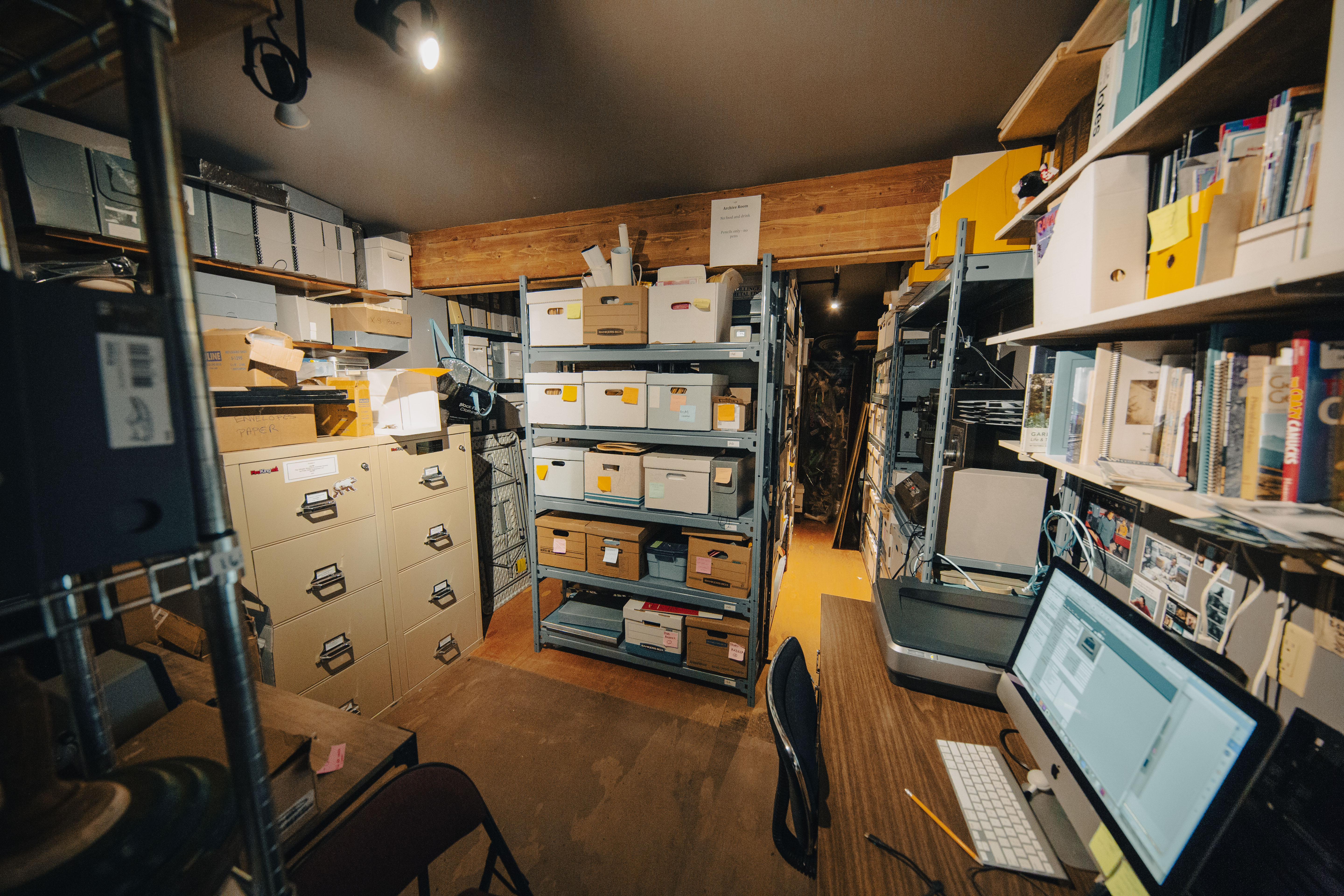
Just because it was documented, doesn’t mean we have it…Just because it was documented, doesn’t mean we have it…

0 Comments

The archives depends on you: dispelling some misconceptions about the process of building the Museum’s collection

 “Archives are the documentary by-product of human activity retained for their long-term value. […] Like people, archives are diverse,” explains the International Council on Archives.

In simple terms, the archives is a euphemism for a ‘collection of story parts.’

In a recent Pique article, I, the Whistler Museum’s Events and Community Manager, was quoted as saying, “an archive is a living, breathing, exciting thing. ‘Archive’ is a verb.”

The action of the archive, however, is only expanded by donations of materials; adding chapters, pages, periods and punctuation to the make-up of a place… and herein, lies one of the major misunderstandings on how the broadening of our museum collection works.* Just because an event happened and it was photographed, or a document was produced relating to the town in some way – does not automatically mean that we have it.

In short, the archive is infused by gifting. We are dependent on donations This can also mean that the archive can be disproportionately reflective of a place’s demographic. This, too, is true for our Whistler archive.

The Museum’s archive can be viewed as an ever-expanding puzzle; whilst we try to configure matching pieces and identify those missing. The process is equally as diverse as the people and collections who breathe life into it: a reciprocal exchange between gifting and receiving.

The local archive is only made broader — more reflective of those who have, and still do, live here – by donations of material: from physical elements (text, photographs, video/film assets) to non-physical ‘oral histories’ that people come in and record. The Museum’s repository is expanded by people contributing to being part of place-making and meaning. Please never underestimate the value of your experience. The Museum does not have an age limit.

Speakers Series are also a valuable way of documenting reflections and past events, recording our stories through the power of conversations — which add to the record — becoming platforms for thought. Again, I was cited in the same March 20th article by Luke Faulks as saying: “…a museum is an exciting place. Your history sheds light on your present, and it’s a springboard for how we inform our future.”

The Museum invites you to become an active participant and co-creator of our storied happenings by attending one of our events, by volunteering to record your tale or by donating relevant items you may have.

This segues into another often misunderstood element of how the Museum is able to process items received. It’s not instantaneous.

 We are a not-for-profit organization that operates with a small staff of three. Currently, we have an additional person added to the team, hired under contract for the sole purpose of inventorying, appraising, processing (arranging and describing) the donation of the Bruce Rowles 70,000+ photographic collection. This entire process has already taken seven months, working full time, and is still ongoing. Ideally, the last step for archivists is to digitize our collections, which is important for preservation of degrading materials and for easy access to these images. The process is time and labour-intensive. A collection of 20,000 images could take one year to digitize, ensuring it meets Canadian archival standards. It is, however, a donation we are exceedingly happy and grateful to receive: a benefit to the entire community. Bruce wanted to ensure his life’s work would be remembered and appreciated. A selection of his photography will be exhibited at the Whistler Museum from April 24th to June 14th.

As further means of perspective, the Whistler Museum’s entire photographic collection currently exceeds 300, 000 items.  With the addition of the Rowles collection, it will be nearing 400, 000. We have approximately 90, 000 of those items digitized. We try to make many of those items available through a variety of means: from special exhibitions, to being posted on our social media networks, online on our archival database to highlighting them through articles and being featured in events.

The local archives is an expansive and immersive space: infused by your continuous contributions into the building of a pastiche-of-place.

*

*It would be remiss of us not to acknowledge the past wrongs associated with many colonial museum practices: with a legacy of taking, extracting without permission and stealing from Peoples. The Whistler Museum has participated in the repatriating of some items that were donated, that we did not feel were ours to have. Together, we learn through the past how to co-create collaborative futures…

Icons Gone — brought back centre-stage!Icons Gone — brought back centre-stage!

0 Comments

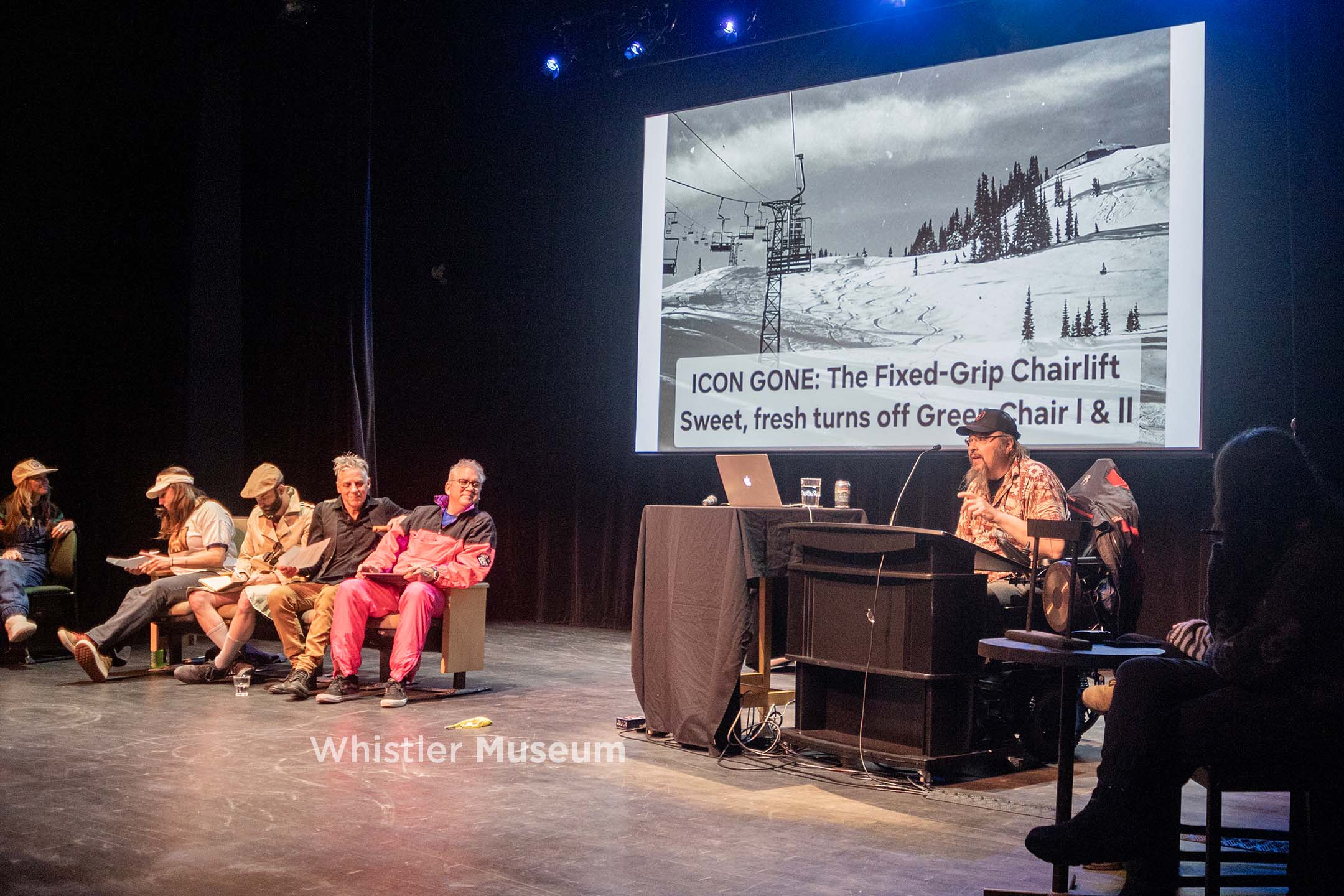
Featured Image: Keven “Big Kev” Mickelsen presents at last year’s Icon Gone. Whistler Museum Collection.

It could be argued that a signpost or a benchmark of a town’s maturity can be tabulated by how many significant symbols/things/happenings/elements-uniquely-local that have come to be associated with it, can now be referred to in the past tense… measuring a community’s forward trajectory by its ‘icons gone’.

Lamenting the legacy of legends-left-behind is the focus of next week’s ‘ICON GONE’ event put on by the Whistler Museum at the Maury Young Arts Centre/Millenium Place. The event began in 2008 and ran for many years up until 2013. It was resurrected last year with yet another all-star cast.

In a lively evening of friendly competition (tinged with debaucherous debate…it is, after all, 19+), six notable locals will take to the stage and argue for what they think is the largest loss in the landmark of Whistler-specific icons. The audience (through applause-and-yell-o-metre) along with a panel of equally notable judges will crown a champion. Nudity was the winner of last year’s debate. Citta’ (pronounced Cheetah’s, for those who don’t know), the runner up.

This year’s panel promises to deliver on all levels, covering the extremes from the raunchy to the contemplatively serious. Past topics have included everything from Fixed-Grip Chair Lifts to A-Frames, Squatters Cabins to The Boot Pub, the Passenger Train and Toonie Races to the Toad Hall Poster; from the Snow, Water, Earth Race to the Party Barge, Mountain Man Beards to Beavers. Gravity – as a topic, as a subject — even won one year.

The purpose of the evening is two, even three-fold. Undeniably, entertainment and community-fun are a major focus. However, the event also serves as a way to highlight the Museum’s local archive – and remind people of its absolute essential relevance. Through the eyes of the present we are given tools to reflect upon our past. ICON GONE serves to illustrate the value of preserving our stories, our legacies, our legends and some of the many ways which we can keep them alive. Humour is one of them, a method of honour. The archive is not a dusty, musty collection – it is active, vital and alive – infused only by our present perspectives.

In a December 5, 2025 editorial titled ‘Who remembers Whistler?’ Pique Newsmagazine editor Braden Dupuis deftly articulated the value of the Museum. ICON GONE offers the opportunity to showcase Dupuis’ points, worth repeating anew:

“If we don’t invest in institutions that collect, preserve, archive, and explain, we lose more than objects and photographs. We lose context. Identity. A sense of place beyond postcards and ski packages.

Left unchecked, the version of “Whistler history” that remains will be curated by marketing budgets: sleek, sanitized and built for outside consumption. It’s cultural erasure in its most casual, passive form.

[…]

By preserving history, we don’t resist change, we anchor it in respect. We ensure Whistler doesn’t forget it is more than a ski-lift and slopes, a playground for the rich or an ATM for faceless corporations—that it is a real community built by people, labour and continuity.”

In the spirit of continuity – through raucous reverence — let us celebrate the cornerstones of this community…

On Friday, April 17 – at 7:00 pm – join judges Ace MacKay-Smith, Julia Murray and Brandon Barrett as together we applaud debaters Feet Banks, Princess Stephanie, Stinky, Laugh Out Live’s Rebecca Mason, lawyer Tanya Kong — as they set to historically hammer home their iconic topic of choice!

For more information and Tickets, please visit www.whistlermuseum.org

Whistler’s Answers: December 24, 1986Whistler’s Answers: December 24, 1986

0 Comments

In the 1980s the Whistler Question began posing a question to three to six people and publishing their responses under “Whistler’s Answers” (not to be confused with the Whistler Answer).  Each week, we’ll be sharing one question and the answers given back in 1986.  Please note, all names/answers/occupations/neighbourhoods represent information given to the Question at the time of publishing and do not necessarily reflect the person today.

Some context for this week’s question: This one seems pretty self explanatory, so we think we’ll leave it there.

Question: If the world could make a New Year’s resolution, what might it be?

Sylvia Pokar – Reservation Agent – Adventures West

To put a halt to the nuclear arms race and to concentrate on world peace. To help people in other countries by recognizing their human rights and creating more jobs in those countries to alleviate their unemployment problems. And to work to prevent famine in certain countries.

Leo Cooper – Freelance Writer – Vancouver

I think the world should go on a heavy vegetarian diet and cut down on the plutonium and lead. And laugh a lot more.

Dave MacKinnon – Articling Law Student – Vancouver

Here’s a practical one. I don’t think peace in the world is ready for this year, at least the odds aren’t that big for the next six weeks. How about free transportation for everybody, everywhere, or at least the same as a 60-cent metro ticket no matter where you’re going or how you’re getting there. Just keep everybody moving, it’s good for them.