Coexisting with Whistler’s BearsCoexisting with Whistler’s Bears

2 Comments

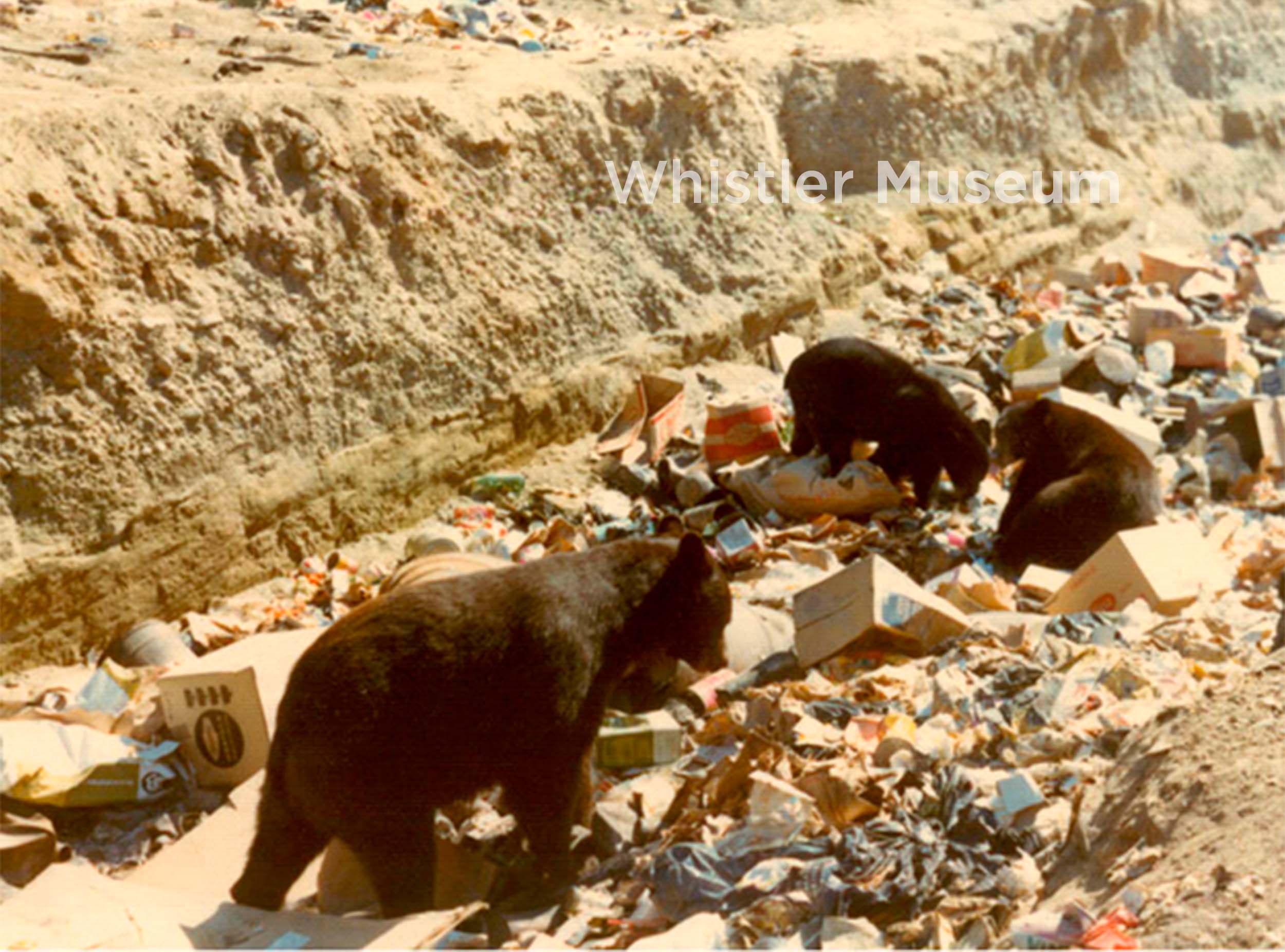
Cover Image: Bears in the garbage dump (future site of Whistler Village), ca. 1965. Petersen Collection.

Like us, animals feel love, joy, fear and pain, but they cannot grasp the spoken word. It is our obligation to speak on their behalf, ensuring their well-being and lives are respected and protected”. 

– Sylvia Dolson

Sylvia Dolson’s work with the Get Bear Smart Society was central to Whistler achieving Bear Smart Community status. Photo credit: Joanne Vaughan

Whistler has an ever-evolving relationship with bears. Whistler residents and visitors alike are fascinated by bears and consider it a privilege to share the community with these magnificent animals. However, it hasn’t always been this way.

Not long ago, the general feeling in the community was that Whistler had a “bear problem”, but that missed the point. The issue was never the bears. The real problem is how people handle food and garbage while living in the middle of bear country. Whistler was built in prime black bear habitat, so it’s no surprise that people cross paths with them often. Bears have an exceptional sense of smell and are naturally drawn to anything that offers an easy, high-calorie reward, whether it’s garbage, barbecue residue, or pet food left outdoors.

When a bear discovers easy access to human food, everything changes. They lose their natural caution around people and begin searching for effortless meals wherever they can find them, sometimes causing damage in the process. This puts both people and their property at risk and puts the bears’ lives in danger. Any bear seen as assertive or “too comfortable” around humans is usually killed. When a bear pays the price for human behaviour, it is a preventable loss.

Between 1990 and 2016, 263 bears were killed in Whistler as a result of preventable conflict, an average of 10 each year. A great deal of work has gone into reducing those numbers, and the community has made encouraging progress. Between 2016 and today, 38 bears have been killed — still far too many, but a meaningful decrease that reflects years of education, planning, and commitment to coexistence.

 Bears on Whistler Mountain 2018. Nichols Collection. 

Efforts to make Whistler safer for bears took shape in 1995 with the creation of the Get Bear Smart Society. The organization focused on reducing human-caused problems for bears through education, science-based solutions, and community collaboration. Whistler is fortunate that Sylvia Dolson served as Executive Director for 21 years. Shortly after arriving in 1996, she read a newspaper headline about a “garbage bear” being destroyed, and that moment sparked her dedication to advocacy.

Sylvia founded the Bear Working Group, bringing together municipal staff, enforcement agencies, conservation officers, waste management partners, Whistler Blackcomb, and community members. This collaborative approach became the backbone of Whistler’s progress. Under her leadership, the community strengthened education, encouraged responsible behaviour, and worked to reduce attractants that bring bears into conflict.

In the late 1990s, the municipality began installing bear-resistant garbage cans and updating bylaws addressing attractants. These steps, paired with sustained education and enforcement, significantly reduced conflict over time. In 2010, Whistler applied for Bear Smart Community status, a provincial program that recognizes communities addressing the root causes of human-bear conflict.

Whistler achieved Bear Smart Community Status in 2011, a milestone reflecting the community’s willingness to take responsibility for living in bear country. Before leaving for the Sunshine Coast in 2017, Sylvia was recognized by the municipality for her years of service and her leadership on behalf of bears. What began as grassroots advocacy has grown into an established, long-term program — a powerful example of what is possible when people choose compassion, responsibility, and respect for the wildlife that shares their home.

The ‘Skin’ny on Whistler’s Ski Touring HistoryThe ‘Skin’ny on Whistler’s Ski Touring History

0 Comments

Top Image: Pip Brock and Don Munday walking down Whistler’s tracks, packing skis.
Photo taken by Phyllis Munday and from the BC Archives.

Ski touring and split-boarding continue to grow in popularity as people strive to extend their range into the backcountry of the local Coast Mountains. However, it is nothing new.

In 1933, the first documented ski ascent and descent from the top of London Mountain – now known as Whistler Mountain – was made by Pip Brock. With “terrible” skis purchased from a Vancouver department store, the feat of the intrepid 19-year-old was at first disbelieved by locals. His claim was, however, confirmed by binoculars which showed his tracks: the first top-to-bottom run of Whistler, sited and sighted, 92 years ago.

Pip recalls “Most mountaineers thought that skiing was impure and indecent. But a few of us being frivolous, realized the fin and value of ski for winter touring.” Pip was later joined by celebrated, nationally-treasured mountain adventurers Don and Phyllis Munday, skiing up Wedge Creek as means to summit Wedge Mountain.

Initially, local ski touring converts were few and far between. Pioneering prospector Harry Horstman (whom the glacier on Blackcomb and hut are named after) indignantly heckled the young Pip Brock, chastising him with: “What the hell you got them planks fur? I can get around twice as fast on my snowshoes as you can on them slitherin’ boards!”

But it was “slitherin’ boards” that George Bury, along with three others, chose to use for their 1939 expedition: the first to assess the potential for ski development in the area. The four men began their explorations from Cheakamus Lake and over the period of 10 days, skinned and skied their way around. The tour ended by way of skiing down ‘The Barrier’ to the railroad tracks and flagging down the southbound train headed for Squamish. The development idea was sidetracked with the start of World War II. The group never revisited the idea post-war.

Members of the Bury expedition in 1939.
Bury collection.

In the 1960s, Stefan Ples became actively involved with Garibaldi Lifts Ltd. in their development of Whistler as a ski area. Stefan was incredibly familiar with the mountain, having been touring up and down it for years.

There is a story of when Stefan first met Franz Wilhelmsen (‘The Father of Whistler’), President of Garibaldi Lifts, fittingly on top of the mountain. Franz had arrived by helicopter, Stefan by skis. Franz is reputed to have said “What are you doing on my mountain?” to which Stefan replied “What are you doing on mine?” It is ironic that Stefan became so involved with the ski resort’s development given that it is said he truly could not conceive why people would choose to take a lift up the mountain, just to ski just a short distance down. Though eventually awarded a lifetime pass, Stefan’s preferred method of access was by skinning. It took Stefan approximately 3 hours to reach the peak.

Members of the Bury Expedition in 1939 at Black Tusk.
Bury collection.

The Spearhead Traverse is now the area’s most popular ski touring mission, linking Blackcomb and Whistler by way of an approximately 34 km horseshoe-shaped route across the peaks of the Fitzsimmons and Spearhead ranges. The traverse crosses 13 glaciers, and depending on routing 9-11 mountain passes. In 1964, the first successful tour of the circuit was completed by four UBC Varsity Outdoor Club members. It took the group nine days, starting from the base of Blackcomb.

Today, the Spearhead Traverse is regarded as beginning at the backcountry gates atop of Blackcomb and ending in Whistler Village. The Spearhead Huts Society built a state-of-the-art 38-bunk backcountry accommodation in 2019, with two more huts planned along the route. A strenuous endeavour, most take 2-4 days to complete the trek, however the fastest known times currently hover around the 2 hour mark for both men and women.

The Spearhead Traverse is undertaken by approximately 4000 people per year, skinning their way into the storied tracks of this place.Ski touring and split-boarding continue to grow in popularity as people strive to extend their range into the backcountry of the local Coast Mountains. However, it is nothing new.

***

(*Please note that the version of this article that was published in The Pique Newsmagazine on December 26, 2025 had the wrong photo credit with the Brock/Munday photo. Credit is correct here.)

Emerald Forest: the final link in Whistler’s green beltEmerald Forest: the final link in Whistler’s green belt

4 Comments


 Top Image: Alex Philip with guests from Rainbow Lodge heading down the River of Golden Dreams. 1941.  Philip Collection.

“Protecting biodiversity and fighting climate change takes more than isolated efforts: it requires a living network of protected and conserved areas that are deeply interconnected”. – Parks Canada 

Our last nature article was about Whistler’s remaining wetlands and how important it is for Whistler to protect them. However, protected areas in isolation are not enough; they also need to be connected by green belts, defined as open land where development is restricted or banned. This allows for ecological connectivity, which is the ability for animals on land or in water to move freely from place to place. This is essential because it allows wildlife to find food, breed, and establish new home territories.

 In 1985, when the Resort Municipality of Whistler (RMOW) expropriated what is now Rainbow Park near the north end of Alta Lake, the RMOW also recognized the value of protecting a wetland corridor along the River of Golden Dreams (ROGD) from Alta Lake to Green Lake. Over time, the RMOW protected the Whistler Nature Reserve (Rainbow Park wetlands), Golden Dreams Conservation Area, Meadow Park, and Dream River Park. The last piece of the puzzle was the establishment of the Emerald Forest Conservation Area in 2000. It was a huge win for ecological connectivity, but acquiring what was previously private land was a complex, lengthy and intriguing process.

 In the late 1970s the 139-acre Emerald Forest property was purchased by Decigon Corporation and zoned for residential development. Even though the RMOW wanted to protect the land, it didn’t have the money to buy it. For several years, Decigon sought rights to their land that exceeded the allowed development or included subdivision. Over time, a large group of dedicated community members advocated to protect this critical ecosystem and recreation area. So, with community support, the RMOW renewed its efforts to safeguard the land.

In August 1999, it was finally announced that a deal had been made for the Emerald Forest lands. In a surprising twist, Intrawest had been brought in as a third party to make the deal happen. In the three-way agreement, Intrawest purchased the Emerald Forest lands from Decigon for an undisclosed price. In exchange for the Emerald Forest, the RMOW paid Intrawest $1 million and granted Intrawest approval for additional development rights in the Benchlands and other areas.

The Emerald Forest Conservation Area (2 on map) is a vital link in the protected
River of Golden Dreams corridor.

 In 2000, the Emerald Forest Conservation Area was permanently protected through a legally binding agreement between the RMOW and The Land Conservancy of BC. Emerald Forest ecosystems include wetlands, which connect to the much larger ROGD corridor, as well as upland forest, which connects to wetlands on most sides and is significant habitat for many species. Much of the upland forest is unlogged, and some of the biggest trees are almost 400 years old!

 I hope you have a renewed appreciation for the work done by the RMOW, Intrawest, and the community at large to protect the Emerald Forest for recreation and, more urgently, as an essential link in a protected wetland corridor. The ROGD green belt is vital for protecting Whistler’s biodiversity and resilience against climate change, a basic need for both people and wildlife.  

Whistler’s Answers: December 24, 1986Whistler’s Answers: December 24, 1986

0 Comments

In the 1980s the Whistler Question began posing a question to three to six people and publishing their responses under “Whistler’s Answers” (not to be confused with the Whistler Answer).  Each week, we’ll be sharing one question and the answers given back in 1986.  Please note, all names/answers/occupations/neighbourhoods represent information given to the Question at the time of publishing and do not necessarily reflect the person today.

Some context for this week’s question: This one seems pretty self explanatory, so we think we’ll leave it there.

Question: If the world could make a New Year’s resolution, what might it be?

Sylvia Pokar – Reservation Agent – Adventures West

To put a halt to the nuclear arms race and to concentrate on world peace. To help people in other countries by recognizing their human rights and creating more jobs in those countries to alleviate their unemployment problems. And to work to prevent famine in certain countries.

Leo Cooper – Freelance Writer – Vancouver

I think the world should go on a heavy vegetarian diet and cut down on the plutonium and lead. And laugh a lot more.

Dave MacKinnon – Articling Law Student – Vancouver

Here’s a practical one. I don’t think peace in the world is ready for this year, at least the odds aren’t that big for the next six weeks. How about free transportation for everybody, everywhere, or at least the same as a 60-cent metro ticket no matter where you’re going or how you’re getting there. Just keep everybody moving, it’s good for them.