Boarder Bob: Whistler-based 1990’s Comic StripBoarder Bob: Whistler-based 1990’s Comic Strip
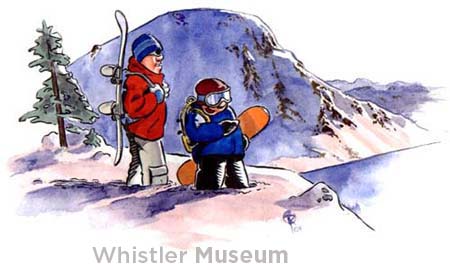
Featured image: Boarder Bob comic illustrated by Olivier Roy, published in Snowboard Canada Magazine (starting somewhere in the mid-nineties!)
Olivier (Oli) Roy is “an artist snowboarder” who first came to Whistler “right after high school in 1990” to attend a Craig Kelly Camp. He moved here, three years later, after art college.
Now, with a career of more than thirty years of ongoing coaching and creating under his belt, he holds a Lifetime Whistler Blackcomb Pass in one hand, a paintbrush in the other and continues to ride the endless canvas offered up by the mountain: artistically and athletically.
The early/mid-nineties has been referred to as the ‘golden age of snowboarding.’ It was fresh, edgy and still relegated to counter-culture status. In Whistler, it was synonymous with a lifestyle and a community.
During this era, the Ontario-based Snowboard Canada Magazine was born. Broadening their output, they enlisted Roy, as he describes, a “cool artist.”
Thus, Boarder Bob – the character and comic strip – were born. Border Bob “moves to Whistler to pursue [his] dream of being a pro snowboarder, but he’s very delusional … he thinks he’s a big shot…” But, he’s not. After a season or two, “he gets a sidekick, Jed Shred.”
Jed is a devoted fan: “he’s all like, ‘Oh, Boarder Bob, you’re so epic’. But, as is proven – through Bob’s trials, tribulations and failed attempts at ease and epicness – he is anything and everything, but.
Roy collaborated with local Glenn Rogers – known for his comic panels in The Whistler Question (a former, local publication started in 1976) – to produce the strip. The two worked together for eight years (“if I remember correctly”, states Roy), producing the 8 panel, 2 row, half-page ‘Boarder Bob’ strip. Published four times a year, “we had a lot of fun” poking fun at the “life of snowboarding in Whistler and on the West Coast.”
The stresses of balancing the desire to shred while staying fed, being able to board while needing to find literal board-ing to trying to be the bawler at the bar were all fodder for the two creative duos: Roy and Rogers, Bob and Jed. Moral quandaries were occasionally tackled through the ink of these stories: “should we risk everything to be in the shot?!” Arguably, Boarder Bob was 90% total fun, 10% tackling that ‘the stakes are real’.

The comic ran from about 1995 to 2002, or thereabouts. The pinpointing of specifics is about as precise as Bob’s technique, working more with the “ish” verb. However, when it comes to the technical hows of developing the strip, the collaborative process between Roy and Rogers was fine tuned.
Rogers would usually come up with the story. Admittedly, Roy states “I was never good at writing the stories, I was more the artist and inker.” He would receive the script and then sketch it, all by hand, on an 11 x 17 piece of cardboard:
“I would pencil it and then use China ink [for] the black and white and use markers, like alcohol markers and a bit of watercolor.” It was all hand-lettered. “And then I would send it by FedEx back to Snowboard Canada magazine. And I, I remember a few times where the FedEx guy would ring the bell and I would still be finishing … after an all nighter.” Each strip took between 10-20 hours. “It was a labour of love,” Roy reminisces. “I loved it.”
Boarder Bob eventually got abducted by aliens (I mean, why not?) – or this is insinuated, but never confirmed for the reader. “There’s a UFO and he disappears.”
Boarder Bob carved out a seminal space in the culture and history of snowboarding art, taking its place in the local legacy of slope-inspired comic strips. The Peak Bros ran from 1979-2002 (in The Whistler Answer and Whistler Review), poking fun at 80s ski culture, whereas Boarder Bob tackled the snowboarding shenanigans of the nineties.
Roy continued, and continues, to flourish on and off the slopes: the line between his art and sport overlapping.
He has illustrated for Snowboarder Magazine (the prominent US publication), been Whistler Blackcomb’s online illustrator, designed top sheets for such companies as Prior, Luxury and Option Snowboards; been sent to Ottawa as a Whistler Art Ambassador in 2010 for Canada Day and continues to regularly produce art that showcases the mountains and its vibrant culture.
The born-in-Montréal skateboarding kid who first came out to join Craig Kelly’s summer camps on the glacier, to then gain accolades as a competitive snowboarder in “half pipe contests, some slope styles, some boarder cross” to now working for Whistler Blackcomb’s Alpine Program and holding the title of being Whistler Valley Snowboard Club’s longest-running coach, working with the program since its inception almost 30 years ago – has literally drawn together the lines of on and off-mountain creativity.

Boarder Bob Comic. Illustrated by Olivier Roy, written by Glenn Rogers: featured in Snowboard Canada Magazine. The comic strip highlighted and poked fun at the Whistler snowboarding scene of the nienties.