This week we’ve got something a little different for you.
We’ve written before about the beautiful Neal Carter photo collection, which documents a two-week exploratory mountaineering expedition into the mountains surrounding Alta Lake by Neal and his friend Charles Townsend in September 1923.
Approaching the summit of Wedge Mountain.
Well, since we also have the written account that Charles wrote for the British Columbia Mountaineering Cub’s journal, we plugged some of their photos and words together into Google Earth, and have recreated their encounter with these mysterious, unexplored peaks as a sort of virtual tour that you can follow from the comforts of your home:
This first video revisits the first two days of their trip, during which the pair managed the first ascent of Wedge Mountain – the highest peak around. Instead of contently heading back to Rainbow Lodge, Neal and Charles continued deeper into the Coast Mountain wilderness towards the lesser-known but equally formidable Mount James Turner, which they named after a popular Vancouver reverend. Check back next week for this episode, as well as their subsequent climb of Whistler Mountain and more first ascents deeper in the Fitzsimmons Range.
Of course, watching this little video doesn’t provide quite the same experience as actually climbing these peaks. Since we’re currently enjoying a wonderful window of late summer weather similar to 1923, hopefully the virtual tour inspires you to get up into the alpine for some fresh air, exercise, and inspiring views!
As the end of summer approaches many people might make the most of it by going on one last camping trip before heading back to work and school. To all those, the Museum would like to offer the advice of Old Bill, suitable for all seasons.
Waiting for the train at Alta Lake station, 1937. Left to right: Bill Bailiff, Mr and Mrs Racey, Ed Droll, Betty Woollard, Larry, Flo and Bob Williamson.
Born in Liverpool, Bill Bailiff moved to Canada and began working for the Pacific Great Eastern railway in 1913. He soon quit over unsafe working conditions and walked up the unfinished track to make his home at Alta Lake. Bill settled in a log cabin on the Pemberton Trail near Scotia Creek and kept a trapline up the Cheakamus and in Fitzsimmons Pass. As the community around Alta Lake grew Bill became an involved resident so that at the time of his death in 1958 he had been serving as the president of the Alta Lake Community Club.
First Alta Lake Community Club picnic on the point at Rainbow.
Founded in 1924 the Alta Lake Community Club regularly held dances, card parties, and film nights, as well as constructing the first school building in the area. The club also put out a weekly newsletter called the Community Weekly Sunset to which Bill, as president, contributed a column on life in the mountains. Going through the archives I found one of these columns entitled “What Not to Do” and thought it was time to share the advice of Old Bill.
Original illustration from the Community Weekly Sunset.
1. Don’t ever make your campfire against a tree and in summertime don’t make it against a log or windfall. make it where it can be controlled at any time. Remember, fire is a good servant but a bad master.
2. If in company never carry a firearm loaded. By loaded I mean a live shell in the chamber. Be careful of that sharp axe, best to have it covered as anyone brushing against you could receive a nasty cut.
3. Don’t go sliding down a steep snowbank as you may not be able to stop and the rocks below are harder and sharper than your bones.
4. If on a glacier don’t ever attempt to cross on a snowbridge over a crevice as these are liable to give way anytime so leave that to the experienced mountaineers who rope themselves.
5. Don’t be a litterbug around a campsite clean it up as someone else might be along to use it and don’t stay too long on a snowfield without dark glasses on as you may get a terrific headache from partial snowblindness.
6. Remember your forest ranger is your friend and you’ll find him very nice and co-operative providing you are not a careless firebug who none of us has any use for.
7. Don’t go killing wild life needlessly as some species are nearing extinction from indiscriminate slaughter. Much better to try a shot with your camera and picture them.
9. Don’t be an old grouch round the camp or on the trail as this has a bad morale effect on others. If the going is tough take it with a smile and joke about it as it makes it easier and pleasanter.
From a different issue but still applicable. Original illustration in the Community Weekly Sunset.
Sound advice, 90 years ago or today. Happy camping!
We have tens of thousands of photos in the museum archives. Amongst the plethora of photos of our pioneers, the community, and the ski hill is the occasional image that really defies explanation, and to be honest, these photos sometimes seem better without knowing the stories behind them. We thought it was high time we shared some with the public. In the hopes of making you laugh a little, here are a selection of photos we’ve dubbed ‘Awkward Archival Photos’.
A personal favourite (and the photo that inspired this blog post) is the following photo of a baby in a tree. This baby is Doreen Tapley, and apparently the boughs were shoved in the tree to give it “a more festive look”. Unfortunately, little Doreen’s facial expression is not so festive.
She looks cold – throw some more cedar boughs in there to keep her warm!
Apparently the problem of parents trying to capture their teenagers’ awkward coming of age has persisted through the ages. The young man below looks like he’s dressed in his Sunday best, ready for a photo shoot, when someone suggested he curl up in fetal position and perch on top of a stump.
Time to put on your Sunday best and pose on a tree stump.
Some of our photos have red pen markings on them, but I like the way that in this photo, two women appear to have been specifically crossed out (one of them is Myrtle Philip).
When I first saw this photo, I thought this man was rescuing this woman. Then I realized that no, unless he’s wearing that bandana to prevent infection, this is a bizarrely posed mountain shot.
When trying to protect yourself from the sun, tie a bandana over your face. To complete the bandito look, grab a helpless maiden.
The following photo really grabbed me because the gentleman reading his newspaper on a frozen lake looks incredibly casual. Perhaps this family visited from the southern hemisphere, forgetting that the seasons are reversed, and had hoped for a lovely lakeside summer vacation. Being a stubborn fellow, this man insisted on adhering to his plan.
This is one of those accidental optical illusions that worked out to comic ends. The photo is actually labeled ‘See the length of that cow!’, so it appears that the photographer may have been in on the joke.
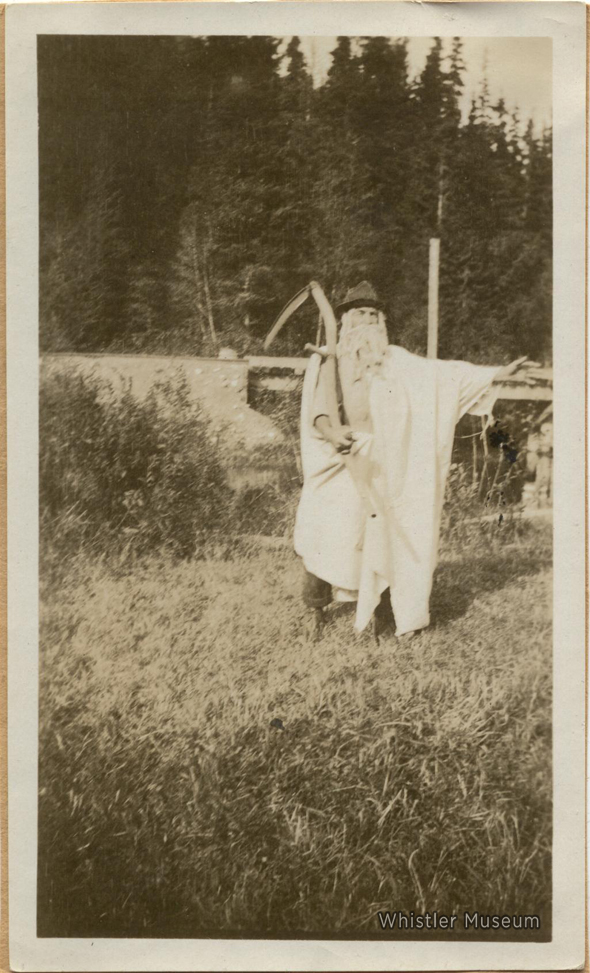
When I first saw this photo, I thought it was a member of the KKK. Thankfully, I was wrong, but I have no idea what this costume is about. A wizard? Moses? A scarecrow?
We have a surprising number of photos of men in drag. This was apparently a popular costume for Whistler’s pioneers. This photo stands out because the drag is incredible, and the pose just tops it off.
We’ll never forget the year Dad put on a one man show of Swan Lake.
One question stands out for me from this photo: Do you think her parents specifically chose this outfit because it matched the two dead birds she’s holding?
Our collection of photos of squatters and ski bums has a few gems. In the days when people partied hard and threw caution to the wind, bizarre photos were fairly common place. I like the facial expression of the child in the background, which seems to say, “Shame on you.”
Getting naked at a family event is sure to attract the attention of law enforcement.
The Collections Department has also been endeavouring to complete the museum’s collection of Whistler Question issues. At this point we are missing quite a few. If anyone out there has any of the issues on our list that are in good condition we would be more then happy to take them off your hands. If you would like a copy of the list you can email us at collectionassistant@whistlermuseum.org
Missing Question issues from the Whistler Museum collection
1976: Apr. 28, June 2
1978: Jan. 18, Jan. 25, Mar. 8, Mar. 22
1991: Feb. 2
1994: Aug. 4
1995: Dec. 25
1996: Jan. 1, Dec. 26
1997: Jan. 2
1999: Aug. 31
2001: Aug. 30, Oct. 11, Dec. 6
2002: Dec. 19
2004: Mar. 4
2005: Jan. 6, Sept. 8
2006: Feb. 9/2006
2007: Feb. 8, July 5
2008: Jan. 3, Jan. 10, Jan. 17, Jan. 24, Jan. 31, Feb. 7, Feb. 14, Feb. 21, Feb. 28, Mar. 6, Mar. 13, Mar. 20, Mar. 27, Apr. 3, Apr. 10, Apr. 17, Apr. 24, May 1, May 8, June 5
2009: Jan. 1, Jan. 22, Feb. 5, Apr. 2, May 28, June 4, Dec. 10