
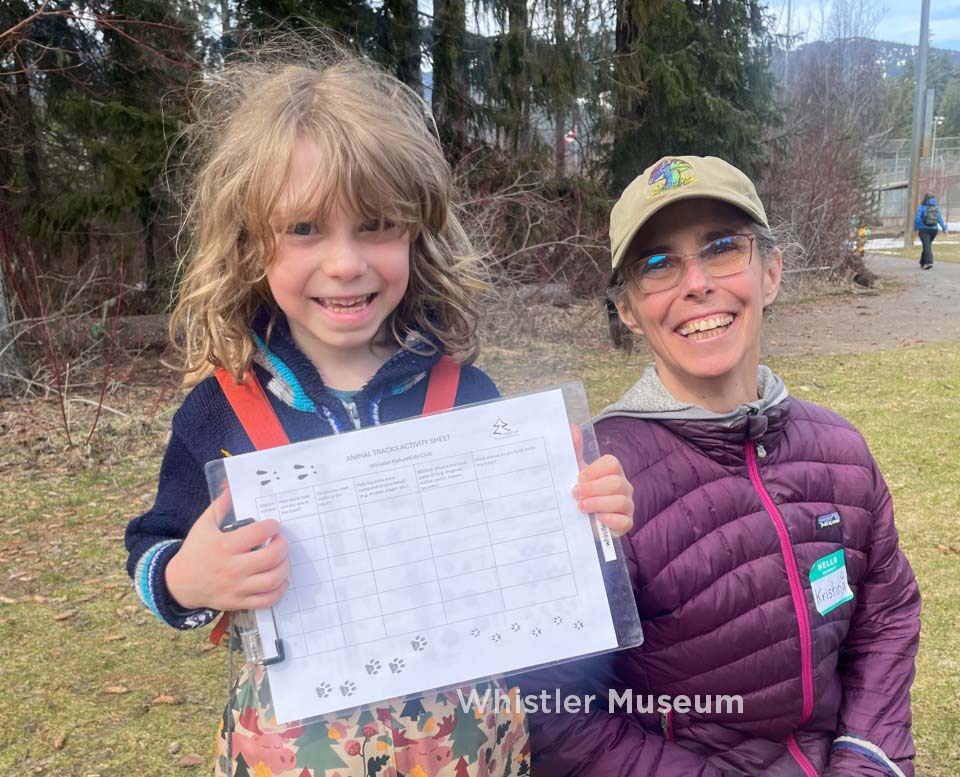
Featured Image: The author with a Whistler NatureKids Club participant. Photo by Ashley Bordignon
“Even a wounded world is feeding us. Even a wounded world holds us, giving us moments of wonder and joy. I choose joy over despair. Not because I have my head in the sand, but because joy is what the earth gives me daily and I must return the gift.”
-Robin Wall Kimmerer
I believe most Whistler residents care about our more-than-human neighbours, such as bears, birds, and berry bushes. I also realize human-driven environmental harm is causing anxiety for many of us, especially youth. A 2023 study found that 78 per cent of Canadian youth reported climate change impacts their overall mental health. How might we address this?
“The environmental crisis is also a crisis of hope,” says Elin Kelsey, author of Hope Matters. When people feel hopeless, they become apathetic. It’s deeply unfortunate that the media tends to focus on environmental crises, which fuel eco-anxiety and apathy, rather than on evidence-based solutions currently underway.
What brings me hope is nature’s capacity to heal itself. Examples include the steady recovery of the ozone layer and the comeback of humpback whales in the Salish Sea. I’m also inspired by people tackling today’s environmental challenges head-on (for examples, see happyeconews.com). I believe together, we have the power to heal our planet and successfully advocate for our neighbours who cannot.
Kelsey’s book helped me understand that “hope is something we do, not something we wait for.” With that in mind, it’s wonderful to see this community helping young people build relationships with the natural world. When youth are inspired to help nature out of love, it transforms anxiety into empowerment.
More good news: small acts of stewardship can create waves of positive change. Hopeful behaviours to model include those in Whistler’s Climate Change Strategy. Also consider advocating for environmental protection at all levels of government; eating plant-based meals—the single biggest way to reduce our impact; and eco-conscious buying.
Finally, it’s encouraging that Whistler’s Priority Habitat Framework, which includes recommendations to help protect important natural habitats, is available to guide land-use planning at municipal hall.
This is the last in a 10-article series highlighting nature to mark the Resort Municipality of Whistler’s 50th anniversary. Check online for references. Thanks for reading.
The Whistler Museum will continue its long-running Discover Nature program this summer, running at Lost Lake on weekdays in June and July with free, drop-in opportunities to explore Whistler’s unique natural history through hands-on displays and conversations with interpreters. The Museum is also offering A Whistler Nature 101 & Interpretation, a three-day course on May 21, 22, and 28, combining classroom learning, field trips, and hands-on practice. More information is available at whistlermuseum.org.