Tag: Rainbow Lodge

Reporting on RainbowReporting on Rainbow

0 Comments

Wartime rationing was nearing its end by the summer of 1947, but for Rainbow Lodge, a renowned romantic honeymoon destination, another type of rationing prevailed. Upon returning from her summer vacation, Pat Wallace reported that it was “poor hunting for husbands at summer resorts”, and that “the chances of nabbing a rich romeo or a plain every-day bread-winner for the future [were] very slim.” 

The lack of romantic prospects did not seem to deter Pat Prowd and Pat Wallace, both reporters for Vancouver newspapers who often journeyed up to Alta Lake. Pat Prowd was a reporter for the Daily Province and the Vancouver News-Herald from 1939 to 1960, while Pat Wallace began her career at the Vancouver Sun before moving to the Daily Province in 1944 to be Women’s Editor, retiring in 1982. Pat Wallace’s sister, Moira, married Pat Prowd’s distant cousin, James McCarthy, in 1951, connecting the two families. James had proposed at Rainbow Lodge at Christmastime 1950.

Christmas 1950, Alta Lake. (Left to right) Pat Wallace, Myrtle Philip, Pat Prowd, Jim McCarthy, Moira Wallace. Philip Collection.

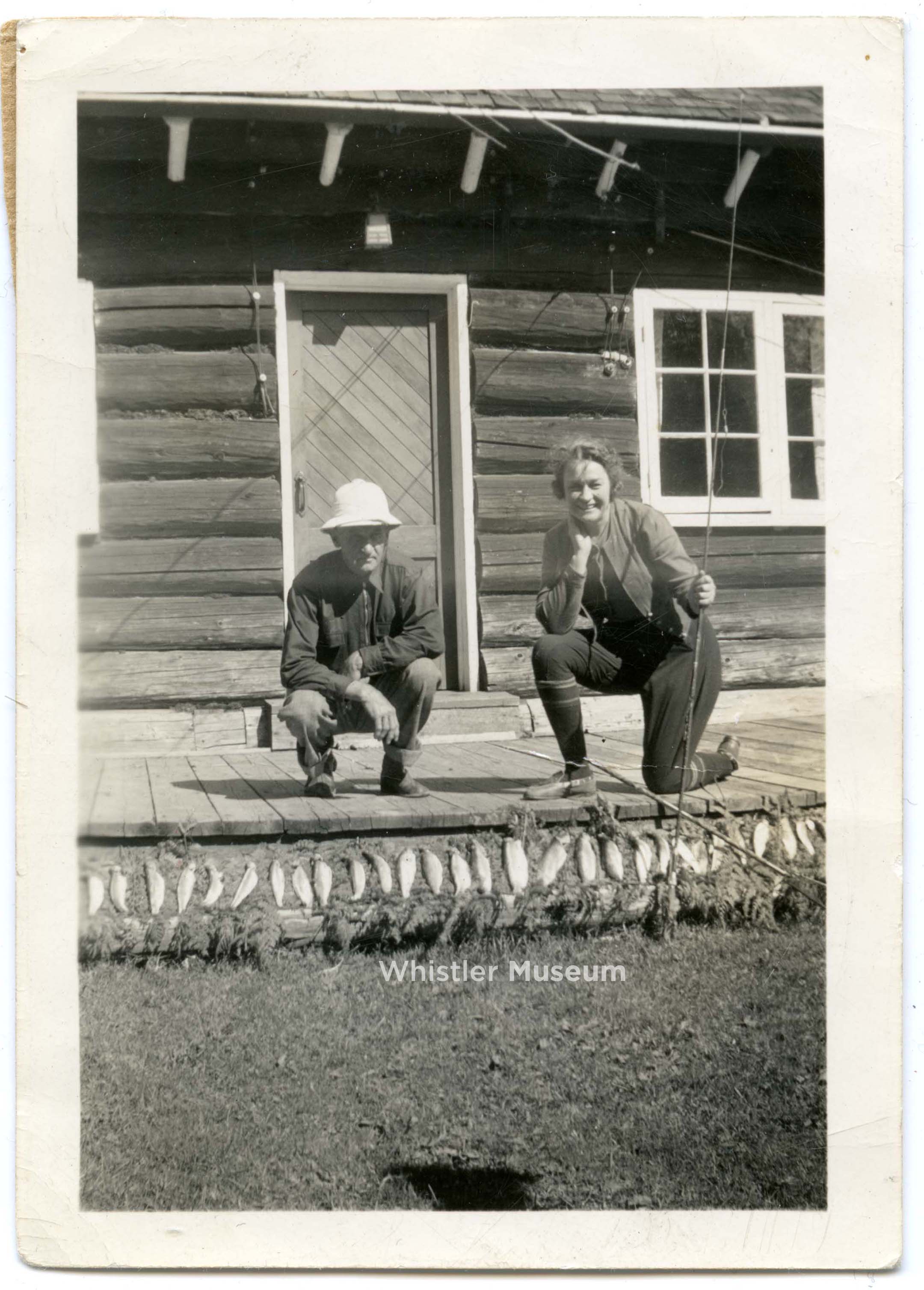
The two women may have been guests at the resort, but they were not afraid of mixing business with pleasure. Pat Prowd in particular “usually lent a hand to Myrtle in the running of the lodge.”  According to Dick Fairhurst, “this meant helping the staff clean the main lodge, cabins, and shower house.” Both journalists documented life at Rainbow Lodge in the 40s and 50s, singing the praises of the lakeside community. 

Pat Prowd and Myrtle Philip standing beside tennis courts at Rainbow Lodge, circa 1940s. Philip Collection.

In August 1947, Pat Wallace’s column, “Urban Album” publicized the ‘Doin’s Club,” a “familiar institution” of Rainbow Lodge. The club embraced the task of greeting guests at the station, their motto being: “don’t wait to be introduced, just smile and say hello.” The club derived its name from Billy Standard, a veteran of the First World War who purportedly first visited Rainbow Lodge in the 20s. Billy became notorious for referring to Worcester sauce as the ‘doin’s’, and the term quickly became “the by-word of the camp that season,” lending its name to a social club.

The initiation ritual? Drinking a teaspoon of Worcester sauce. With some 1600 members initiated by the summer of 1947, it is no surprise that supply of the condiment remained scarce at the resort. 

Myrtle Philip and Pat Prowd cross country skiing, circa 1940s. Philip Collection.

Winter weather did little to discourage either journalist from making the journey up the railway. In fact, Pat Prowd’s March 1950 visit resulted in a “deep suntan to rival anything she might have picked up in Palm Springs.” Her holiday consisted of wintry picnics at Green Lake, with Myrtle building fires in the snow. Myrtle also adapted her “delicious flaky blueberry pie” recipe for the season, adding fresh snow to the ingredient list. Her guests deemed this variation “pure ambrosia.” 

Both reporters spent the holiday season of 1950-1951 at Alta Lake, described as “a winter wonderland of gentle white quiet.” Pat Wallace told the Daily Province’s readers how she was met with “great stars of white” as she disembarked the train at Rainbow Station. The Philips’ house guests danced their way into the new year, dispersing at half past five on January 1st. “High in the mountains,” Pat Wallace wrote, “1951 received a warm hearted welcome bar none.” 

Logan Roberts is the Summer Program Coordinator at the Whistler Museum through the Young Canada Works Program. 

A Rainbow Lodge WranglerA Rainbow Lodge Wrangler

2 Comments

Horses were a vital part of life at Alta Lake in the early half of the 20th century, facilitating transportation, construction, agriculture, leisure, and exploration. David Esworthy, who passed away in 2015, was a highly respected figure in the Canadian equestrian scene whose beginnings can be traced back to Rainbow Lodge. He went on to amass an impressive score of accolades, including president of the Canadian Equestrian Federation and Horse Council BC, and member of the BC Sports Hall of Fame. 

David as a toddler on horseback, held there by Myrtle. Philip Collection.

David was born on January 29, 1929, in Victoria, B.C. His mother, Margaret Esworthy (née Tapley), had travelled to Alta Lake from Maine to help her sister, Myrtle Philip, set up Rainbow Lodge in 1914. Photographs from the Philip collection reveal that David very quickly became acquainted with the lodge’s horses. 

Growing up in the Lower Mainland, David spent summers at Rainbow Lodge. As a teenager, he worked as the lodge’s wrangler. During that era, guests could sign up for early morning trail rides, which meant employees like David rose at 4 o’clock to prepare the horses. Lodge guests could pre-book their breakfast rides to Lost Lake or Green Lake, or opt for midnight trail rides complete with campfires, singing, and toasted marshmallows. 

Margaret Tapley Esworthy holding her son David, on a hill overlooking Rainbow Lodge. Philip Collection.

Moira McCarthy, who tended to the horses with David, remembered how Myrtle once caught them jumping the horses over logs, and the pair received a healthy scolding. Still, a 1974 article in The Province announcing a Rainbow Lodge reunion fondly remembered David as “the summer wrangler [who] had all the young things scrambling to ride along with him when he rounded up the horses at 4 a.m.” 

David as a baby on horseback with his aunt, Jean Tapley. Philip Collection.

After leaving the lodge, David worked on a ranch in the Interior for two years and studied agriculture at the University of British Columbia. In 1949, he married Patricia Howat, and the couple naturally chose Alta Lake as their honeymoon destination. 

Myrtle and David in Vancouver, circa 1940s. Philip Collection.

David, Patricia, their son Philip, and dog Sandy continued to visit Myrtle and would often travel to Alta Lake in the summers. The Alta Lake Echo’s December 18th, 1960 edition described how the Esworthys got stuck on the PGE when a bridge over Cheakamus Canyon caught flame, arriving so late for dinner at the Philips’ that there was no time to help wash dishes before they had to turn around and return home!

Seeking to spend more time with his young family, David joined North Vancouver’s Northridge Riding Club, and soon became its instructor and buyer. For the next fifty years, he dedicated himself to the sport, teaching clinics internationally and serving as judge, a horse show chair and an organizer. He was one of the few Fédération Equestre Internationale stewards to hold tickets in all three disciplines, a director on the Canadian Horse Council, and he assisted in the preparations for the equestrian events in the 1976 and 1984 Olympics in Montreal and Los Angeles. David’s vast resumé of volunteer work was merely in addition to his 40 year career with the Hastings Brass Foundry, the last four serving as president and CEO. 

Alex Philip and great nephew Philip Esworthy.

David was undeniably influential in Canada’s equestrian scene, and, if stories of his indomitable aunt are to be believed, he certainly came by his penchant and inclination towards horses honestly!

Logan Roberts is the Summer Program Coordinator at the Whistler Museum through the Young Canada Works Program.

Creating Whistler’s Parks: Rainbow Park, appropriate to expropriateCreating Whistler’s Parks: Rainbow Park, appropriate to expropriate

0 Comments

The Whistler Question wrote in 1980, “The Municipality has reviewed the opportunities in the Alta Lake area and without expropriation or purchase of private land property, the recreational opportunity in the Alta Lake area for swimming, especially a beach area for young children, is extremely limited.”

It was clear all along that more public access was required for Alta Lake and the Resort Municipality of Whistler (RMOW) had been looking into buying lots on the foreshore of the lake to turn into parks. When Drew Meredith became Mayor in 1986 the council started to think bigger than buying single-family lots, and Rainbow Lodge caught their attention.

Rainbow Lodge, where Rainbow Park is now located, had a long history of tourism. Myrtle and Alex Philip opened the popular vacation destination for summer visitors in 1914. Then in 1948, they sold Rainbow Lodge to the Greenwood family where it continued as a summer resort. In its heyday Rainbow Lodge contained over 40 buildings, including a main lodge, post office, stables and many cabins.

Rainbow Lodge and surrounding facilities, ca 1930. Philip Collection.

Rainbow Lodge was sold to Joan Saxton, a speculator from Vancouver, in 1970. Resort operations ceased in the early 1970s, however, people could still rent rooms and cabins on a more long-term basis. Disaster struck in 1977 when the main lodge burnt down during renovations, and by 1986 many of the remaining buildings had fallen into disrepair.

Whilst Whistler had gone through a period of booming development throughout the 1970s and 1980s, Rainbow Lodge remained rather unchanged. Joan Saxton said during the expropriation in 1986, “Pat Carleton said he wanted to get the town centre going, and then after that it would be my turn. They’ve down zoned me and put me off the sewer system.” In Saxton’s eyes this unfairly reduced the value of the land, and the RMOW and Saxton could not come to an agreement on purchase price.

The RMOW had the land appraised twice, and then went to the Provincial Government where they received permission to expropriate the land for public interest. In 1987, the 43.2 hectare (108 acre) parcel of land on Alta Lake was expropriated for $367,000.

The lakeside cabins at Rainbow Lodge. Philip Collection.

If the owners had been living on the property the expropriation process may have been more difficult, but the Saxtons lived in the city and rented out some of the remaining cabins. Many of these buildings were in rough shape and had to be demolished when the area became a park. Three of the cabins were preserved for historical value, however, and you can still see these in Rainbow Park today.

Three remaining guest cabins at Rainbow Park. Photo courtesy of Jeff Slack.

The park was quickly developed, opening for public use during the summer of 1987. Early improvements to the property included creating a pedestrian crossing over the railway, building up the marshy pathway which was often flooded, and clearing vegetation from the sandy beach. Open wells that had been used for the lodge were filled in, the parking was cleared, and picnic tables added. The beachfront and facilities continued to expand and the park quickly reached the goal of becoming the top beach park in Whistler.

While the council at the time believed the deal was signed and done, the story of Rainbow Park does not end there. In what would become one of the longest lawsuits the RMOW has faced to-date, the Saxton family continued to fight for further compensation. They argued that the land appraisals were not taking into account the size and development potential of the property.

In 2012, the decades-old dispute was finally settled with the judge ordering the RMOW to pay an additional $2.4 million to the Saxton family, valuing the land at $12,000 an acre, comparable to the value of the Nicholas North lands in the early 1990s. With hindsight, the land was revaluated to $1.3 million dollars, and the RMOW was required to pay the difference, plus an additional $1.5 million for unpaid interest.

While Drew Meredith disagreed with judgement, he said Rainbow Park was worth it even at $2.4 million. With the number of people enjoying the sunshine recently, I tend to agree.

Rainbow Park in September 1990. Griffith Collection.

Alta Lake DancesAlta Lake Dances

0 Comments

Before the ski resort brought power and paved roads to the valley, and it was renamed Whistler, Alta Lake was a fairly small and remote town. Without developed roads it could be hard getting around and residents from opposite sides of the valley rarely crossed paths. One thing that would bring the community together, however, was the Alta Lake dances. While the music and location of the dances varied over the years, fond memories are recounted by many people that visited or called Alta Lake home.

Fred and Elizabeth Woods lived in Alta Lake with their children from around 1926 until the 1940s, and during this time their family band was the staple entertainment at dances and community events. Dances featuring the Woods family band helped raise money for the first Alta Lake School, which children Helen, Pat, Jack and Kenneth Woods attended. When the one room schoolhouse was built in the 1930s it doubled as a community hall where regular dances continued to be held.

Pat Woods was quite young when he started playing at the Alta Lake dances with his family. “We used to load the toboggan with the guitars, accordion, and a violin. We’d ride the toboggan down to the dance hall, play crib, then make some music. We weren’t very old then, but everybody was up dancing. We were 9 or 10.”

The Woods family band played at community events, such as dances and fundraisers.

Almost everyone was up dancing. School desks were pushed to the side for the dances and really young children would sleep through the event under the desks. The schoolhouse, like most buildings, was lit by coal oil lamps. When the home waltz started and the lamps turned off it was time to bundle up and head home.

Kenneth Farley’s family came to Alta Lake in 1943, after the Woods family band had moved on. “The music was the wrangler,” recounted Kenneth. “Philip’s wrangler looked after the horses. He played a fiddle and he would keep the time with the heel of his cowboy boots to set the pace, while the whisky in his back pocket would be sloshing away. You didn’t need to be able to dance because it was so crowded you could hardly move.”

Alta Lake School doubled as the community hall where dances were regularly held. Philip Collection.

For those living along the lake, the festivities started before arriving at the dance. A boat with an outboard motor would start at the north end of the lake, picking up everyone in rowboats on the way past. By the time they arrived to the dance there would be a long string of boats pulled along behind the motorboat.

John Burge first came to Alta Lake in 1956 and spent the summers here while growing up. Not quite the same as the dances you’ll find at Garfs or The Longhorn today, he remembers learning the foxtrot, waltz, schottische and polka from Florence Petersen. “We just learned all these dances and people did them. It was a fun time.”

John started working at Rainbow Lodge when he was around 13 and after working for five summers he had saved enough money to pay for university. One of his jobs was to wax the floors after the Saturday night dances held in the Rainbow Lodge dining room, which could be attended by up to 100 people. By then Rainbow Lodge was owned by Alec and Audrey Greenwood, who had bought the lodge from Myrtle and Alex Philip when they retired in 1948. The lodge was made of wood and the whole building would dance, with the deteriorating wood floor bouncing up and down as much as six inches as people boogied.

The dining room at Rainbow Lodge. Philip Collection.