Tag: Lost Lake

We almost lost Lost Lake Park!We almost lost Lost Lake Park!

0 Comments

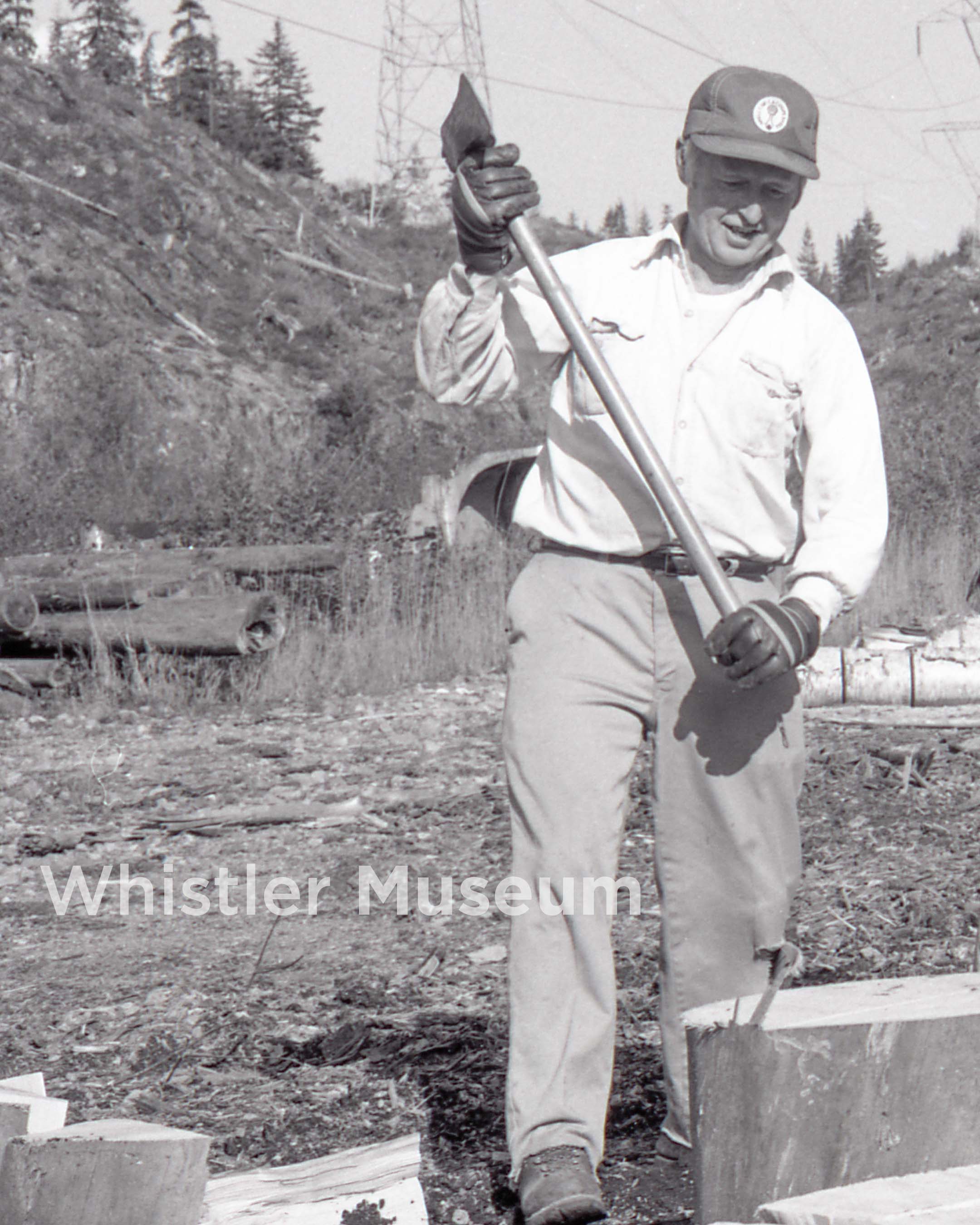
Photo credit: Don MacLaurin volunteering with the Whistler Rotary Club. 1984. Whistler Question Collection

If you want to believe that the world is terrible, watch the news. If you want to believe that the world is incredible, spend time in nature.” – Austin Perlmutter

It’s hard to imagine Whistler without Lost Lake Park, our largest and most natural municipal park. However, the creation of the park was not a certainty. In the 1930s, as tourism in Whistler (then Alta Lake) grew, guests at Rainbow Lodge (located at what is now Rainbow Park) were taken on excursions to Lost Lake for swimming, fishing, and picnics. However, in the 1940s the Lost Lake area shifted from recreational to industrial. During the next twenty years most of the surrounding forest was logged, while the Great Northern Mill operated on the north shore of Lost Lake.

In the early 1960s residential development was proposed. The timber licenses straddling Lost Lake were about to expire, and developers started staking out lots and preparing to apply for waterfront property. Keep in mind: this was 15 years before the Resort Municipality of Whistler (RMOW) was created, so it took someone with vision and determination to ensure this beautiful natural playground could be enjoyed by the entire community and visitors.

Don MacLaurin: Bridge builder

Whistler was very fortunate that Don MacLaurin (1929-2014) made Alta Lake his summer home in the 1960s. Don was a forester for the BC Forest Service and later an instructor at BCIT (British Columbia Institute of Technology), teaching courses in forestry and parks management. He was also a tireless volunteer and mentor. Don strongly believed in the value of getting into the mountains, and he championed the summer enjoyment of Whistler’s landscape.

Don was able to navigate the complicated relationship between industry and recreation. “Don was living and teaching sustainability before the term was invented. [He] was the bridge builder, the guy who looked at both the economics and the ecology,” recalled Arthur DeJong in a 2014 Pique article.

Don was the driving force behind preserving the Lost Lake area as a park. With the help of his contacts at BC Parks, he was instrumental in ensuring Lost Lake Park was designated as a park, preventing privatization and preserving the space in perpetuity. Lost Lake Park opened officially in 1982.

It’s no surprise that today, Lost Lake Park is cherished for opportunities to conserve and appreciate nature. Every year I am filled with hope when I see how the community comes together to protect thousands of tiny Western Toads as they migrate from Lost Lake to the forest. The RMOW leads toad stewardship with permanent features such as signage, fencing, underpasses (for the toads!), and staff expertise. The Museum runs the Discover Nature program at Lost Lake Park, and we often hear that learning about and moving toads away from danger is a favourite activity. I know Don would be pleased!

Lost Lake trails today. RMOW map.

We can thank Don for more than Lost Lake Park

Don worked as an advisor to the RMOW in the 1980s. When the forestry industry planned to clearcut the south side of Whistler Mountain, which is the first thing everyone sees when driving to Whistler from the south, Don and the council of the day fought back and got that logging license moved. Similarly, when the Ancient Cedars (just north of Whistler) were threatened with logging in 1988, that license was also moved due to Don’s persistence, persuasion and advocacy by the Western Canada Wilderness Committee.

Don also worked tirelessly on planning the Whistler Interpretive Forest. He mapped and developed the trails and helped people understand the forest and its importance. The suspension bridge spanning the Cheakamus River is called MacLaurin’s Crossing, a fitting tribute to this influential bridge builder.

Lake Fun in WhistlerLake Fun in Whistler

0 Comments

Whistler’s lakes offer a variety of water-based activities and are a great place to cool off during the summer heat. From sailing regattas and floating art galleries to swim races and a quadrathlon, Whistler’s lakes have seen it all!

The Alta Lake Sailing Club’s annual season end “Regretta” included sailing races as well as land-bound activities for participants of all ages. The first ever “Regretta” was hosted in the summer of 1965 and was named after the regret the community feels as the summer comes to an end. Today, the Whistler Sailing Association offers sailing programs, rentals, and races throughout the summer. Alta Lake and Green Lake permit motorized boats; however, on Alta Lake they must be kept under 10 horsepower. Non-motorized boats such as pedal boats, kayaks, canoes, and standup paddle-boards are welcome on all of Whistler’s lakes.

Participants in the Great Snow Earth Water Race rush out of the water. Whistler Question Collection, 1980

On Victoria Day, 1975, the Great Snow Earth Water Race first started. The first leg of Whistler’s version of the relay race included skiing from the top of Whistler Mountain, then running the remaining distance to today’s Creekside where the first baton pass-off took place. The next leg was a bike ride around Alta Lake where the baton was passed to the group’s canoe team. The canoeists then paddled through the River of Golden Dreams to the first weir and passed the baton to a runner who completed the race by running all the way back to Creekside. The 2014 revision of the race included an extra three components: ski or snowboard touring, downhill mountain biking, and cross-country biking. Unfortunately, the last Great Snow Earth Water Race took place during the 1990s.

Windsurfers on Alta Lake in August 1981. George Benjamin Collection

Through the 1970s and early 1980s, windsurfing at Alta Lake became very popular. Whistler was home to multiple windsurfing regattas as well as a weekly race night. Participation eventually declined due to lack of availability of the equipment and legal issues. Windsurfers on Alta Lake were a concern for those participating in the Fun Fitness Swim Race in the 1980s. After a swimmer and windsurfer collided (both were ok!) the swim race was moved to Lost Lake. The Fun Fitness Swim Race was roughly a mile and a half long and was offered as a community fitness event rather than a competitive race. The swim race took place from 1979 until the early 1990s.

Today’s water-bound activities include paddling across Alta Lake and through the River of Golden Dreams. This route takes visitors past old growth trees, through lush scenery, and offers breathtaking mountain views. A round trip takes roughly 3 hours and can be completed in a kayak, canoe, or on a paddle-board. Tours can be booked or self-guided depending on skill and comfort level. Alta Lake is also home to Art on the Lake, which includes local artists, live music, and a floating art gallery. One of Arts Whistler’s more recent annual undertakings, the first Art on the Lake event was organized four years ago as a way to host an arts event during the pandemic. This event takes place in August and is accessible by boat, kayak, canoe or paddle-board.

A group (who appears to have forgotten their lifejackets!) paddle down the River of Golden Dreams. Whistler Resort Association Collection

Keep an eye out more more information on local lake activities to participate in this summer. Remember your sunscreen and towel for every lake day adventure!

Ella Healey is the Summer Program Coordinator at the Whistler Museum through the Young Canada Works Program.

(Nordic) Ski Racing in 1980(Nordic) Ski Racing in 1980

0 Comments

While the Alta Lake Sports Club (ALSC) was founded in 1975 to “organize and encourage participation in outdoor sports at all levels of ability in the Whistler area and beyond,” in the winter months the ALSC was all about cross country skiing. Members organized events in Whistler and competed in races with other clubs around the province, although they got off to a rocky start in the winter of 1976/77 when a particularly mild winter forced one event after another to be cancelled or moved to Manning Park. By 1980, however, the ALSC was consistently hosting multiple races each season and the first few months of the year were busy ones for the members.

In January 1980, members of the ALSC travelled to 100 Mile House to take part in the Cariboo Marathon, a 50km race with 1,500 competitors that took place in “extremely cold” and “frigid” temperatures according to the report in the Whistler Question. The ALSC was well represented in the women’s division of the Marathon, with members Joan McGrath, Loreen Barnett and Betty Ann Hopner taking first, second and fourth places. Catherine Gaarder and Jenny Busdon, both ALSC members, provided a picture-perfect finish after meeting at the 15km mark and cross the finish line with their hands together after 5 hours and 10 minutes.

Competitors cross the bridge during the ALSC and Labatt’s annual meet. Whistler Question Collection, 1980

ALSC members did not far so well in the men’s division, where the Finlandia Club from Vancouver swept the first five spots. Some members were out with injuries or working out of the country while others ran into difficulties during the race. Al Fisher, the ALSC coach, ended up in the trees around the 20km mark, was knocked unconscious, broke his nose, recovered, and made it to the finish line in 13th place. Both he and Nello Busdon ended up at the hospital with frostbite.

On February 10, the ALSC and Labatt’s hosted their annual meet on the trails around Lost Lake with a 25km course for racers and a 12km course for tourers and “youngsters.” The ALSC was well represented in both divisions this time, with McGrath again coming first in her category and Dan McDonald placing third in his, behind two members of the Finlandia Club.

Later that month, ALSC members competed at the BC Championship Cross-Country Ski Meet held in Manning Park, where they came second in the 3x5km relay (coming in just behind the Finlandia Club team).

Kauko Puscnius of the Finlandia Club receives his first place medal from Al Fisher as Labatt’s Terry Burns looks on. Whistler Question Collection, 1980

The last big race that year for the ALSC was the 4th Annual Fischer Cup, again held around Lost Lake. The rain and warm weather before the race had some members wondering if the race would go ahead, but according to Jenny Busdon, “We are an optimistic bunch and one thing our Club never does is give up!” The race director Jim Bishop took three days off from his work in the city and spent two days shovelling with other members to build a new course that eliminated previous problem areas that caused “scenes of absolute bedlam” whenever one skier went down. In the end, the 15km course was in “fantastic” condition for the race.

A skier comes down water tower hill in the Fischer Cup. Whistler Question Collection, 1980

At this last race of the season, McDonald took first, finally coming ahead of the “seemingly unbeatable Finns.” The event also included an elementary age race where new ALSC skiers, some of whom had only tried the sport a few times before, got a taste of competition over 5km.

The Fischer Cup was followed by a medals ceremony, prizes from Fischer, Labatt’s, Andres Wine, the Highland Lodge, and Molson, and a dance at the school, where the social aspects of belonging to a club took precedence over the competition.

Through the 1980s, the ALSC hosted fewer skiing events as the newly formed Whistler Nordic Ski Club grew. Last night (Monday, February 5) we had a great time learning about Nordic skiing and the Whistler Nordic Ski Club from Tom Barratt, Keith Bennett and Stephanie Sloan and heard some amazing stories. Thank you to everyone who came out to our first Speaker Series of 2024 and we hope to see you at our next events!

The First Fun Fitness SwimThe First Fun Fitness Swim

4 Comments

After arriving in Whistler in August 1974 on a year’s leave from teaching that became multiple seasons, BJ Godson filled various roles in the growing community, from bartender at establishments such as the Highland Lodge to the creator of the Ski Friends program on Whistler Mountain. During her time in Whistler, she also founded Whistler’s annual Fun Fitness Swim.

According to BJ’s mother, she began to swim at the age of one, even before she started walking. She continued to swim and, in 1979, her boyfriend at the time suggested that she organize a swim in the area because she was “such a good swimmer” and “loved to organize things.” This led to the first Fun Fitness Swim, a fun distance race of about a mile and a half (about 2.4 km) in Alta Lake on August 19, 1979.

A smiling BJ Godson presents a swimming prize to Sheila Peters while Denver Snider looks on. Whistler Question, 1979.

BJ’s time working at the Highland Lodge had introduced her to Roy Adams, a representative of Molson’s, and he agreed to have the company sponsor the event. Thanks to this sponsorship, every participant in the race was guaranteed a t-shirt and drinks, and bananas and chocolate were available to those who needed it during the swim. Local resident Chico made trophies for the first place winners and local businesses donated prizes for a draw.

Rather than focusing on the competition of a race, this event was described by the Whistler Question as “a community event to encourage fitness” and was open to everyone over the age of 19. Thirty-seven swimmers left Wayside Park in one minute intervals, led by BJ and heading for the docks at Adventures West. Volunteers in rowboats and canoes were recruited to help any struggling swimmers and spectators were encouraged to come cheer. The race was followed by an afterparty at the Christiana Inn with refreshments provided by Molson’s and members of the Alta Lake Community Club. The first two winners were Rick McFadden at 41:25 and Meg Fellowes at 44:00, both of whom were reportedly so cold after the race that they didn’t make it to the afterparty.

Participants for one of the early Fun Fitness Swims. Photo courtesy of BJ Godson.

The first Fun Fitness Swim was such a success that the second year went ahead with almost full registration even though the weather was wet, cold and windy. The course changed a few times over the first years until the Fun Fitness Swim moved to Lost Lake in the mid-1980s. According to BJ, one of the main reasons for moving to Lost Lake was the danger of windsurfers on Alta Lake.

Though the windsurfing club and local windsurfers were asked to stay out of the swim course for a couple of hours during the race, there was little they or organizers could do about visiting windsurfers or those who didn’t get the notice. One swimmer in the 1982 event even recalled colliding with a windsurfer. The Question reported his comments, saying “I hit one. He was a beginner. He fell and couldn’t get out of the way. I didn’t see him and – bang – I ran into him.”

Swimmer Shelley Warne heads from Wayside Park to the Alta Lake Inn and back under the watchful eye of Marilyn Moore, who dusted off her bathtub derby craft for the occasion. Whistler Question Collection, 1984.

Though the event continued to focus on encouraging participation rather than competition, swimmers still swam to the best of their abilities and BJ remembered one participant in particular demonstrating their athletic ability. According to BJ, she was swimming around Lost Lake when “all of a sudden, there’s somebody passing me a high clip, swimming so fast they made a little wake.” She soon realized that she had been passed by Dawn Titus, which was particularly annoying as Dawn had had a cast on her leg until just a couple of weeks before the swim.

The Fun Fitness Swim continued to take place at Lost Lake without windsurfers and under BJ’s leadership, with help from other organizations, until 1989, when her friend Cindy took over the organization. Molson’s continued to sponsor the event until the last Fun Fitness Swim was held in the early 1990s.