Tag: Alta Lake

The original Black Tusk Snowmobile ClubThe original Black Tusk Snowmobile Club

0 Comments

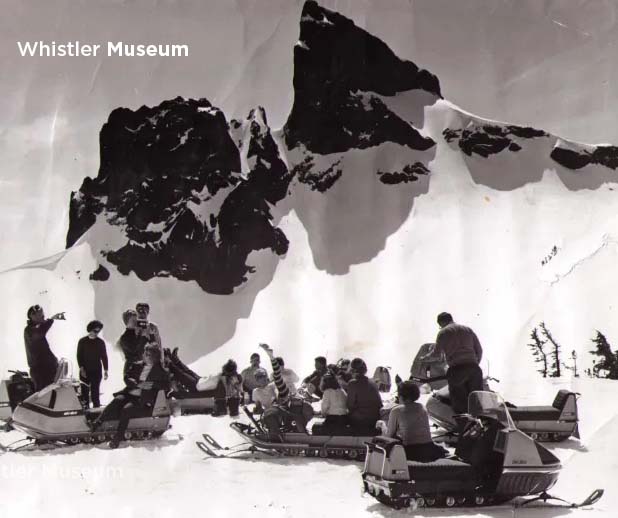
Feature Image: Snowmobilers take a break in front of Black Tusk. Judging by the sleds, this is probably from the early 1970s: however, unfortunately we do not have any details about this archival photograph.

This year 60 is a big number. 

Whistler Mountain is celebrating its ‘diamond jubilee’. 

Another sixtieth anniversary of note is the formation of the first local snowmobile club, on the opposite shores of Alta Lake.

The inaugural meet-up and race of the lower mainland-based BC Snow Vehicle Association was also held on Alta Lake, at the end of January, sixty years ago. 23 people competed in the event and the winner of the 20 gate, large machine slalom course was won by local Dick Fairhurst: completing the run in a whopping 39.9 seconds.

Dick Fairhurst was one of the ‘westside gang’ – a band of early residents – who called themselves the Black Tusk Snowmobile Club. The club (whose numbers are hard to confirm) would venture out and among the surrounding peaks, including Rainbow, Sproatt and up into the Callaghan. 

From R-L, Dick Fairhurst, Gray Mitchell, Stephan Ples, and Don Gow take a break on Callaghan Lake, March 1970. The entire upper Callaghan Valley, including Callaghan Lake, is now a non-motorized zone to avoid conflicts with backcountry and nordic skiers.

Dick – a logger and trapper of Cypress Lodge fame (now the site of the Point Artist-Run-Centre) and creator of the valley’s first ski ‘tow rope’ in 1960 – was one of the three founding members of the snowmobile club, along with Don Gow and Glen Creelman. Together, the three became the area’s first distributors of Bombardier Ski-Doos.

Don Gow moved here in 1955. He stayed and was the station agent at Alta Lake for four years, up until the train’s scheduled stop (in operation since 1914) was demoted to simply a ‘flagstop’ in 1959. However, the area’s appeal and pull was strong, and Don returned to Alta Lake in 1965 (along with his wife, who became the postmaster and their two children). They lived here until 1975.

Glen Creelman was a microwave technician. In 1957, BC Telephone Co. installed a double copper line around Alta Lake. Glen was responsible for establishing an open circuit/party line – linking lodges and homes with this new thread of communication. One was able to lift the receiver of the old crank telephones and listen in on your neighbour’s conversations. 

And surely, at that time, part of the talk of the town was the growing popularity and access to motorized sleds…

From up the Callaghan Valley. Fairhurst Collection.

Bombardier pioneered the development of the snowmobile. In 1966 – the year the Black Tusk club was formed; the year Dick won the inaugural BC Snow Vehicle Association race; and the year Don, Glen and Dick began selling the machines to the Alta Lake Community – the Canadian company released a line of three machines with “new, super slick styling.” The models included the ‘New Alpine,’ the ‘Olympique’ and the ‘Super Olympique.’ The latter was what Dick won the race on. The 250 lb machine had a roller chain in oil bath drive, the patented Bombardier track and was 2.36 metres in length. It was also bright yellow. 

Dick Fairhurst with sled-groms in front of Cypress Lodge (now The Point Artist Run-Centre) — on a neighbour’s sled, Ron Dent’s “Dentmobile” in 1965.
Fairhurst Collection.

Snowmobiling – or sledding, as it is more colloquially referred – remains as popular as ever as a thrill-seeking, backcountry sport. Handling has been honed and the horsepower hiked… but the same spirit seeking freedom, fast movement and further access prevails.  

Not all who sled are members of a club, but other regional groups now exist. The Powder Mountain Snowmobile Club has been operating since 1990. The Pemberton Valley Snowmobile Club was officially incorporated in 2000, but sledding stories in the area far precede that date, too

As for the Black Tusk Snowmobile Club, it ‘still’ exists, however its base now operates out of the Brohm Ridge former ‘Rat-Pack’ chalets. This particular incarnation of the club dates their inception to 1971. Records of how the Alta Lake-based group either entirely dissolved or transitioned to the current location are perhaps best described as being frozen in two-stroke time…

Time for Tea (treats, tales … and a tow rope!)Time for Tea (treats, tales … and a tow rope!)

2 Comments

Enjoying a cup of tea is a sanctified ritual for many… and Whistler’s past is steeped in its own lore and tradition with two pioneering tea houses (both with a twist!).

Before the advent of Whistler Mountain being developed as a ski destination (officially opened in January 1966), many early residents of the area predominantly lived on the opposite shores of Alta Lake. The Pacific Great Eastern railway line began running lakeside in 1914 and Rainbow Lodge, the first vacation destination, opened in 1915 as a fishing resort. 

Harrop’s Tea Room on Alta Lake, circa 1930.

In the 1920s, Bert Harrop purchased the point of land in the middle of the west side of Alta Lake. He had originally come to the area as a guest of Rainbow Lodge, whereupon his asthma improved greatly during his short stay. Enamored with the place, he and his wife Agnes first moved into a rented cabin and then into their own home – which Bert framed on the shores of Rainbow Lodge (with the help of the proprietor’s father) and floated it on a raft of cedar logs down to his new piece of land. It was secured to the shore and became a floating cottage. 

On the water’s edge, Bert built a building with a large porch which was supported by log piles in the lake. Harrop’s Tearoom was born and Agnes went into business.

Every summer, Betty Jane and Claudia visited the Harrop’s tearoom where they had a floating cottage right on Alta Lake.

Guests, made up of visitors and locals alike, would, arguably, come more for the gossip than the tea… and the fortune telling. Agnes had a designated indoor tea-leaf reading room (the accuracy or aftermath of her predictions remain undocumented!), infusing the experience and take-away of customers. Outside, people would gather on the floating verandah, enjoying afternoon tea amidst expansive views.

The Harrops Tearoom came to an end in 1948, when the couple sold the venture and moved on.

Six years later, in 1955, a new tearoom opened in Cypress Lodge (the site of the current Point Artist-Run-Centre). The lodge was built by Richard (Dick) Fairhurst, in the late forties/early fifties as a fishing camp. The buildings boasted electricity supplied by a generator and then later were powered by waterwheel, a novelty at the time. 

Dick’s mother, Elizabeth Alice, came up from Vancouver to run the tearoom. Noted as being a ‘colourful character’, Ma Fairhurst was equally famous for her beloved butter tarts. Besides baking, Elizabeth Alice cleaned the cabins, did the laundry and took care of the cooking for guests, while Dick was either tending his traplines in the Spearhead Range or logging with one of the nearby operations. 

A trademark of the tearoom was its ‘Hot Dog Friday Night’ which gathered many. Friday was synonymous with the once-weekly delivery of fresh food and meat by refrigerated train car to the community, and the occasion was worthy of celebration. 

Cypress Lodge also boasted the first tow-rope in the area. Built in 1960, a Ford V8 motor was used to pull 259 metres worth of rope through four pulleys affixed to four towers. The first downhill-only ski course in Whistler had been created on the slope directly behind the camp of cabins. Guests could come in from skiing for something sweet or grab tea and then go for a tow!

The Cypress Lodge tearoom closed 7 years after its inception, in 1962 to make room for more buildings, much to the dismay of the community.

Cypress Lodge as seen from the lake. Fairhurst Collection.

In the still-standing, main building of the original Cypress Lodge, the tradition of meeting over tea and treats, is being continued by the Point Artist-Run-Centre with its weekend Creative Café (www.thepointartists.com) … where, undoubtedly, here too, a few gems of local gossip get shared in fine, long-standing community fashion!

Reporting on RainbowReporting on Rainbow

0 Comments

Wartime rationing was nearing its end by the summer of 1947, but for Rainbow Lodge, a renowned romantic honeymoon destination, another type of rationing prevailed. Upon returning from her summer vacation, Pat Wallace reported that it was “poor hunting for husbands at summer resorts”, and that “the chances of nabbing a rich romeo or a plain every-day bread-winner for the future [were] very slim.” 

The lack of romantic prospects did not seem to deter Pat Prowd and Pat Wallace, both reporters for Vancouver newspapers who often journeyed up to Alta Lake. Pat Prowd was a reporter for the Daily Province and the Vancouver News-Herald from 1939 to 1960, while Pat Wallace began her career at the Vancouver Sun before moving to the Daily Province in 1944 to be Women’s Editor, retiring in 1982. Pat Wallace’s sister, Moira, married Pat Prowd’s distant cousin, James McCarthy, in 1951, connecting the two families. James had proposed at Rainbow Lodge at Christmastime 1950.

Christmas 1950, Alta Lake. (Left to right) Pat Wallace, Myrtle Philip, Pat Prowd, Jim McCarthy, Moira Wallace. Philip Collection.

The two women may have been guests at the resort, but they were not afraid of mixing business with pleasure. Pat Prowd in particular “usually lent a hand to Myrtle in the running of the lodge.”  According to Dick Fairhurst, “this meant helping the staff clean the main lodge, cabins, and shower house.” Both journalists documented life at Rainbow Lodge in the 40s and 50s, singing the praises of the lakeside community. 

Pat Prowd and Myrtle Philip standing beside tennis courts at Rainbow Lodge, circa 1940s. Philip Collection.

In August 1947, Pat Wallace’s column, “Urban Album” publicized the ‘Doin’s Club,” a “familiar institution” of Rainbow Lodge. The club embraced the task of greeting guests at the station, their motto being: “don’t wait to be introduced, just smile and say hello.” The club derived its name from Billy Standard, a veteran of the First World War who purportedly first visited Rainbow Lodge in the 20s. Billy became notorious for referring to Worcester sauce as the ‘doin’s’, and the term quickly became “the by-word of the camp that season,” lending its name to a social club.

The initiation ritual? Drinking a teaspoon of Worcester sauce. With some 1600 members initiated by the summer of 1947, it is no surprise that supply of the condiment remained scarce at the resort. 

Myrtle Philip and Pat Prowd cross country skiing, circa 1940s. Philip Collection.

Winter weather did little to discourage either journalist from making the journey up the railway. In fact, Pat Prowd’s March 1950 visit resulted in a “deep suntan to rival anything she might have picked up in Palm Springs.” Her holiday consisted of wintry picnics at Green Lake, with Myrtle building fires in the snow. Myrtle also adapted her “delicious flaky blueberry pie” recipe for the season, adding fresh snow to the ingredient list. Her guests deemed this variation “pure ambrosia.” 

Both reporters spent the holiday season of 1950-1951 at Alta Lake, described as “a winter wonderland of gentle white quiet.” Pat Wallace told the Daily Province’s readers how she was met with “great stars of white” as she disembarked the train at Rainbow Station. The Philips’ house guests danced their way into the new year, dispersing at half past five on January 1st. “High in the mountains,” Pat Wallace wrote, “1951 received a warm hearted welcome bar none.” 

Logan Roberts is the Summer Program Coordinator at the Whistler Museum through the Young Canada Works Program. 

Wartime by the LakeWartime by the Lake

0 Comments

Last year marked the 80th anniversary of D-Day, the Allied land invasion of Normandy which initiated the liberation of Europe from the Nazi regime. The Second World War managed to disrupt Alta Lake’s idyllic summers, and for one of its longtime families, June 6th, 1944 would prove to be especially memorable.  

Margaret Bellamy (née Clarke) was born in 1946 and started journeying up to Alta Lake with her family a few weeks later. Her grandmother, Grace Woollard, had first arrived at Alta Lake along the Pemberton Trail in 1912 with her friend, Grace Archibald, and her brother, Ernie Archibald, who was working for the Pacific Great Eastern Railway. 

In an oral history from 2012, Margaret recounted how her mother, Betty Clarke (née Woollard) and father, Douglas Clarke, spent summers at Alta Lake growing up. Their fathers were colleagues at the Shaughnessy Military Hospital, and the two families had become good friends. Betty was Alta Lake School’s second teacher, replacing Margaret Partridge in 1936. After Betty and Douglas’ marriage in 1941, Douglas departed for the war, and Betty decided to buy a cabin at the south end of Alta Lake, rather than stay in Vancouver. Wanting to be closer to her daughter and grandchild, Grace Woollard sold her cabin on the east side of the lake, and purchased a neighbouring cabin at the southern end.

Betty and her sister Eleanor along the tracks at Alta Lake. Lundstrom Collection

Prior to her father’s 33rd birthday on June 6th, 1944, soon to be cemented in history as D-Day, Margaret’s mother sensed something major was about to occur concerning the war. She knew that her husband had been stationed in the south of England for “months and months and months and months” and Vancouver newspapers had long discussed an impending invasion, but no one knew when or where this assault would take place. Although Margaret was not born until 1946, she shared her family’s memories of the day as they were later told to her.

The first Canadian soldiers landed on Juno Beach just before 10 pm Vancouver time on June 5th. The Germans reported the amphibious assault on Normandy at 9:37 pm Vancouver time, and Allied sources would later verify the accounts. As news of the invasion finally crackled through the radio, Betty had no indication as to whether her husband was involved in the battle. 

While casualties and updates came through, Margaret described how her older sister Susanne, then a toddler, dropped her beautiful Cowichan sweater down the outhouse. With tears running down her face, Betty fished the soiled sweater out with a stick. She brought it down to the lake to rinse it out, all while frantically trying to listen to the radio. Very little information was coming through, and the short clips that were audible were followed by twenty minutes of maddening static. 

“It was a bad day. And all this being my father’s birthday,” said Margaret. Thankfully, her father survived the war and would have many more birthdays, passing away in 1986 at the age of 74. His ashes were spread at Alta Lake.

Logan Roberts is the Summer Program Coordinator at the Whistler Museum through the Young Canada Works Program.