Author: Whistler Museum

Collecting, preserving, documenting and interpreting Whistler's natural and human history. Want to learn more about Whistler's culture and history? We showcase Whistler's history: pioneers, skiing on Whistler & Blackcomb Mountains, Olympics and black bears. Family fun, interactive exhibits, children’s activities. Great for a rainy day!

Whistler Weasels into Business: Mink, Marten and Mountain Movers Whistler Weasels into Business: Mink, Marten and Mountain Movers 

0 Comments

Feature Image: Nita Lake Fur Farm owner Russell Jordan moved to the area in 1915. Photo: Whistler Museum Collection.

One hundred-and-one years ago, the first fur farm was established in Whistler. One hundred years ago, the local industry doubled, with a second business setting up shop. 

The currency of furs was always one of the mainstays of early residents. The hills were set with traplines extending into the surrounding ranges, however the establishment of farms where animals were raised in captivity – not caught in the wild – began in 1925.

The Lineham Mink Farm was developed on Green Lake – a half mile from where the Pacific Great Eastern Railway ran past the 40-mile post (signifying 40 miles from the Squamish station). P.D. Lineham was a retired businessman from Vancouver who sought out a simpler life in the vast outdoors. His answer to his wilderness quest-for-quiet was to start farming wily weasels.

Lineham’s breeding animals were registered stock – imported from Québec – that had been bred in captivity for generations. By the following spring, the farm had 40 mink and this number was expected to steadily increase.

“The climate of this district is particularly suited to mink and the best pelts are taken from here. They are very little trouble to raise and the losses among the pups are practically nil,” Alex Philip (of Rainbow Lodge renown, the first visitor destination in the valley, established in 1915) reported to Country Life in B.C. magazine. The year this statement was published was 1926. That same year, The Nita Lake Fur Farm began: the first and only marten farm in the province. 

Marten are relentless chewers and diggers. Owner-operator Russell Jordan had his work cut out for him. He rose to the challenge posed by the notorious beasts by constructing pens with 16-gauge wire mesh. The cages were built on the rise of land between Alpha and Nita Lakes and filled with miniature trees. He started with eight pairs of marten, described as being ‘the finest stock that have ever been obtained through careful selection during two trapping seasons.’

Russell first moved to the community of Alta Lake in 1915 with his wife and two children. He worked as a logger and the family purchased the Alta Lake Hotel. In an unusual move for the time, Russell was soon divorced by his wife – and she left for Vancouver with the children. The divorcé continued to operate the hotel (which later burnt down in 1933) while venturing into the pelt-rearing business.

Meanwhile, the Lineham Mink Farm began doing business throughout Canada and Europe. Furs were worth $39 each, while his breeding stock could fetch between $150-$200 a pair. This was a lucrative business at the time.

Both Whistler weasel ventures were proving to be worthy investments…but, their prosperity was short lived. The Wall Street Crash of 1929 marked the end to both local businesses and times turned suddenly much leaner in the valley.

Fast forward to the 1970s and, locally, the name ‘Weasel Workers’ suddenly takes on a much different meaning. No mink, no marten, no furs, no pelts … but, behind every major ski race held on Whistler, it has been said, ‘there was a pack of Weasels’.

The Whistler Weasels were a volunteer organization that began as a group of six, led by Bob Parsons, who prepped the courses for the first World Cup Ski Races on the mountain. The crew earned their moniker  – not for being ‘deceitful or treacherous’ as the name implies when referring to a person – but, rather due to their work on the ‘Weasel’  section of the Dave Murray Downhill which was too steep for the snowcats of the time to make it up. These weasels would flatten the course by foot. The organization was formally registered as the Coast Alpine Event Club in 1984, but the name didn’t stick.

What did stick around was the continued volunteer efforts of the group. The Whistler Weasel numbers soared into thousands during the 2010 Olympic and Paralympic Games, proving the polecats to be a vital and invaluable component for the execution of the Games. 

Weasels, simply put, form an integral part of the historical, community-sustaining efforts of this place. 

The Whistler Museum’s current Special Exhibition is titled Building the Spirit: Whistler’s Volunteers of the 2010 Games. The Weasel Workers feature as part of the exhibit. We look forward to welcoming you! The exhibit runs until March 29. More info: www.whistlermuseum.org

Help protect biodiversity from invasive speciesHelp protect biodiversity from invasive species

0 Comments

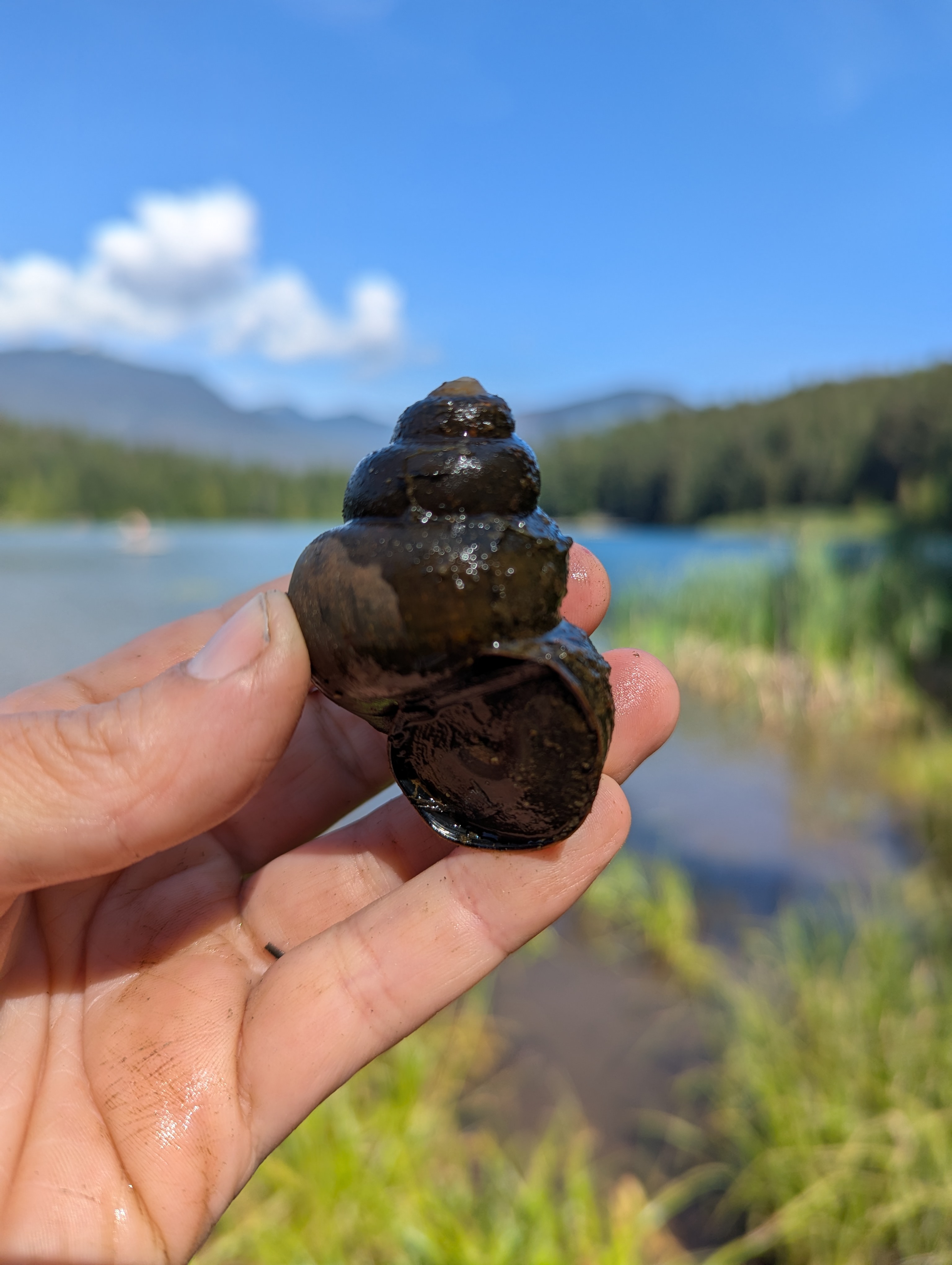
Feature Image: Chinese Mystery Snail at Lost Lake

“Nature once determined how we survive. Now we determine how nature survives.” – Sir David Attenborough

Whistler is fortunate to have the Sea to Sky Invasive Species Council (SSISC) to help protect biodiversity, our strongest natural defence against climate change. SSISC was formed in 2009 to minimize the threat of invasive species—species introduced from other regions, primarily by humans, that rapidly spread and cause significant harm to the environment, the economy, or human health.

It’s often mentioned that invasive species are the second most significant threat to biodiversity after habitat loss. What’s less commonly cited is that both invasive species and habitat loss are driven by economic growth. When we don’t acknowledge economic growth as the primary cause of biodiversity loss, we may believe that, with precautions and technological advances, we can continue to grow forever on a finite planet. However, as Sir Attenborough also has said, anyone who believes this is “either a madman or an economist.”

Some relatively good news among the bad news of invasive species is that, since mass access here was relatively recent (began with the arrival of the railway in 1914), Whistler has been exposed to invasive species for less time than our neighbours in Squamish (mid-1800s) and Pemberton (also mid-1800s when 30,000 gold-rushers passed through). Another positive is that ecologically minded residents have been removing invasive plants on their own initiative for years before SSISC formed. These advantages enable SSISC to now eradicate high-priority invasive plants, such as Scotch Broom, Himalayan Blackberry, and others, from Whistler.

The bad news is that humans spread invasive species, and the Resort is becoming busier, especially in the warmer months when invasives are more likely to spread. One unfortunate example is Whistler’s lakes. Most have been stocked with invasive Rainbow Trout for sport fishing, some as early as the 1920s. Unfortunately, not only did Rainbow Trout displace native Cutthroat Trout, but fish stocking can also introduce other invasive species that hitchhike in transported water and mud. Additionally, lake users who don’t “Clean Drain and Dry” their equipment risk transporting and spreading invasive species. Finally, many released aquarium pets become invasive species, and sadly, Whistler has multiple water bodies where released goldfish are devastating native fish and amphibians.

Western Toad.

The Whistler Museum operates its Discover Nature program at Lost Lake every summer, so we’re attuned to the ecology of the lake. We noticed giant snails (up to 6 cm) a few years ago, which seemed out of place, and indeed, they were. They turned out to be invasive Chinese Mystery Snails, and this year their populations grew exponentially—a typical trajectory for invasive species. SSISC confirms they are present in other Whistler lakes as well, but our concern for Lost Lake specifically is that it is the only place in the valley where Western Toads breed. The invasive snail can harm aquatic food webs, which the Western Toad is a big part of in Lost Lake.

We’re looking forward to working with SSISC and the municipality to see what can be done to protect Western Toads from invasive species. How the snails arrived is currently unknown, but could be any of the reasons above or a vector we don’t yet understand. To learn more about invasive species and how you can protect biodiversity, please visit SSISC.ca.

The Bucking Bronco of Après: Part II of a not-so-Dusty-taleThe Bucking Bronco of Après: Part II of a not-so-Dusty-tale

0 Comments

Featured Image: The Den at Dusty’s photo. Intrawest Collection. Does anyone have any information about ‘The Den’? The Museum would love to learn more…

Last week, the adventures of Dusty – the one-time stuffed bucking bronco – from the bar that still bears his name, were chronicled. This mythic tale takes up where the last article trailed off…

The bar and bbq joint re-branded in the late 1980s, setting Dusty off from the raunchy ranch into the ‘realm of mythology.’ The now-battered-up bronco hit the fundraising circuit. He was auctioned off on Timmy’s Telethon. The buyer never picked up his rodeo cocktail champ, and that’s when Ski Patrol stepped in and ‘rescued’ him.

Dusty was set up in the Volly cabin, right next to Honest Eddie: the pop-turned-beer machine. One dollar bought you a brew-with-a-view with the dead horse.

Only in Whistler: Tales of a Mountain Town (Harbour Publishing, 2009), the book by longtime local Stephen Vogler, relays that Dusty also became a prankster. Or perhaps, more aptly, the mascot for mayhem-makers. He showed up on top of the lift evacuation practice tower, surely after going up the Pony Trail: a sky-high stallion who stirred the concerns of animal rights activists, stating it was inappropriate treatment of a dead animal. He was removed.

The bar which still bears Dusty’s moniker claims, “One of the greatest legends of our time, our namesake’s origin is as much a mystery as his whereabouts today.” But…or maybe, more appropriately, well… that is not entirely correct, nor incorrect. 

The order of operations of his subsequent adventures is hazy at best: but he did transition to ‘the dark side’. The missing-a-leg Dusty made his way to Blackcomb. He rode by snowmobile and then was transferred to toboggan. The injured horse (whose head apparently may have partly fallen off in the process) was hoped to be moved to the upper alpine, but was only able to make it to the top of Chair 2, halfway up the hill. Vogler’s telling shares many more of the bumps and bruises of the journey, including the fact that in the morning, he was promptly removed and sent to the dump.

But the story doesn’t end there… and as Vogler points out, “perhaps it’s best to leave names out when the police become involved.” And so it goes…the driver of the horse-disposing truck (again, no mention of it being a Bronco!) apparently could not bear the thought “of dumping a once-famous museum-worthy equine in the landfill” (*and as far as Museum records show, no attempt to contact the archivist was made!). The truck rolled over the old log bridge and from there “Dusty made one last jump for freedom” into the Cheakamus River. 

But, then there was the kayaker. The kayaker who called the RCMP. And the RCMP who dispatched the dive team and called in a crane to remove the horse who had “clearly stumbled over the rugged banks to its death.” The cops called in the cowboy who ran the stables at Mons, whereupon seeing the horse is reputed to have said “That’s Dusty. He’s been dead for fifty years.”

The RCMP wanted to lay charges. None were ever filed.

Back into the truck Dusty went and back to Blackcomb Base II did Dusty take his last ride. With a match, and a can of gasoline, it is rumoured that Dusty saddled up to become a blazing effigy to Après adventures and the legacy of rodeo-like-ski-resort town…

The Bucking Bronco of Après: a not-so-Dusty-taleThe Bucking Bronco of Après: a not-so-Dusty-tale

0 Comments

Featured Image: The Interior of Dusty’s Bar & BBQ, 1987. Whistler Mountain Collection.

Dusty’s Bar & BBQ is about as synonymous with Whistler’s Après party scene as is snow to skiing, fish to water… or, in the memories of many locals and longer-timers: a stuffed bronco is to beers (and braless bawdiness!).

Dusty was a horse. A taxidermied bronco forever frozen in mid-buck. A stuffed relic, with an origin story that begins, however, with three different  ‘Once upon a times…’ 

The first: He was from 1920s Texas – an award winner in his time: one who had surely earned many of his rodeo riders big-buckle-bragging rights. Naturally, this would translate to him finding his ‘rightful’ place at the base of a snow-bawllin’ slope, in a bar named after him some 100 years later. Dusty’s opened in 1983.

The second, according to Dusty’s website (the bar’s not the bronco’s): “Some say Dusty [was] bred on a farm owned by the local druggist in the town of Hope. It was said this pharmacist was the best in the Fraser Valley, and upon Dusty’s untimely passing, the kindly druggist had him stuffed and placed in front of his store.”

The third: “Dusty was a Hollywood stunt horse. His trainers were forced to shoot poor Dusty when he threw a certain trailer-turned-actress into the middle of her 30’s. It is said that Dusty, a rock-and-roll horse at heart, couldn’t take it when the star stopped singing that Broadway tune. The actress had Dusty shot.” (https://www.dustyswhistler.com

The tales of Dusty’s tail only start there… but what remains undisputed is when he arrived here. In 1979, Dusty rolled up in the back of a truck (sadly, in a missed moment of potential corollary – or corralary – synchronicity: there is no mention that he rodeoed in in a Bronco). He was destined to be the centerpiece of the newly re-branded, mountain-base, post-slope watering hole: converting from the original L’Après to Dusty’s. However, the bar was locally, Creekside-colloquially, known as The Deadhorse. 

Much for being dead, Dusty had a lively Après-life, a Whistler ‘After’-life.

Rules, necessarily, soon needed to be put in place. Management became wranglers: if riders rode the bronco with their clothes on, they had to buy the house a round. If clothes were shed, well legends were born and tall-tales were spread from the fogginess of fact vs. fiction…

Perhaps one of the most famous stories, from which many re-tellings have been told involves a young woman in mountain management, some ‘bareback’ bouncing, a sudden supposed full moon and claims that she was subsequently fired. Some twenty years later, the woman who raised the bar – and the bar’s profile – overnight, wrote a letter to The Pique to set the riding-record straight. She was not fired, but remains known as ‘Lady Godiva’ ever since.

The bar and BBQ joint re-branded in the late 1980s, setting Dusty off from the raunchy ranch into the ‘realm of mythology.’ The now-battered-up bronco hit the fundraising circuit. He was auctioned off on Timmy’s Telethon. The buyer never picked up his rodeo cocktail champ, and that’s when Ski Patrol stepped in and ‘rescued’ him.

Dusty’s adventures will be continued in next week’s column …