
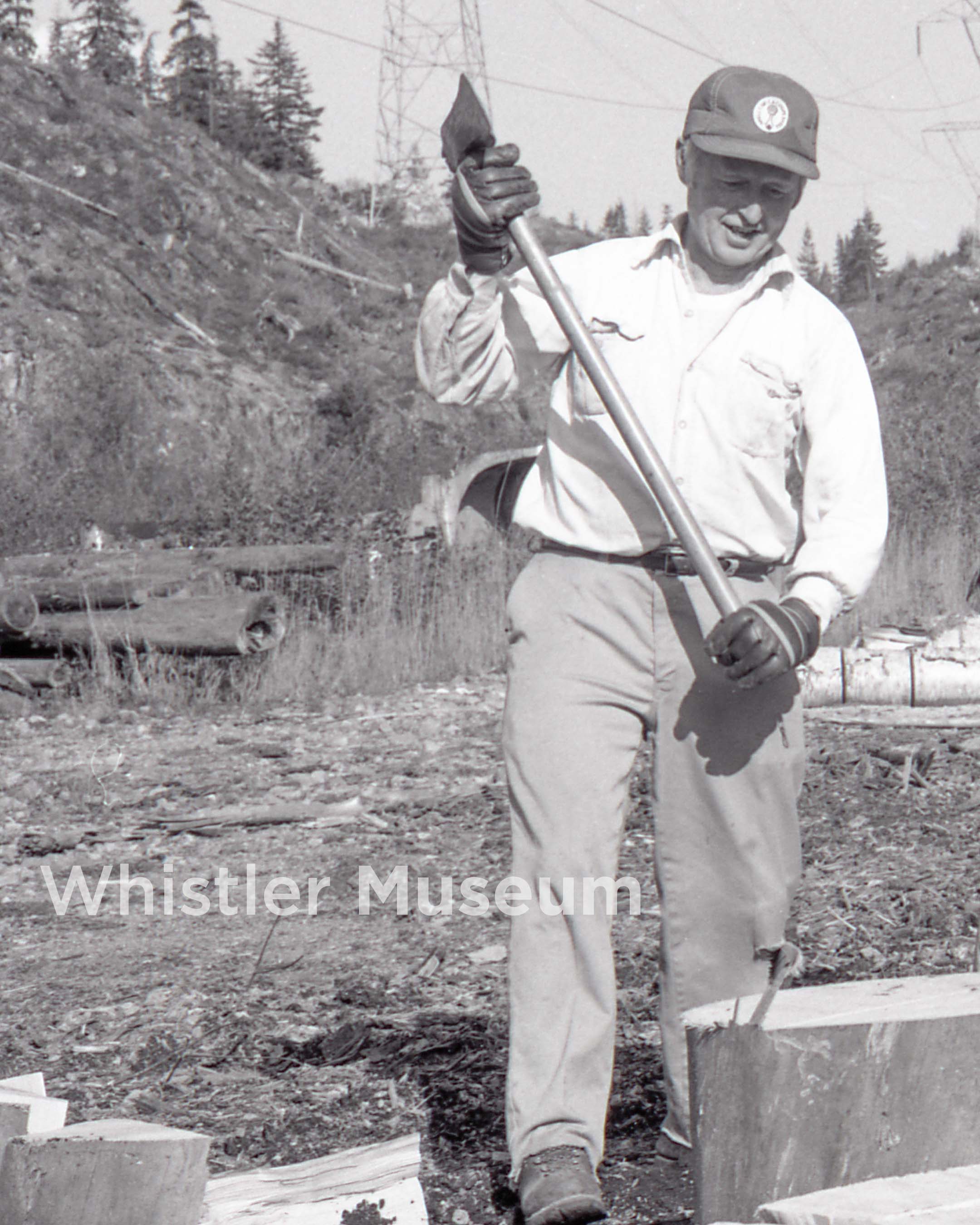
Photo credit: Don MacLaurin volunteering with the Whistler Rotary Club. 1984. Whistler Question Collection
“If you want to believe that the world is terrible, watch the news. If you want to believe that the world is incredible, spend time in nature.” – Austin Perlmutter
It’s hard to imagine Whistler without Lost Lake Park, our largest and most natural municipal park. However, the creation of the park was not a certainty. In the 1930s, as tourism in Whistler (then Alta Lake) grew, guests at Rainbow Lodge (located at what is now Rainbow Park) were taken on excursions to Lost Lake for swimming, fishing, and picnics. However, in the 1940s the Lost Lake area shifted from recreational to industrial. During the next twenty years most of the surrounding forest was logged, while the Great Northern Mill operated on the north shore of Lost Lake.
In the early 1960s residential development was proposed. The timber licenses straddling Lost Lake were about to expire, and developers started staking out lots and preparing to apply for waterfront property. Keep in mind: this was 15 years before the Resort Municipality of Whistler (RMOW) was created, so it took someone with vision and determination to ensure this beautiful natural playground could be enjoyed by the entire community and visitors.
Don MacLaurin: Bridge builder
Whistler was very fortunate that Don MacLaurin (1929-2014) made Alta Lake his summer home in the 1960s. Don was a forester for the BC Forest Service and later an instructor at BCIT (British Columbia Institute of Technology), teaching courses in forestry and parks management. He was also a tireless volunteer and mentor. Don strongly believed in the value of getting into the mountains, and he championed the summer enjoyment of Whistler’s landscape.
Don was able to navigate the complicated relationship between industry and recreation. “Don was living and teaching sustainability before the term was invented. [He] was the bridge builder, the guy who looked at both the economics and the ecology,” recalled Arthur DeJong in a 2014 Pique article.
Don was the driving force behind preserving the Lost Lake area as a park. With the help of his contacts at BC Parks, he was instrumental in ensuring Lost Lake Park was designated as a park, preventing privatization and preserving the space in perpetuity. Lost Lake Park opened officially in 1982.
It’s no surprise that today, Lost Lake Park is cherished for opportunities to conserve and appreciate nature. Every year I am filled with hope when I see how the community comes together to protect thousands of tiny Western Toads as they migrate from Lost Lake to the forest. The RMOW leads toad stewardship with permanent features such as signage, fencing, underpasses (for the toads!), and staff expertise. The Museum runs the Discover Nature program at Lost Lake Park, and we often hear that learning about and moving toads away from danger is a favourite activity. I know Don would be pleased!

We can thank Don for more than Lost Lake Park
Don worked as an advisor to the RMOW in the 1980s. When the forestry industry planned to clearcut the south side of Whistler Mountain, which is the first thing everyone sees when driving to Whistler from the south, Don and the council of the day fought back and got that logging license moved. Similarly, when the Ancient Cedars (just north of Whistler) were threatened with logging in 1988, that license was also moved due to Don’s persistence, persuasion and advocacy by the Western Canada Wilderness Committee.
Don also worked tirelessly on planning the Whistler Interpretive Forest. He mapped and developed the trails and helped people understand the forest and its importance. The suspension bridge spanning the Cheakamus River is called MacLaurin’s Crossing, a fitting tribute to this influential bridge builder.