Tag: Whistler Mountain

The Dual Mountain Duel: 7th Heaven and Peak ChairThe Dual Mountain Duel: 7th Heaven and Peak Chair

0 Comments

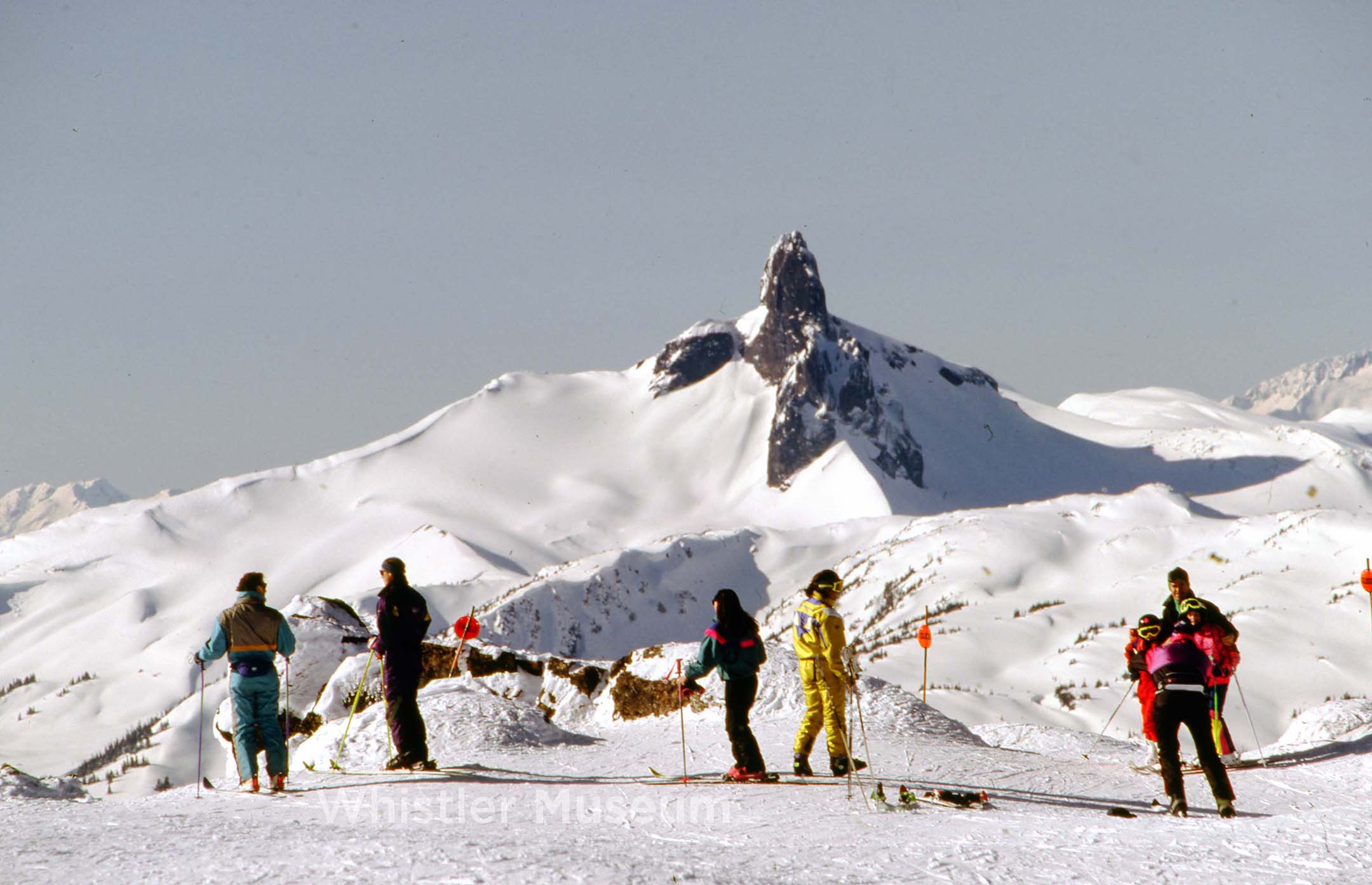
Top Image: Skiers atop Whistler Peak. 1990s. Griffith Collection.

This week marks the 60th anniversary of Whistler Mountain’s opening. Blackcomb Mountain opened in 1980. Whistler’s runs were designed more to side-run the mountain, whereas Blackcomb’s followed more of the fall lines. 

Up until 1997, the two mountains operated separately. There was, however, a Dual Mountain Pass that could be purchased, granting access to both mountains. The pass was one of the only points of collaboration between the two competitors, whose rivalry was best showcased in their alpine lift duel.

In 1985, Blackcomb installed the 7th Heaven T-Bar: at the time, becoming the continent’s first, and only, “Mile High Mountain.” A vast amount of new terrain was opened up by this development – expansive glacial access and four powder bowls – extending Blackcomb’s skiable area by almost two-thirds. The significant upgrade served to dispel its previous uniformity in design. Skiers now could  travel down runs covering 1160 acres, a substantial increase over the previous 420. 

The alpine world had been opened up. 

The mid-1980s, short-lived 7th Heaven T-Bar. Griffith Collection.

A young Mike Douglas (“Godfather of Freeskiing”, filmmaker and founder of the Canadian chapter of Protect Our Winters) described the experience of arriving at the top of 7th Heaven as being “dropped off at the edge of the world.” Nancy Greene (Olympic gold medalist voted Canada’s Female Athlete of the 20th Century) declared “The enormous variety of slopes and spectacular views are unequalled in North America.” In the forefront of those views was Whistler Mountain. 

Whistler responded by countering a year later with the opening of the Peak Chair, a three-seater, one kilometre long lift depositing people just beneath the summit of the mountain at 2182 metres. The bar had literally just been raised (in every sense of the word!), one upping Blackcomb in the process.

Peak Chair was initially restricted to just advanced skiers. Snowboarders, at this time, were still not welcome on the mountain. 

Whistler’s original Peak Chair. Griffith collection.

Challenging, cliffed, corniced and steep terrain characterized the area off the peak. Glaciated bowls and bouldered outcrops earmarked the summit’s geologic geography; whereas, its demography was being populated by seekers-of-skiing’s-extreme.

Blackcomb was not to be outdone. Riding 7th Heaven, arguably, remains the pinnacle of the Blackcomb experience.  The following year, in 1987, 7th Heaven Express opened, replacing the two-year existence of the T-bar. The new four person chair, running along a longer and new lift line is the same one in operation today. Much like the Peak Chair, only skiers were permitted, when both first opened. 

Blackcomb was the first to welcome snowboarders in 1988/89. Whistler followed suit; however, in this case, the mountain was much more reluctant to follow this trend, only opening their slopes to shredders a full year later.

In 1996, the two mountains joined forces, merging under the banner ‘Whistler Blackcomb.’ Continuing the streak of earning international accolades, the united front earned the Number One spot in SKIING Magazine’s ranking of the ‘Top 25 Resorts in North America’ (Tourism Whistler, 2019).

Two years later, Whistler further upgraded access to its alpine summit, with the unveiling of the four-seater, Peak Express. This same high speed, detachable chairlift remains in operation today.

And every morning, the eager and the energetic mingle and gather at the bases of 7th Heaven and Peak Express, awaiting Ski Patrol to finish their avalanche clearance protocols, in a bid to carve fresh tracks through unparalleled terrain.
The duel of the dual mountains – the rivalry of lifts and runs –  may have ended on a financial and marketing level, but preferences ran – and still run – strong between slope-sliders and stylers  as to which side of the mountain they prefer… along with their preferred method of flying down their chosen hill!

Santa Slays the Mountain!Santa Slays the Mountain!

0 Comments
Santa on the Slopes of Whistler, 1994. Insight Photography Collection

He sprang to his sleigh, to his team gave a whistle …

Their hundreds of eyes— oh! how they twinkled! 

Their dimples, how merry!

Their cheeks were like roses, their noses like cherries!

Their droll little mouths were drawn up like bows, 

as, together, they rode up the gondola in droves

Sporting beards on their chins as white as the snow …

Then away they all flew, down the slopes with skis and boards,

all donned up in red and white…

(some outfits loose and baggy, others mighty tight!)

The annual Dress Like Santa Day: another sleighing sight!

For more than twenty years, Whistler Blackcomb has been hosting this colourful, costumed and cheer-fuelled Christmas tradition. Just as its name suggests – every year on one mid-December day , this year on Friday, December 19 – snowboarders and skiers are encouraged to dress up like Mr. or Mrs. Claus and take to the slopes.

Merriment and holiday-spirit spread amongst ‘Ho, Ho, Ho’ing participants as they gather at the base of Whistler Mountain. From the young to the still-young-at-heart, the all-ages event has steadily grown in popularity since its inception (exactly what year that was is hard to pinpoint, as it remains a glorified extension of previously established on-mountain Santa-spotting happenings) … but, the early 2000s seems to be the general consensus.

Once at the top, the Santa slope stylers travel together from the Roundhouse-cum-North Pole to the base of Emerald Chair – where a group photo is taken. 

As per tradition, a free lift ticket has been awarded to the first 100 people who arrive in full attire. This number has grown from an original 50 free tickets, to 75, to its now 100: handed out to the pipe-toting, black-belt bulging, and boot-wearing crew. With great Whistler flair, custom costume-modifications have made this a Santa Spectacle, sanctioned under a ‘Creative Claus’ (with… “A wink of his eye and a twist of his head/Soon gave me to know I had nothing to dread!)”

Mountain Hostesses follow Santa down the Slopes. Greg Griffith Collection.

The Whistler Mountain Hostesses definitely skied with St. Nick. Beginning in the 1974/75 season, the program “specialized in fun” … and dressing up as elves and touring the slopes with Santa was a part of their ‘mandate’. “We had the greatest job in the world,” recalls founding Hostess Leanne Dufour.

The program morphed into the Ski Friends (also Santa’s helpers!) in the late 80s and then further into the present-day Mountain Host program. 

Off the slopes, Santa has announced his arrival in other less-than-conventional ways throughout Whistler’s history. In 1980, the “jolly old elf” cruised in by chopper, dropping down from the skies – heralded by helicopter – only to be mobbed by a group of candy-covetting children.

After a dramatic arrival by helicopter, Santa is mobbed at the Rainbow Ski Village Saturday as he tries to distribute candy canes.

Dating back even further… The children of the one-room Alta Lake schoolhouse (first opened in 1933) would also receive an annual visit from Father Christmas. It is fair to speculate that trapper and railway section-gang worker, Billy ‘Santa’ Bailiff, likely arrived by horse or on foot. Remembered as a ‘gentle man.’ Billy – famed for his ‘Stellar Jay Pie’ and ‘potato water bread’ – was the unanimous choice as the Santa stand-in with his plump figure and round rosy cheeks.  

Billy died in 1958 and the baton of community Kris Kringle seems to have been passed onto to Jack Biggin-Pound, who settled in McGuire (an old mill town from the 1930s, two kilometres north of Brandywine Falls), staking a claim there on Crown Land in 1961. Jack recalled, “Never again will Myrtle Philip [Founder of Rainbow Lodge, the first tourist attraction in the Whistler area, opened in 1915] undo my flies, to the great amusement of everyone, to stuff a pillow in to make me a more portly Santa Claus for the school children. They all tried hard but I don’t think ever found out who Santa was”…

The mystery of who Santa was, or is, either singularly in our schools – or in plural, plummeting down the hill –  remains part of this town’s mountain magic … 

Santa spotted on Blackcomb. Blackcomb Mountain Collection.


Mountain Washrooms: BlackcombMountain Washrooms: Blackcomb

0 Comments

Though Whistler Mountain opened for skiing in January 1966 with no Roundhouse and few on-mountain amenities, when Blackcomb Mountain began its operations in December 1980 the Rendezvous Lodge and the daylodge at Base II were both already up and running. Over the years, as Blackcomb gained more customers, these facilities were added onto and more were added, including the Glacier Creek Lodge in 1993.

In 1980, both the Rendezvous and the daylodge offered food services run by the Parsons family and were fulling equipped with running water and washroom facilities. According to Hugh Smythe, president of Blackcomb Ski Enterprises, his experiences with washrooms at Whistler Mountain led him to believe that these facilities were not going to be enough. He recalled discussions with the architects where he tried to convince them to add more washrooms to the plans but both the design of the buildings and the budget prevented adding more facilities. As Blackcomb skier visits increased, more washrooms were added to the Rendezvous through the addition of construction washroom trailers that were bolted to the bottom floor. When the building was expanded and Christine’s Restaurant was added, the bottom floor was also expanded and more washrooms were included in the building, replacing the trailers.

Blackcomb Mountain didn’t just advertise its women’s washrooms, it also took promotional photos of the men’s room. Blackcomb Mountain Collection, Randy Lincks

Blackcomb Mountain decided to take no chances when it came to planning the washroom facilities for the Glacier Creek Lodge, though the building itself did come close to looking entirely different than it does today. Smythe remembers that the team at Blackcomb, then owned by Intrawest Resort Holdings Inc., originally asked the architects for a shed roof design, similar to the Bugaboo Lodge and the daylodge at Sunshine Village. Situated at the bottom of the Jersey Cream Express and the Glacier Express, the 1,000 seat restaurant was designed to look up the lift lines and capture as much sunlight as possible and featured industrial elements such as metal beams. As they neared the construction window, however, Blackcomb asked for an architectural rendering that they could put on display. According to Smythe, despite having seen all of the plans and being involved in the process, one look at the rendering was enough to realize that the design was all wrong.

Glacier Creek Lodge on Blackcomb Mountain. Insight Photography Collection

Blackcomb engaged new architects, a husband and wife team called Lutz & Associates, and got to work on a new design. Smythe recalled one presentation at which the architects had something under a sheet in the middle of the table. Throughout the presentation, Smythe kept getting distracted by the mysterious object until finally they pulled the sheet off to reveal a model of Glacier Creek Lodge. Like with the architectural rendering, one look was enough for Smythe to say, “That’s what we need.” Metal beams were switched for large log posts and there was even money in the budget to commission root chandeliers from Eric Skragg.

By October 1993, the 30,000 sq ft Glacier Creek Lodge was nearing completion. It included 1,000 seats spread out over two levels, an additional 600 seat patio, and ten food court stations. According to the Whistler Question, the building also included “one of the largest washrooms in North America, complete with 38 stalls.” The size of the washrooms was even used in the marketing for the new facility. In November 1993, the Question featured an image captured by photojournalist Bonny Makarewicz showing a line of toilets before the partitions were installed and captioned “OK! Who left the seat up? Toilets in the ladies room sit awaiting stalls in the new Glacier Creek restaurant, Tuesday. The women’s can will feature 38 toilets.” A similar image and caption was also used in a ski magazine.

A line of stalls in the Glacier Creek Lodge washroom. Blackcomb Mountain Collection, Randy Lincks

Whistler Mountain renovated Pika’s restaurant that same season, doubling the size and increasing the women’s washrooms from nine to 26 stalls. By the 1990s, both mountains had come a long way from the amenities and outhouses offered to early skiers on Whistler Mountain.

Mountain Washrooms: WhistlerMountain Washrooms: Whistler

2 Comments

When Whistler Mountain opened for skiing in the winter of 1965/66, it wasn’t known for its on-mountain amenities. Even after the Roundhouse was built in the summer of 1966, the only facilities on the top of the mountain were nearby outhouses.

The maintenance of these outhouses fell under the purview of Whistler Mountain’s paid ski patrol. John Hetherington, who joined the patrol in the 1967/68 season, remembered shoveling out and cleaning the outhouses as an “ugly job.” According to fellow patroller Hugh Smythe, Hugh gained quite a lot of experience cleaning and restocking the facilities in his first year on the patrol, often using rescue equipment such as ice axes. He described these duties as “the glamour of being a ski patroller.”

The Roundhouse before the balcony and the lower level were enclosed. Whistler Mountain Ski Corporation Collection

One of the first major renovations of the Roundhouse involved digging out and enclosing a lower floor which would include indoor washrooms. According to Garibaldi’s Whistler News, this was done in part due to skier demands. Doing so presented a couple of problems as at the time, the Roundhouse did not have water and some high points of rock beneath the Roundhouse made the space more a crawlspace than another level.

The first problem was solved by hiring a professional water dowser from Vancouver Island. He arrived with a willow stick and was able to find running water near enough to the Roundhouse that the lift company was able to install a pump and have enough water for the newly installed kitchen and for washrooms. The second problem involved removing some of the rock that the Roundhouse was built on.

Smythe had a blasting ticket because of his patrol work doing avalanche control but, as he recalled, “no experience blasting rock.” He drilled some holes and covered the area in sheets of plywood, then added explosives. Luckily, only one piece of rock went through the main floor of the Roundhouse, though others were embedded in the ceiling. Once the debris was cleared out, washrooms and additional seating were added to the space.

A new building that included additional washrooms under construction in front of the Roundhouse. Whistler Question Collection, 1979

While the addition of indoor washrooms was a big step for Whistler Mountain, the lift company continued to experience washroom woes. The Roundhouse now had four stalls in the women’s washroom, two stalls and two urinals in the men’s washroom, and the pre-existing outhouses. The facilities, however, were still not sufficient for the number of skiers on the mountain on a busy day and Smythe recalled that the lineups for the women’s washroom would be “horrendous.” At one point, season pass holders signed a petition for additional women’s washroom facilities, as the women had gotten tired of waiting in the line and the rest of their group had gotten tired of waiting for them, sometimes for over half an hour. Mirrors were moved from the washroom to the hallway to discourage any lingering, clips were installed to keep the sleeves of one-piece ski suits off the ground, and there were even staff stationed at the washrooms with stopwatches. None of these measures were particularly effective and Smythe remembered some skiers, tired of waiting in line, decided to “just storm the men’s.”

The Roundhouse after renovations. Whistler Question Collection, 1980

In 1979, a new building was installed beside the Roundhouse that included extra washrooms, a new ski school office, a ski repair shop, and a sewer plant. When the Roundhouse Lodge was completely rebuilt in 1998, the new building boasted much larger washroom facilities than the original structure. His experiences with both the outhouses and the Roundhouse facilities left a lasting impression on Hugh Smythe that would inform future developments in his career.