Tag: Blackcomb Mountain

The Dual Mountain Duel: 7th Heaven and Peak ChairThe Dual Mountain Duel: 7th Heaven and Peak Chair

0 Comments

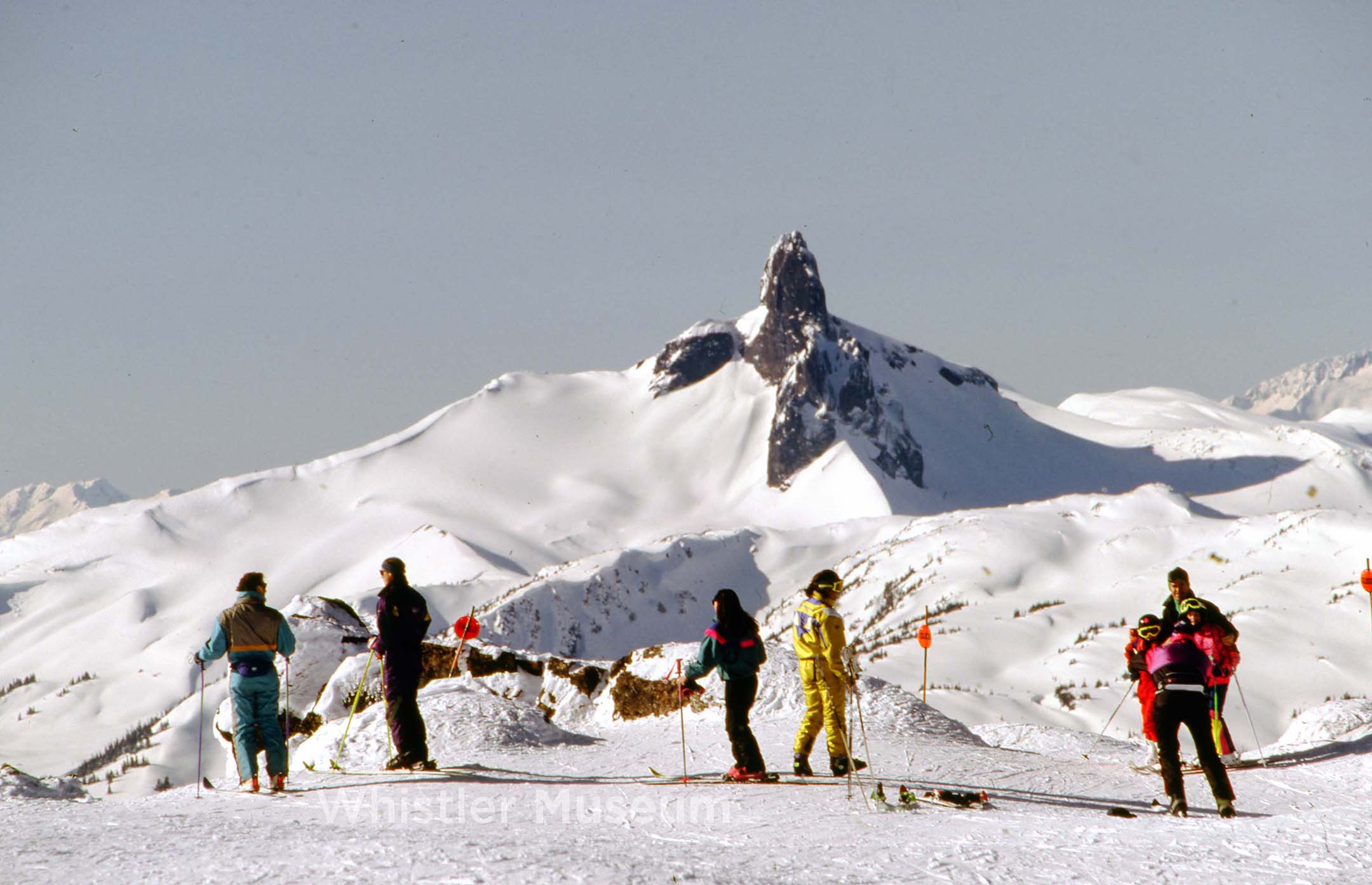
Top Image: Skiers atop Whistler Peak. 1990s. Griffith Collection.

This week marks the 60th anniversary of Whistler Mountain’s opening. Blackcomb Mountain opened in 1980. Whistler’s runs were designed more to side-run the mountain, whereas Blackcomb’s followed more of the fall lines. 

Up until 1997, the two mountains operated separately. There was, however, a Dual Mountain Pass that could be purchased, granting access to both mountains. The pass was one of the only points of collaboration between the two competitors, whose rivalry was best showcased in their alpine lift duel.

In 1985, Blackcomb installed the 7th Heaven T-Bar: at the time, becoming the continent’s first, and only, “Mile High Mountain.” A vast amount of new terrain was opened up by this development – expansive glacial access and four powder bowls – extending Blackcomb’s skiable area by almost two-thirds. The significant upgrade served to dispel its previous uniformity in design. Skiers now could  travel down runs covering 1160 acres, a substantial increase over the previous 420. 

The alpine world had been opened up. 

The mid-1980s, short-lived 7th Heaven T-Bar. Griffith Collection.

A young Mike Douglas (“Godfather of Freeskiing”, filmmaker and founder of the Canadian chapter of Protect Our Winters) described the experience of arriving at the top of 7th Heaven as being “dropped off at the edge of the world.” Nancy Greene (Olympic gold medalist voted Canada’s Female Athlete of the 20th Century) declared “The enormous variety of slopes and spectacular views are unequalled in North America.” In the forefront of those views was Whistler Mountain. 

Whistler responded by countering a year later with the opening of the Peak Chair, a three-seater, one kilometre long lift depositing people just beneath the summit of the mountain at 2182 metres. The bar had literally just been raised (in every sense of the word!), one upping Blackcomb in the process.

Peak Chair was initially restricted to just advanced skiers. Snowboarders, at this time, were still not welcome on the mountain. 

Whistler’s original Peak Chair. Griffith collection.

Challenging, cliffed, corniced and steep terrain characterized the area off the peak. Glaciated bowls and bouldered outcrops earmarked the summit’s geologic geography; whereas, its demography was being populated by seekers-of-skiing’s-extreme.

Blackcomb was not to be outdone. Riding 7th Heaven, arguably, remains the pinnacle of the Blackcomb experience.  The following year, in 1987, 7th Heaven Express opened, replacing the two-year existence of the T-bar. The new four person chair, running along a longer and new lift line is the same one in operation today. Much like the Peak Chair, only skiers were permitted, when both first opened. 

Blackcomb was the first to welcome snowboarders in 1988/89. Whistler followed suit; however, in this case, the mountain was much more reluctant to follow this trend, only opening their slopes to shredders a full year later.

In 1996, the two mountains joined forces, merging under the banner ‘Whistler Blackcomb.’ Continuing the streak of earning international accolades, the united front earned the Number One spot in SKIING Magazine’s ranking of the ‘Top 25 Resorts in North America’ (Tourism Whistler, 2019).

Two years later, Whistler further upgraded access to its alpine summit, with the unveiling of the four-seater, Peak Express. This same high speed, detachable chairlift remains in operation today.

And every morning, the eager and the energetic mingle and gather at the bases of 7th Heaven and Peak Express, awaiting Ski Patrol to finish their avalanche clearance protocols, in a bid to carve fresh tracks through unparalleled terrain.
The duel of the dual mountains – the rivalry of lifts and runs –  may have ended on a financial and marketing level, but preferences ran – and still run – strong between slope-sliders and stylers  as to which side of the mountain they prefer… along with their preferred method of flying down their chosen hill!

Mountain Washrooms: BlackcombMountain Washrooms: Blackcomb

0 Comments

Though Whistler Mountain opened for skiing in January 1966 with no Roundhouse and few on-mountain amenities, when Blackcomb Mountain began its operations in December 1980 the Rendezvous Lodge and the daylodge at Base II were both already up and running. Over the years, as Blackcomb gained more customers, these facilities were added onto and more were added, including the Glacier Creek Lodge in 1993.

In 1980, both the Rendezvous and the daylodge offered food services run by the Parsons family and were fulling equipped with running water and washroom facilities. According to Hugh Smythe, president of Blackcomb Ski Enterprises, his experiences with washrooms at Whistler Mountain led him to believe that these facilities were not going to be enough. He recalled discussions with the architects where he tried to convince them to add more washrooms to the plans but both the design of the buildings and the budget prevented adding more facilities. As Blackcomb skier visits increased, more washrooms were added to the Rendezvous through the addition of construction washroom trailers that were bolted to the bottom floor. When the building was expanded and Christine’s Restaurant was added, the bottom floor was also expanded and more washrooms were included in the building, replacing the trailers.

Blackcomb Mountain didn’t just advertise its women’s washrooms, it also took promotional photos of the men’s room. Blackcomb Mountain Collection, Randy Lincks

Blackcomb Mountain decided to take no chances when it came to planning the washroom facilities for the Glacier Creek Lodge, though the building itself did come close to looking entirely different than it does today. Smythe remembers that the team at Blackcomb, then owned by Intrawest Resort Holdings Inc., originally asked the architects for a shed roof design, similar to the Bugaboo Lodge and the daylodge at Sunshine Village. Situated at the bottom of the Jersey Cream Express and the Glacier Express, the 1,000 seat restaurant was designed to look up the lift lines and capture as much sunlight as possible and featured industrial elements such as metal beams. As they neared the construction window, however, Blackcomb asked for an architectural rendering that they could put on display. According to Smythe, despite having seen all of the plans and being involved in the process, one look at the rendering was enough to realize that the design was all wrong.

Glacier Creek Lodge on Blackcomb Mountain. Insight Photography Collection

Blackcomb engaged new architects, a husband and wife team called Lutz & Associates, and got to work on a new design. Smythe recalled one presentation at which the architects had something under a sheet in the middle of the table. Throughout the presentation, Smythe kept getting distracted by the mysterious object until finally they pulled the sheet off to reveal a model of Glacier Creek Lodge. Like with the architectural rendering, one look was enough for Smythe to say, “That’s what we need.” Metal beams were switched for large log posts and there was even money in the budget to commission root chandeliers from Eric Skragg.

By October 1993, the 30,000 sq ft Glacier Creek Lodge was nearing completion. It included 1,000 seats spread out over two levels, an additional 600 seat patio, and ten food court stations. According to the Whistler Question, the building also included “one of the largest washrooms in North America, complete with 38 stalls.” The size of the washrooms was even used in the marketing for the new facility. In November 1993, the Question featured an image captured by photojournalist Bonny Makarewicz showing a line of toilets before the partitions were installed and captioned “OK! Who left the seat up? Toilets in the ladies room sit awaiting stalls in the new Glacier Creek restaurant, Tuesday. The women’s can will feature 38 toilets.” A similar image and caption was also used in a ski magazine.

A line of stalls in the Glacier Creek Lodge washroom. Blackcomb Mountain Collection, Randy Lincks

Whistler Mountain renovated Pika’s restaurant that same season, doubling the size and increasing the women’s washrooms from nine to 26 stalls. By the 1990s, both mountains had come a long way from the amenities and outhouses offered to early skiers on Whistler Mountain.

The Lifty OlympicsThe Lifty Olympics

0 Comments

Thirteen years before Whistler and Vancouver hosted the Olympic and Paralympic Winter Games, Blackcomb Mountain began hosting a smaller, perhaps less prestigious, but likely no less competitive event called the Lifty Olympics.

The Lifty Olympics began in April 1997 as part of the second World Ski and Snowboard Festival (WSSF). In its first year, WSSF had featured 22 events over ten days, including the Couloir Ski Race Extreme, the Whistler Cup, and the WestBeach Classic, along with performances by bands such as Vancouver’s 54•40. For its second year, additional events were included such as the Norco Challenge (Norco factory riders competed to see who could go the fastest on their bike down Whistler Mountain’s Saddle) and the Backbone Enduro Vertical Challenge. While most WSSF events catered to those who skied or snowboarded on the mountains, the Lifty Olympics featured those who worked in mountain operations.

Lifties are an integral part of keeping the mountain running smoothly, especially when working with fixed grip lifts. Whistler Mountain Ski Corporation Collection

According to organizer Jim Tutsch, the Lifty Olympics was “specifically designed to test the wiles of local lifties” and “demonstrate the activities of a lift operations specialist in the course of their daily duties.” Teams from both Whistler and Blackcomb Mountains competed in four timed events. In one, they had to set up 36 maze gates in a standard pattern used to merge four lines of skiers down to one. Teams also had to transport garbage cans of snow up the mountain, perform a net drop rescue with a fireman’s net, and complete a full shut down procedure. Tutsch warned that these activities would be made a bit harder, such as by scattering rakes, shovels, ropes and gates around the bottom terminal that would need to be stacked when shutting down. The team that completed their duties with the fastest times won a keg of beer and year’s worth of bragging rights.

With space for six teams, all of the positions were reportedly filled within one day. Each team had four people, of which one member had to be female and one (though it is unclear if it could be the same one) had to be “an Australian or a reasonable facsimile.” A few days before the competition on April 7, Tutsch told the Question that staff members on both mountains were in training “polishing shovels, moving maze gates and counting down the days to the event.” This early enthusiasm for the Lifty Olympics had Tutsch thinking of expansion, whether to other mountain departments or to teams from other ski resorts.

A lifty needs to be prepared for anything, including a visit from a wizard. Blackcomb Mountain Collection, Greg Griffith, 1992

While the Lifty Olympics doesn’t appear to have spread to other departments, the Cascade Toboggan Ski Patrol Challenge joined the WSSF line up in 1999 and featured ski patrollers from across North America in five events such as the Dual GS Toboggan Challenge, Speed Packaging, and the Multiple Transceiver Search.

The Lifty Olympics at Blackcomb’s Base II continued as part of WSSF over the next few years, though it is not part of the WSSF line up these days. In 2000, Tutsch told the Question that the event was not just a competition, but also “a big thank you and formal recognition of the invaluable input of these unsung heroes.”

Building a Fortress: Part IIIBuilding a Fortress: Part III

0 Comments

When Dave and Lynn Mathews and Hugh Smythe arrived at Fortress Mountain in September 1974, their goal was to turn the ski area around and make it saleable. Snowridge, as it was called at the time, had declared bankruptcy in 1973 and been put up for judicial sale by the Federal Business Development Bank (FBDB). Over the 1974/75 ski season, Dave, Lynn, Hugh and their employees turned Fortress into a successful ski resort, which meant that the time had come to sell the operation for the FBDB.

When Dave and Hugh met with Ken Miller of FBDB about selling Fortress, they suggested that they approach Aspen Skiing Corp (later Aspen Ski Co), then the largest ski company in North America and considered “the top of the pecking order.” A small ski area in Alberta seemed like an unlikely investment for Aspen, but a series of events in Colorado made it a surprisingly good time to approach the company.

According to Hugh, they had heard that Darcy Brown, the president of Aspen, was having trouble getting some approvals for developments they wanted to do at Snowmass and so was looking at other potential projects. He was even reported to have made a statement at a public meeting about taking Aspen’s money out of not just the county but the country, which made it seem like an ideal time to approach the company. They traveled to Colorado to pitch Fortress to Darcy and in 1975 Aspen decided to buy half of the ski resort, leaving the other half with the FBDB.

Aspen President Darcy Brown, Mayor Pat Carleton and Aspen’s Jerry Blann at breakfast in Whistler. Whistler Question, 1979

Once the sale was completed, Dave and Lynn took a bit of time off and then returned to Whistler to manage the Whistler Inn and Resort for Jack and Ann Bright. In June 1975, Aspen asked Hugh to continue managing Fortress. He decided to stay and, like he had while working for Garibaldi Lifts Ltd., began taking night school classes to learn more about the business side of skiing, this time at SAIT in Calgary.

Over the next few years at Fortress, Hugh got Aspen to invest in the resort’s first triple chair (Aspen needed some convincing that with mazing, singles lines, and clear instructions, triple chairs could be fully loaded) and Fortress began to make a profit. Then, in 1977, a couple of things happened that would influence Whistler’s development; Paul Mathews contacted Hugh and suggest that they work together on a development proposal for Blackcomb Mountain and 20th Century Fox made a lot of money off of the success of Star Wars merchandising.

Jerry Blann and Hugh Smythe from Fortress Mountain Resorts present the Blackcomb development to the public in November 1978. Whistler Question Collection, 1978

Though the official call for proposals for Blackcomb had not yet been put out by the province of British Columbia, Paul and Hugh, along with engineer Ken Farquharson, began putting together a bid. To secure financing, they decided to pitch it to the Aspen board of directors. While that pitch didn’t get very far with the board, Al Raine, then in charge of provincial ski area coordination, reached out to Jerry Blann, who worked in planning for Aspen. Aspen then became interested in Blackcomb and Hugh had to make what he described as “a critical decision in [his] career,” whether to continue with Paul and Ken or stick with his employer. Like at Fortress in 1975, he decided to stay with Aspen.

Skiers head up on Blackcomb’s opening day, December 4, 1980. Greg Griffith Collection

In 1978, 20th Century Fox used the profits from Star Wars to diversify and bought Aspen. Also in 1978, the province chose the bid from Aspen and development began on Blackcomb Mountain, meaning Hugh returned to Whistler as competition for his previous employer, Garibaldi Lifts. The opening of Blackcomb Mountain on December 4, 1980 was part of an era of huge change and development in Whistler when, with the construction of the Whistler Village, Whistler began to look more like the resort you see today. It is possible, however, that Whistler would be quite different if Dave, Lynn and Hugh hadn’t decided to reopen a “derelict ski area” in Alberta back in 1974.