Category: Tales from Alta Lake

Before the lifts came, Alta Lake was a small resource and summer tourism based community.

Outtakes from the ‘Olden’ DaysOuttakes from the ‘Olden’ Days

0 Comments

Featured Photo: John Millar outside of his cabin 1911. Philip Collection.

The trials of this town’s early trailblazers were not without their moments of hilarity, precarious predicaments and comic quandaries. Here, I highlight four such stories: standouts in the history of how a place comes to be… 

John Millar ran a roadhouse at Mile 34 ½ (Function Junction) in the early 1900s. A former cow wrangler, rumour had it he was on the run from the Texas Rangers with a couple ‘notches in his gun.’ He housed and fed weary travellers who were making the arduous journey along the original Pemberton Trail. He was known to serve stewed raccoon, muskrat stew and haunch of bear; recognizable by his broken nose, his buckskin coat, beat-up stetson and neck-wrapped red polka dot handkerchief.

John was a character. He was also a trapper and tended a line up the Cheakamus Lake valley: catching marten, rabbit, mink, muskrat…and wolverine. On one mission, John put the limp body of what he thought was a dead animal – a large, muscular and aggressive member of the weasel family – into his pack and set off… only to have the angry beast ‘come to’ and bite him in the buttocks. The tangle on the trail made it so that John could not sit comfortably for some long time after!

*

The Burnt Stew Hike. Petersen Collection

Fast forward to the summer of 1958 and a backpacking trip around London (now, Whistler) Mountain. Local notables Florence Peterson, Kelly Fairhurst and Don Gow were out with overnighting packs and picnic gear and a billy can they rigged over a fire to make dinner. The pot was neglected, as campfire comradery took over, only to be remembered when the pungent smell of scorched food filled the air. The stench permeated the area to such an extent that the basin and the ski run earned its name ‘Burnt Stew’.

*

Back now to butt-bitten John. Periodically he would venture with his packhorses down to Squamish and then take the steamer to Vancouver. One fall, he was returning with his entire winter’s supply of liquor, when one of his horses fell hard into Rubble Creek. Every bottle of John’s seasonal spirits were broken, shattered in the stream. The only glass that didn’t break was a bottle of vinegar. “I was so cussin’ gol’ danged mad that I pulled the cork out of the vinegar and a good swig of it.” Rueing the woes of the rubble, John made his way home with a much lighter, more sobering load.

*

Then there was explosive Charlie Chandler. Charlie came to the valley in the early 1900s. He, too, was a trapper. A floatplane pilot gifted Charlie with a small amount of high-grade aircraft fuel, which he then used to clean his filthy overalls. After laundering the garment in gas, he felt it best to dispose of the dirty fuel down the pit of his outhouse. He didn’t think twice about it. The next time he visited the bivvy, he sat himself down, lit his pipe as was his custom, and survived (albeit, stunned and singed!) to tell the tale of an explosion that was heard from miles around!

Charlie would later leave the world with a bang, again sitting down. In 1946, friends found him dead, in his chair, outside his cabin. He appeared to have had a heart attack. He was also frozen stiff.  Charlie was transported – still in his chair – by  ‘speeder’ along the rail line to Rainbow Lodge to catch the train south. The train, however, was not to arrive until the next day. Now this is where the story gets a little blurry, but somehow, as local lore would have it, in the meantime, Charlie was offered a final drink – (surely to warm up!) – and hoisted, still seated, bolt upright, into a boxcar for his final, if not somewhat flamboyant, voyage!
The original Black Tusk Snowmobile ClubThe original Black Tusk Snowmobile Club

0 Comments

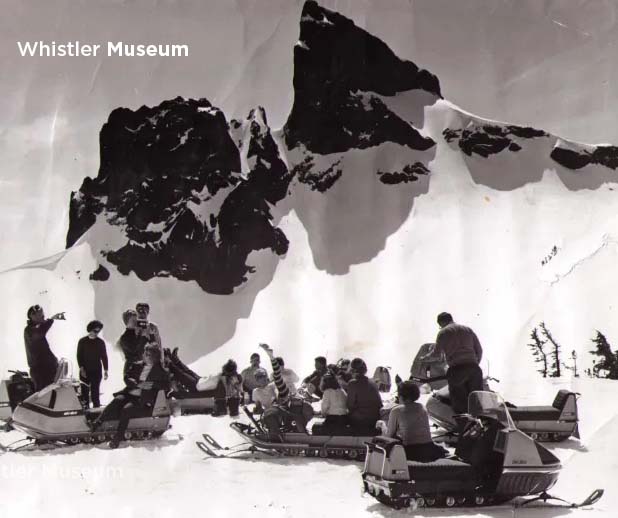
Feature Image: Snowmobilers take a break in front of Black Tusk. Judging by the sleds, this is probably from the early 1970s: however, unfortunately we do not have any details about this archival photograph.

This year 60 is a big number. 

Whistler Mountain is celebrating its ‘diamond jubilee’. 

Another sixtieth anniversary of note is the formation of the first local snowmobile club, on the opposite shores of Alta Lake.

The inaugural meet-up and race of the lower mainland-based BC Snow Vehicle Association was also held on Alta Lake, at the end of January, sixty years ago. 23 people competed in the event and the winner of the 20 gate, large machine slalom course was won by local Dick Fairhurst: completing the run in a whopping 39.9 seconds.

Dick Fairhurst was one of the ‘westside gang’ – a band of early residents – who called themselves the Black Tusk Snowmobile Club. The club (whose numbers are hard to confirm) would venture out and among the surrounding peaks, including Rainbow, Sproatt and up into the Callaghan. 

From R-L, Dick Fairhurst, Gray Mitchell, Stephan Ples, and Don Gow take a break on Callaghan Lake, March 1970. The entire upper Callaghan Valley, including Callaghan Lake, is now a non-motorized zone to avoid conflicts with backcountry and nordic skiers.

Dick – a logger and trapper of Cypress Lodge fame (now the site of the Point Artist-Run-Centre) and creator of the valley’s first ski ‘tow rope’ in 1960 – was one of the three founding members of the snowmobile club, along with Don Gow and Glen Creelman. Together, the three became the area’s first distributors of Bombardier Ski-Doos.

Don Gow moved here in 1955. He stayed and was the station agent at Alta Lake for four years, up until the train’s scheduled stop (in operation since 1914) was demoted to simply a ‘flagstop’ in 1959. However, the area’s appeal and pull was strong, and Don returned to Alta Lake in 1965 (along with his wife, who became the postmaster and their two children). They lived here until 1975.

Glen Creelman was a microwave technician. In 1957, BC Telephone Co. installed a double copper line around Alta Lake. Glen was responsible for establishing an open circuit/party line – linking lodges and homes with this new thread of communication. One was able to lift the receiver of the old crank telephones and listen in on your neighbour’s conversations. 

And surely, at that time, part of the talk of the town was the growing popularity and access to motorized sleds…

From up the Callaghan Valley. Fairhurst Collection.

Bombardier pioneered the development of the snowmobile. In 1966 – the year the Black Tusk club was formed; the year Dick won the inaugural BC Snow Vehicle Association race; and the year Don, Glen and Dick began selling the machines to the Alta Lake Community – the Canadian company released a line of three machines with “new, super slick styling.” The models included the ‘New Alpine,’ the ‘Olympique’ and the ‘Super Olympique.’ The latter was what Dick won the race on. The 250 lb machine had a roller chain in oil bath drive, the patented Bombardier track and was 2.36 metres in length. It was also bright yellow. 

Dick Fairhurst with sled-groms in front of Cypress Lodge (now The Point Artist Run-Centre) — on a neighbour’s sled, Ron Dent’s “Dentmobile” in 1965.
Fairhurst Collection.

Snowmobiling – or sledding, as it is more colloquially referred – remains as popular as ever as a thrill-seeking, backcountry sport. Handling has been honed and the horsepower hiked… but the same spirit seeking freedom, fast movement and further access prevails.  

Not all who sled are members of a club, but other regional groups now exist. The Powder Mountain Snowmobile Club has been operating since 1990. The Pemberton Valley Snowmobile Club was officially incorporated in 2000, but sledding stories in the area far precede that date, too

As for the Black Tusk Snowmobile Club, it ‘still’ exists, however its base now operates out of the Brohm Ridge former ‘Rat-Pack’ chalets. This particular incarnation of the club dates their inception to 1971. Records of how the Alta Lake-based group either entirely dissolved or transitioned to the current location are perhaps best described as being frozen in two-stroke time…

Time for Tea (treats, tales … and a tow rope!)Time for Tea (treats, tales … and a tow rope!)

2 Comments

Enjoying a cup of tea is a sanctified ritual for many… and Whistler’s past is steeped in its own lore and tradition with two pioneering tea houses (both with a twist!).

Before the advent of Whistler Mountain being developed as a ski destination (officially opened in January 1966), many early residents of the area predominantly lived on the opposite shores of Alta Lake. The Pacific Great Eastern railway line began running lakeside in 1914 and Rainbow Lodge, the first vacation destination, opened in 1915 as a fishing resort. 

Harrop’s Tea Room on Alta Lake, circa 1930.

In the 1920s, Bert Harrop purchased the point of land in the middle of the west side of Alta Lake. He had originally come to the area as a guest of Rainbow Lodge, whereupon his asthma improved greatly during his short stay. Enamored with the place, he and his wife Agnes first moved into a rented cabin and then into their own home – which Bert framed on the shores of Rainbow Lodge (with the help of the proprietor’s father) and floated it on a raft of cedar logs down to his new piece of land. It was secured to the shore and became a floating cottage. 

On the water’s edge, Bert built a building with a large porch which was supported by log piles in the lake. Harrop’s Tearoom was born and Agnes went into business.

Every summer, Betty Jane and Claudia visited the Harrop’s tearoom where they had a floating cottage right on Alta Lake.

Guests, made up of visitors and locals alike, would, arguably, come more for the gossip than the tea… and the fortune telling. Agnes had a designated indoor tea-leaf reading room (the accuracy or aftermath of her predictions remain undocumented!), infusing the experience and take-away of customers. Outside, people would gather on the floating verandah, enjoying afternoon tea amidst expansive views.

The Harrops Tearoom came to an end in 1948, when the couple sold the venture and moved on.

Six years later, in 1955, a new tearoom opened in Cypress Lodge (the site of the current Point Artist-Run-Centre). The lodge was built by Richard (Dick) Fairhurst, in the late forties/early fifties as a fishing camp. The buildings boasted electricity supplied by a generator and then later were powered by waterwheel, a novelty at the time. 

Dick’s mother, Elizabeth Alice, came up from Vancouver to run the tearoom. Noted as being a ‘colourful character’, Ma Fairhurst was equally famous for her beloved butter tarts. Besides baking, Elizabeth Alice cleaned the cabins, did the laundry and took care of the cooking for guests, while Dick was either tending his traplines in the Spearhead Range or logging with one of the nearby operations. 

A trademark of the tearoom was its ‘Hot Dog Friday Night’ which gathered many. Friday was synonymous with the once-weekly delivery of fresh food and meat by refrigerated train car to the community, and the occasion was worthy of celebration. 

Cypress Lodge also boasted the first tow-rope in the area. Built in 1960, a Ford V8 motor was used to pull 259 metres worth of rope through four pulleys affixed to four towers. The first downhill-only ski course in Whistler had been created on the slope directly behind the camp of cabins. Guests could come in from skiing for something sweet or grab tea and then go for a tow!

The Cypress Lodge tearoom closed 7 years after its inception, in 1962 to make room for more buildings, much to the dismay of the community.

Cypress Lodge as seen from the lake. Fairhurst Collection.

In the still-standing, main building of the original Cypress Lodge, the tradition of meeting over tea and treats, is being continued by the Point Artist-Run-Centre with its weekend Creative Café (www.thepointartists.com) … where, undoubtedly, here too, a few gems of local gossip get shared in fine, long-standing community fashion!

Join the ClubJoin the Club

0 Comments

In May 1976, the Alta Lake Community Club (ALCC) announced its first meeting since March 1972 and began recruiting new members. This was not the first time that the club had experienced a hiatus, only to re-activate.

In 1923, Grace Archibald suggested forming a social club. She, Lizzie Neiland, Flo Williams and a few other Alta Lake residents and regular summer visitors met at Rainbow Lodge to plan a picnic; from the resulting picnic, the ALCC was created. The ALCC started holding meetings in 1926 but it wasn’t long before the club took a break. In 1933, after almost seven years of inactivity, the ALCC started up again in order to raise money for a community hall, which they accomplished through weekly dances. Over the next few decades, the ALCC hosted dances, picnics, meetings, concerts, pot lucks, film nights, children’s parties and more.

Community Club Christmas Carol singers. From left to right: Andrew Roberts, Melanie Busdon, Clare Jennings, Rachel Roberts, Jessica Wilson, Sara Jennings, Roger Systad, Christopher Systad, Bishop children, Duncan Maxwell. Whistler Question Collection

The ALCC became inactive over the summer of 1972 and did not have another meeting until 1976 when a group of Whistler residents decided that, with Myrtle Philip School and its community space scheduled to open soon, it was time to revive the community club. They placed a notice in the recently founded Whistler Question to recruit members stating, “This is not a political or ladies only club. It is for single people and family groups interested in community recreational activities.”

About 35 people attended the ALCC’s first meeting of 1976 at the Mount Whistler Lodge. They elected a new executive and, with Frans Carpay as president, Ruth Howells as vice-president, BJ Godson as secretary, and Pat Beauregard as treasurer, the club was ready to plan new activities and events. Thanks to its previous activity, the ALCC already had $7,700 in the bank (just over $40,000 today when adjusted for inflation) and they decided to start by sending out a questionnaire to find out what kind of things people wanted to see from the club.

Dressed up at the Alta Lake Community Club Roaring Twenties Pot Luck Dinner, left to right: Max Maxwell, Kelly Maxwell, Diane Smith and Ken Domries. Whistler Question Collection

The ALCC hosted a “Soccer Ball” dance fundraiser that August to raise money for soccer balls and uniforms for the Whistler team, followed by an “old fashioned family fun and sports day.” In its first year back, the club hosted Halloween and Christmas parties (including a visit from Santa), supported the local Brownies and Cubs, held an Easter egg hunt, cooked pancakes for Mother’s Day, and even formed a drama club. They had used some of their funds to establish an annual scholarship for a graduating student from the Whistler or Garibaldi area and purchased sound equipment and tables that could be used by other groups. The ALCC had also started sponsoring events such as the annual ski swap and dance workshops because the club had the necessary liability insurance and were trusted renters of the school community space.

Margate Kogler ‘hams it up’ with a submarine sandwich in the kitchen at the Community Club Fall Fair. Whistler Question Collection

According to Ruth Howells, some of the most successful adult events hosted by the club were their suppers. These were so popular that they had to limit them to members and guests only and even then often ended up with a waiting list. Ruth summed up the success by saying, “Good food, good company and good music make for very enjoyable evenings.”

The ALCC continued to bring people together through events and fundraisers such as their annual Fall Fair into the 1980s. In 1981, they began hosting a “Welcome to Whistler” tea and in 1984 donated money to the RMOW for benches along the Valley Trail. As Whistler continued to grow, other clubs formed for different activities and interests and over time the ALCC wound down.