
The Dual Mountain Duel: 7th Heaven and Peak ChairThe Dual Mountain Duel: 7th Heaven and Peak Chair
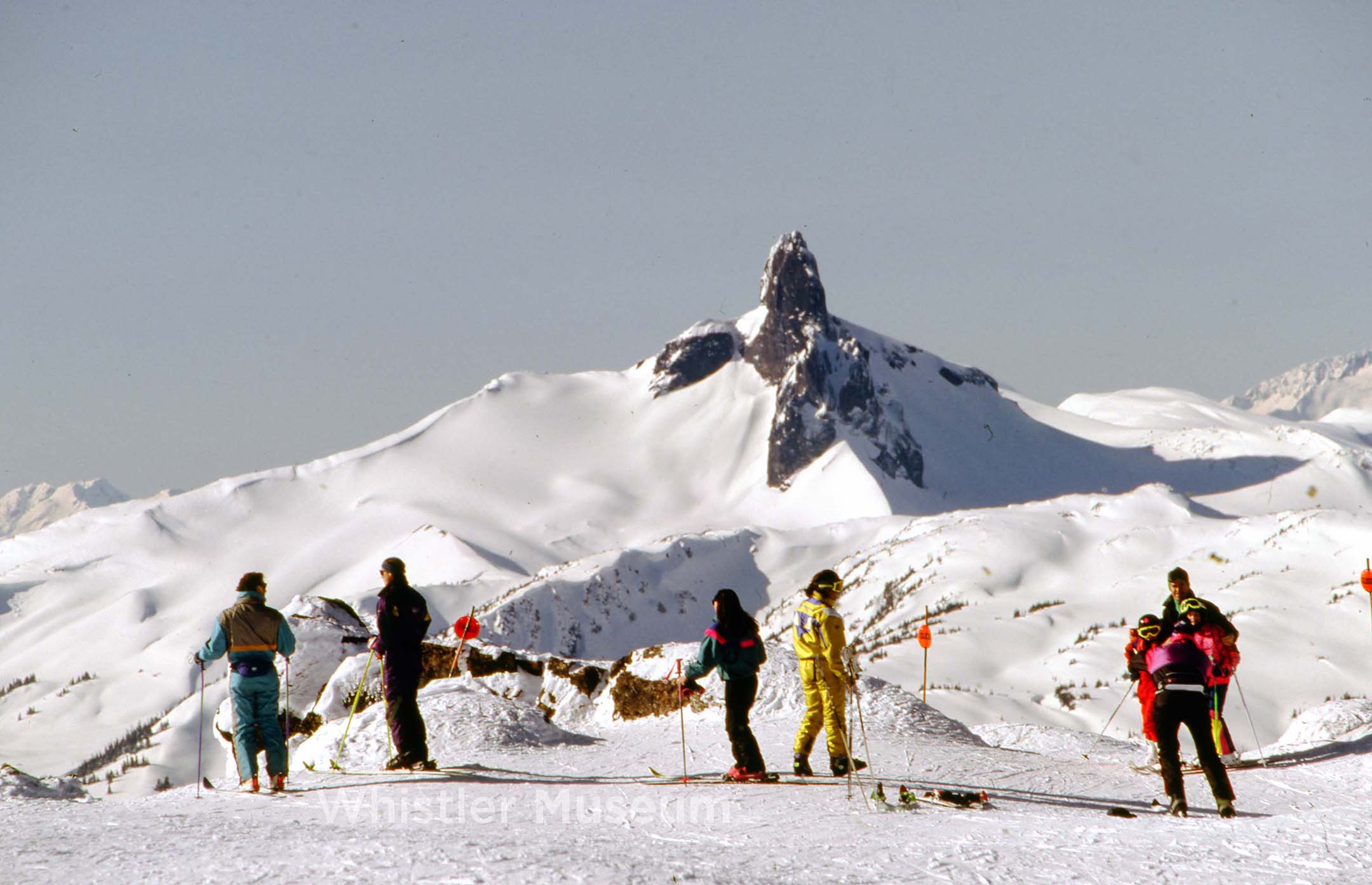
Top Image: Skiers atop Whistler Peak. 1990s. Griffith Collection.
This week marks the 60th anniversary of Whistler Mountain’s opening. Blackcomb Mountain opened in 1980. Whistler’s runs were designed more to side-run the mountain, whereas Blackcomb’s followed more of the fall lines.
Up until 1997, the two mountains operated separately. There was, however, a Dual Mountain Pass that could be purchased, granting access to both mountains. The pass was one of the only points of collaboration between the two competitors, whose rivalry was best showcased in their alpine lift duel.
In 1985, Blackcomb installed the 7th Heaven T-Bar: at the time, becoming the continent’s first, and only, “Mile High Mountain.” A vast amount of new terrain was opened up by this development – expansive glacial access and four powder bowls – extending Blackcomb’s skiable area by almost two-thirds. The significant upgrade served to dispel its previous uniformity in design. Skiers now could travel down runs covering 1160 acres, a substantial increase over the previous 420.
The alpine world had been opened up.

A young Mike Douglas (“Godfather of Freeskiing”, filmmaker and founder of the Canadian chapter of Protect Our Winters) described the experience of arriving at the top of 7th Heaven as being “dropped off at the edge of the world.” Nancy Greene (Olympic gold medalist voted Canada’s Female Athlete of the 20th Century) declared “The enormous variety of slopes and spectacular views are unequalled in North America.” In the forefront of those views was Whistler Mountain.
Whistler responded by countering a year later with the opening of the Peak Chair, a three-seater, one kilometre long lift depositing people just beneath the summit of the mountain at 2182 metres. The bar had literally just been raised (in every sense of the word!), one upping Blackcomb in the process.
Peak Chair was initially restricted to just advanced skiers. Snowboarders, at this time, were still not welcome on the mountain.

Challenging, cliffed, corniced and steep terrain characterized the area off the peak. Glaciated bowls and bouldered outcrops earmarked the summit’s geologic geography; whereas, its demography was being populated by seekers-of-skiing’s-extreme.
Blackcomb was not to be outdone. Riding 7th Heaven, arguably, remains the pinnacle of the Blackcomb experience. The following year, in 1987, 7th Heaven Express opened, replacing the two-year existence of the T-bar. The new four person chair, running along a longer and new lift line is the same one in operation today. Much like the Peak Chair, only skiers were permitted, when both first opened.
Blackcomb was the first to welcome snowboarders in 1988/89. Whistler followed suit; however, in this case, the mountain was much more reluctant to follow this trend, only opening their slopes to shredders a full year later.
In 1996, the two mountains joined forces, merging under the banner ‘Whistler Blackcomb.’ Continuing the streak of earning international accolades, the united front earned the Number One spot in SKIING Magazine’s ranking of the ‘Top 25 Resorts in North America’ (Tourism Whistler, 2019).
Two years later, Whistler further upgraded access to its alpine summit, with the unveiling of the four-seater, Peak Express. This same high speed, detachable chairlift remains in operation today.
And every morning, the eager and the energetic mingle and gather at the bases of 7th Heaven and Peak Express, awaiting Ski Patrol to finish their avalanche clearance protocols, in a bid to carve fresh tracks through unparalleled terrain.
The duel of the dual mountains – the rivalry of lifts and runs – may have ended on a financial and marketing level, but preferences ran – and still run – strong between slope-sliders and stylers as to which side of the mountain they prefer… along with their preferred method of flying down their chosen hill!