Tag: Karl Ricker

Obituaries in Ice…Obituaries in Ice…

0 Comments

“Hope plays a crucial role in how we notice and respond to glacial recession—not as a naïve optimism, but as a motivating force that helps communities stay engaged rather than overwhelmed. But hope reframes that experience. It reminds us that while change is happening, our actions still matter…”

– Alison Jenkins, executive director of AWARE

Alpine Club of Canada (ACC) member and longtime Whistler resident Doug Wylie has helped monitor two of our local glaciers consistently for the past two decades.

He has been visiting Wedgemount Glacier since 1984.

“I have a nice picture, actually, standing there. And ice was right in the lake. Quite a ways in the lake,” he says.

In 2011, Wylie began active annual monitoring of Wedge, joining Karl Ricker—an honorary member of the ACC, the highest rank bestowed by the esteemed organization, and part of the first team to complete the Spearhead/Fitzsimmons Traverse in 1964.

“I was really just a chain man. I would hold the end of the tape,” he recalls. “It was all very rudimentary, building with rock cairns and measuring by tape to the edge of the ice … we had no way to measure the depth and see how it was thinning. That has only happened in recent years with modern instruments.”

Wedge Glacier – Sept. 23, 2000. Wylie Collection

The Museum has an extensive collection of photographs and meticulous records gathered over the years from the accumulated observations. Records of loss, reading like obituaries.

“I think the thing that stands out is how [glacier recession has] accelerated,” remarks Wylie.

The Overlord Glacier has been another focus of long-term monitoring. Ricker first measured it in 1986, and Wylie joined him in 2006.

“Every glacier’s different,” notes Wylie, “but … the amount of recession and depth loss in the last half a dozen years has been really dramatic.”

Wylie has also photographed Blackcomb’s Horstman Glacier from the same location each September since the 1980s. “I’ve got a series of these,” he says. “It’s just a mess now … It’s all been happening quicker and quicker. That’s where hope becomes hopeless.”

I am struck hard by his remark. This from a man who continuously has a smile on his face. This from a man I first met in the backcountry, near Russet Lake. This from a man who, at the time of publication, was a week away from his 82nd birthday, and had biked in to meet me, leaving his hybrid vehicle at home: a home designed with a heat exchanger and passive solar system. This from a man who actively practices engaged activism. A man who I suspected, from his actions, was likely motivated by some form of “hope.”

Does he feel hope is hopeless? Is there any way we can reverse this? Or is he just monitoring a downward trajectory? I asked.

“You could be an optimist. You could be a pessimist. Somewhere in there is a realist,” Wylie says. When it comes to global warming and receding glaciers, “I’m a pessimistic realist,” he adds. “Or am I a realistic pessimist? Anyway, take your pick. On a global scale, we’re just not going to fix this. My grandchildren are going to suffer, right? But we still have to behave on a local scale.”

According to Alison Jenkins of AWARE, when people believe their choices can influence outcomes—even in small ways—they’re more likely to participate in climate solutions.

“Hope fuels community behaviours like choosing active transportation, reducing waste, protecting habitats, and advocating for policy change,” she says.

Both AWARE and Wylie point towards the necessity for action and advocacy from the local through to provincial, national and global changemakers. As the ice melts away and river flows dwindle, there is no one glacial recession doesn’t affect.

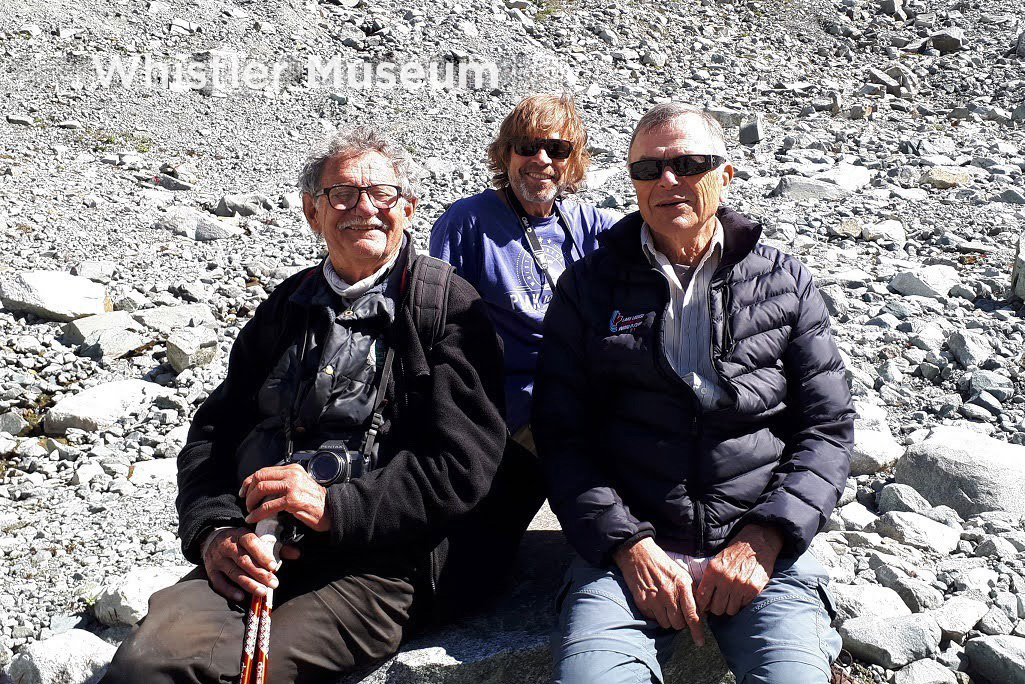
Photo: Karl Ricker, Bob Brett, and Doug Wylie September 6, 2020. Wylie Collection.

Constructing a CabinConstructing a Cabin

0 Comments

Thanks to the recent donation of some UBC Varsity Outdoor Club (VOC) Journals to our research collection, we’ve been enjoying learning more about how the VOC Cabin came to be.  Last week we took a look at the long search for a site, which culminated in 1965 with a piece of land in today’s Nordic Estates that was to be reserved for club cabins (find it here).

Once the process of finding a site was complete (and even before provincial government surveyors arrived to do their own survey of the area) construction began on the VOC Cabin at Whistler.  Most of the planning and construction work was done by VOC members, including many hours contributed by grads such as Byron Olson.  An architect, Olson postponed his planned trip to Europe to design the structure.  His plans called for a main structure with a lounge to accommodate parties and events of 150 people, a large kitchen, washrooms, a boot-drying room, storage, and separate dormitory structures designed to sleep 90.

The VOC Cabin under construction by VOC members. Karl Ricker Collection.

The plan was to construct the VOC Cabin in stages, beginning with the main structure.  The first stage included putting up walls and getting the roof on by Christmas 1965.  Construction began in August with “enthusiastic work parties of VOC’ers.”  While members volunteered to work on the cabin, the VOC did hire a CAT driver to help clear and level the site.  In the first couple of months, a road to the site was cleared, trails were cut and a waterline was installed.  Building was not, however, always straightforward.

VOC members carry supplies to the building site. Karl Ricker Collection.

Karl Ricker, who was heavily involved in the project, recalls that there was an old logging road that went to the site, which was used by the CAT driver and to get gravel for concrete delivered.  However, the logging road became unusable after the first rain.  Instead, equipment and supplies would be brought up the back road that came within half a kilometre of the site and then carried for the rest of the journey.  Most of the supplies came from Vancouver and, as the highway to Whistler had not yet been completed, had already been on quite a trip.

In the VOC Journal of 1965, Judy MacKay wrote that “autumn brought wind, rain, and a deluge of prospective new members to the site.”  Ricker recalls that each weekend between fifteen and 100 volunteers would arrive to work “like beavers” on the VOC Cabin.  The VOC members were not the only ones making their way to the site – according to Ricker a few Alta Lake residents would also appear each weekend to observe the students’ work.

The VOC Cabin begins to take on a familiar shape. Karl Ricker Collection.

By mid-October the VOC was getting close to finishing the first stage of construction.  By the end of the month, construction was at a point that the VOC Halloween party could be held at Whistler and MacKay reported that, “The cabin sagged and swayed in rhythm to every polka beat.”

Later in the season, however, mid-terms unsurprisingly meant that student labour was harder to come by and members of the Alpine Club helped with the roof and putting on shakes.  Ricker remembered carrying the windows for the cabin from the highway with snow on the ground about two weeks before the beginning of UBC’s December break.

VOC members get inventive carrying materials through the snow. Karl Ricker Collection.

Though there was still a lot of work to be done, the VOC did finish the first stage of construction by Christmas and the cabin was ready for some students who chose to spend their break at Whistler.  The lifts on Whistler Mountain, however, were not quite to ready and did not open in December as planned, leaving the VOC members to spend their holidays ski touring through the area.

Finding a SpaceFinding a Space

2 Comments

Last week we mentioned a recent donation of journals published by the UBC Varsity Outdoor Club (VOC) in the 1960s, covering the period during which the VOC Cabin in Whistler was built.  Combined with an oral history conducted with Karl Ricker (who donated the journals) last year, the journals provide a lot of information about how the VOC Cabin came to be, even before lifts began running on Whistler Mountain.

According to Ricker, Jack Shakespeare, a member of the Garibaldi Olympic Development Association (GODA), began attending VOC meetings in 1963 to promote the proposed development on Whistler Mountain.  At the time, the VOC already had a cabin on Mount Seymour but it was reportedly not being used as a ski cabin and so the VOC began to look seriously at building a cabin in Whistler in 1964.  The idea had to be approved by the VOC membership and it wasn’t immediately accepted by all, as Ricker recalls some people fighting to stay on Seymour.  The Whistler idea, however, did win out and the VOC began searching for a site to build a cabin.

VOC members touring around Whistler during an exploratory trip to the area in 1964. Karl Ricker Collection.

Charlie Daughney, then a Ph.D. candidate, led what was described in one VOC Journal as “the long and frustrating search for land.”  According to Ricker, the VOC first staked out land in what today is Kadenwood, but were then told that there would be no overnight parking at the Whistler Mountain lifts.  There was land available to buy at Jordan’s Lodge on Nita lake but the VOC did not have the money.  They were encouraged to look into applying for a piece of land on Alpha Lake but a search through records showed it was not Crown land but belonged to a man named John Quirk or his descendants.  The VOC even looked at building on the island in Alpha Lake but backed off due to the cost of building a bridge.

At the time the VOC was looking for a site the highway to the Whistler area was still under construction. Trips were taken by train or using the makeshift roads. Karl Ricker Collection.

Finally, in February 1965, the architect planners for the area and GODA told the VOC that there were plans to create a club cabin area in what is now part of Nordic Estates (Ricker mentioned that a club cabin area was also a way to guarantee customers for the lift company).  The next step was to find the tract of land set aside for club cabins, which at the time was simply marked by lines on a map.  In the early summer of 1965, members of the VOC ran a survey from the last known property lines in the area and put in their own stakes.

Surveying underway at the VOC Cabin site. Karl Ricker Collection.

As the first club to plan to build in the area, the VOC acquired “the choice lot” with views of Whistler Mountain and reasonable access to the parking lot that was to be constructed just off the highway.  Though it took longer than expected, official permission was granted by the provincial government to use the land for club cabins before the end of the summer.  In the process, Ricker received a call from a land inspector who had been told to inspect the parcel of land “right away” but didn’t know where it was.  Ricker met him at the train station and showed him to the parcel and, despite a few concerns, the land was approved for the VOC.  Government surveyors later arrived to do their own survey of the area but, according to Ricker, by that time construction of the VOC Cabin was already underway.

News from the Whistler MuseumNews from the Whistler Museum

0 Comments

Back in September 2020 we posted photos on our social media of exploratory trips taken by the UBC Varsity Outdoor Club (VOC) in 1964 and the construction of the VOC Cabin from 1965.  The photos were donated by Karl Ricker, a VOC member who had substantial involvement in the VOC Cabin.  Recently, Ricker brought in copies of the VOC Journal from 1964 to 1968 to add to our research collection and, though we’ve only taken a quick look so far (and are looking forward to examining the journals more closely), they appear to be a very valuable addition.

One of the photos posted on our social media, showing the construction of the Cabin by VOC members. Karl Ricker Collection.

The journals cover a period during which the VOC was exploring the possibility of a cabin in Whistler, constructing the cabin in Whistler, and beginning to put the cabin in Whistler to use.  According to the VOC Journal of 1964, the VOC Cabin on Mount Seymour was rarely being used as a ski cabin, as members could drive right up to the lifts, and skiing on Seymour was becoming increasingly crowded.  They also found that Seymour was “inadequate as an area for ski touring, for hiking, or for mountaineering,” the “most important activities of an outdoor club.”  Building a cabin in the Whistler area was thought to be an improvement as the long drive from Vancouver ensured most skiers would stay overnight, there was a proposal to develop lifts on Whistler Mountain, and the surrounding mountains would “present spectacular opportunities for touring and hiking.”  Members of the VOC made their first reconnaissance trips to the area throughout 1964 and began construction of the cabin in 1965.

Skimming the journals, mention of progress on the VOC Cabin are frequent and, as far as we’ve seen, optimistic.  In 1967 then VOC President Paul Sims wrote in his report of the upcoming completion of the cabin, saying: “When the last shake is nailed to the wall, and the last stone mortared into the fireplace, the construction at Whistler will be of a different nature.  The shaking will continue but from dances, pots and pans, sing-songs, laughter and conversation.  The building will bulge with eager and exhausted outdoor groups instead of construction crews.”

Karl Ricker in the midst of a socially distanced recording session (anyone not in front of the camera is also masked at all times).

The journals were brought in by Ricker when he came to the museum to record an interview for an upcoming exhibition by the Museum of North Vancouver.  We were excited to help facilitate the recording as it gave us a chance to try out equipment we’ve now been using in our virtual events.  This past weekend marked our first BC Family Day Kids Après: At Home Edition.  Rather than invite families to the museum, we created Kids Après Packs that brought parts of the museum to you.  Packs were picked up for free at the museum and included materials for two crafts and a Kids Après Activity Book, which combines stories from our exhibits with colouring pages, mazes, trivia and more.  We released craft videos online so that participants could craft along from home, creating their own skiing snowpeople and a (non-edible) mug of hot chocolate, a staple of Kids Après.

The same equipment was also used to create the craft videos as part of BC Family Day Kids Après: Home Edition.

Tomorrow evening we’ll be hosting our first Virtual Speaker Series of 2021, kicking off the series with Whistler Pride: A Look Back with Dean Nelson.  Though the Whistler Pride and Ski Festival was not able to go ahead this year, you could still see the spirit of the festival in the flags along Village Gate Boulevard – we’ll be learning more about how the festival started and how it has grown and become more visible with one of its long-time organizers.  You can register for the free event here.  Find out more about the rest of our Speaker Series line up for 2021 at our website here.