Tag: Windsurfing

Lake Fun in WhistlerLake Fun in Whistler

0 Comments

Whistler’s lakes offer a variety of water-based activities and are a great place to cool off during the summer heat. From sailing regattas and floating art galleries to swim races and a quadrathlon, Whistler’s lakes have seen it all!

The Alta Lake Sailing Club’s annual season end “Regretta” included sailing races as well as land-bound activities for participants of all ages. The first ever “Regretta” was hosted in the summer of 1965 and was named after the regret the community feels as the summer comes to an end. Today, the Whistler Sailing Association offers sailing programs, rentals, and races throughout the summer. Alta Lake and Green Lake permit motorized boats; however, on Alta Lake they must be kept under 10 horsepower. Non-motorized boats such as pedal boats, kayaks, canoes, and standup paddle-boards are welcome on all of Whistler’s lakes.

Participants in the Great Snow Earth Water Race rush out of the water. Whistler Question Collection, 1980

On Victoria Day, 1975, the Great Snow Earth Water Race first started. The first leg of Whistler’s version of the relay race included skiing from the top of Whistler Mountain, then running the remaining distance to today’s Creekside where the first baton pass-off took place. The next leg was a bike ride around Alta Lake where the baton was passed to the group’s canoe team. The canoeists then paddled through the River of Golden Dreams to the first weir and passed the baton to a runner who completed the race by running all the way back to Creekside. The 2014 revision of the race included an extra three components: ski or snowboard touring, downhill mountain biking, and cross-country biking. Unfortunately, the last Great Snow Earth Water Race took place during the 1990s.

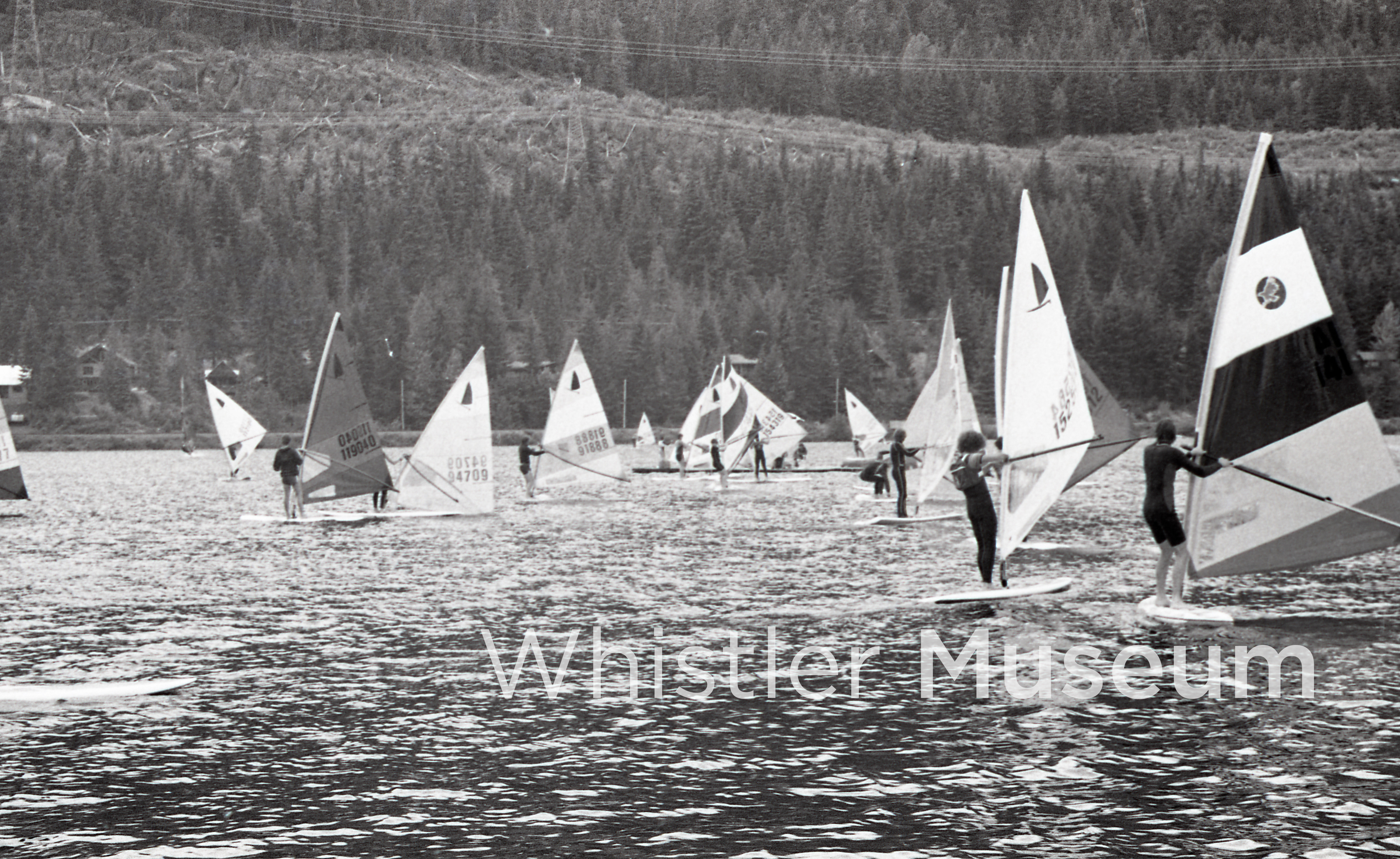
Windsurfers on Alta Lake in August 1981. George Benjamin Collection

Through the 1970s and early 1980s, windsurfing at Alta Lake became very popular. Whistler was home to multiple windsurfing regattas as well as a weekly race night. Participation eventually declined due to lack of availability of the equipment and legal issues. Windsurfers on Alta Lake were a concern for those participating in the Fun Fitness Swim Race in the 1980s. After a swimmer and windsurfer collided (both were ok!) the swim race was moved to Lost Lake. The Fun Fitness Swim Race was roughly a mile and a half long and was offered as a community fitness event rather than a competitive race. The swim race took place from 1979 until the early 1990s.

Today’s water-bound activities include paddling across Alta Lake and through the River of Golden Dreams. This route takes visitors past old growth trees, through lush scenery, and offers breathtaking mountain views. A round trip takes roughly 3 hours and can be completed in a kayak, canoe, or on a paddle-board. Tours can be booked or self-guided depending on skill and comfort level. Alta Lake is also home to Art on the Lake, which includes local artists, live music, and a floating art gallery. One of Arts Whistler’s more recent annual undertakings, the first Art on the Lake event was organized four years ago as a way to host an arts event during the pandemic. This event takes place in August and is accessible by boat, kayak, canoe or paddle-board.

A group (who appears to have forgotten their lifejackets!) paddle down the River of Golden Dreams. Whistler Resort Association Collection

Keep an eye out more more information on local lake activities to participate in this summer. Remember your sunscreen and towel for every lake day adventure!

Ella Healey is the Summer Program Coordinator at the Whistler Museum through the Young Canada Works Program.

Creating Whistler’s Parks: Lakeside Park, slowly but surelyCreating Whistler’s Parks: Lakeside Park, slowly but surely

0 Comments

Following Wayside Park, the second public access point to Alta Lake was at the end of Lakeside Road in Alta Vista, now known as Lakeside Park. Public access to Lakeside Park was first created in 1980, although there were few facilities. When writing about the park in 1980 the Whistler Question specified that, “This area is unknown to many Whistler visitors and residents.”

The relative anonymity of the park went further than the general Whistler population. While Lost Lake Park and Alpha Lake Park featured regularly in the news at the time, there was little information on Lakeside Park. In the one photo of Lakeside Park when it opened, the corresponding article was not even about the park, instead it was about councillor Garry Watson’s proposal to create public access to Alta Lake in the area that is known as Blueberry Park today.

Lakeside Park in 1980. Whistler Question Collection.

In 1982, the Parks and Recreation Commission flagged increasing the size of Lakeside Park through private land acquisition as the highest priority for Whistler. It was at the height of windsurfing when Alta Lake could be seen covered in brightly coloured windsurfers during the summer, and Lakeside was seen as ideal for windsurfer access. Additionally it had road access and parking, and was situated along the main trail corridor.

When the Whistler Rotary Club received its charter in 1976, one of their first projects was to build three floating docks for public use on Alta Lake. One of these floats was brought to Lakeside Park where it allowed visitors to get into the water past the horsetails. Part of the proposal was to further clear the horsetails near the dock, add gravel and sand to improve the beach and put picnic tables and garbage cans in the park. The bathrooms were pump-out septic systems on the shore of the lake and the road was gravel.

The Whistler Question wrote in 1980, “The Municipality has reviewed the opportunities in the Alta Lake area and without expropriation or purchase of private land property, the recreational opportunity in the Alta Lake area for swimming, especially a beach area for young children, is extremely limited.” A benefit of Lakeside was the room for expansion which could be possible through the purchase of private land on either side of the park.

Lakeside Park in 1984. Whistler Question Collection.

However, Whistler became more popular and the land more expensive, and out of reach for municipal coffers. It was very clear that more park space was needed on Alta Lake and in 1984 the idea of a referendum was posed. The proposed referendum would have a long-term policy question on how to reconcile the needs of residents in Alta Vista, with the needs of tourists flocking to the beach.

This was a particularly important question when a rezoning application was submitted to council to change one of the waterfront properties from residential to commercial. Not only would a busy restaurant mean more traffic in the area, it could set a precedent for rezoning approval, increasing the lot value of the area making the plan to buy waterfront land for parks economically unfeasible. Mayor Mark Angus said to the Whistler Question at the time, “How do we ensure that we don’t buy a 60 ft. lot for $600,000? We want the waterfront for the use of the public.” (If only 60 ft. of waterfront was only $600,000 today!)

Go past Lakeside Park on a warm, sunny summers day and you will quickly see it is no longer Whistler’s forgotten park. Bodies are regularly packed into every inch of the grass and docks with people arriving early to claim their space.

The expansions proposed to triple the waterfront area of Lakeside Park were never fully realised. Instead the municipality acquired the land for Rainbow Park on Alta Lake in 1987, and that is a story in itself.

Windsurfing was an incredibly popular pastime on Alta Lake. Benjamin Collection.

Peak Bros: A Whistler Comic Strip 1979 – 1992Peak Bros: A Whistler Comic Strip 1979 – 1992

3 Comments

The Peak Bros. comics captured the hearts and minds of Whistler when they were published between 1979 and 1992 in The Whistler Answer and The Whistler Review. The comics were based on the real-life adventures of Gord ‘Rox’ Harder and his friends, who became known as the Peak Bros. after their love of skiing Whistler Peak.

Gord ‘Rox’ Harder in the maintenance building on Whistler Mountain, where he worked as a journeyman carpenter. Harder Collection.

First created on the back of a Garibaldi Lifts Ltd. logbook, the Peak Bros. comics paid homage to the Fabulous Furry Freak Brothers. Gordy was an avid reader and admirer of the Freak Brothers, created by Gilbert Shelton and first published in Austin, Texas in 1968. The Freak Brothers followed the antics of a trio of cop-dodging cannabis-loving outlaw hippies. The Peak Bros. were the Whistler-ised version, where their outlaw skiing lifestyle gets the Peak Bros. into trouble. The ski police start to chase them, and the trouble begins! Celebrating 80s ski culture and the tongue-in-cheek humour of Gord Harder, Peak Bros: A Whistler Comic Strip, opens at the Whistler Museum on February 22nd 2023.

From left to right – ‘SO’, ‘Rox’ and ‘Crazy Harry’ all featured in the Peak Bros comics. Harder Collection.

With local people from the Whistler community featured in the comics, it could be a thrill to identify who characters were based on when each new Peak Bros. comic was released. Many of the true stories from the real Peak Bros. are as unbelievable as fiction. Building an illegal cabin below the Roundhouse, riding down the mountain on a windsurfer, and catching a helicopter up to the peak to join the Whistler Mountain staff party.

Rob ‘Bino’ Denham, one of the Peak Bros. windsurfing down Whistler Bowl. Photo courtesy of Dave and Laura Kinney.

Shawn Hughes, better known as SO, remembered one of their many adventures up Whistler Peak. “We would camp on the peak every full moon. That was the Peak Bros. tradition. Then we woke up one morning as a bomb went over. That’s when that tradition ended.” Until the close call brought around an abrupt end of the camping tradition, SO had not missed one winter camp in over 6 years.

Gord Harder, and the other real Peak Bros. were excellent skiers and could be found on the mountain every day. Janet Love Morrison recalled watching Gordy ski down the peak during a Whistler Mountain staff party. “There was no Peak Chair. Gordy and his friend, they had hiked up to the peak and they skied Don’t Miss, which is all [permanently] closed now. I didn’t know Gordy was the calibre of skier that he was when I met him, and I remember everybody started hooting and hollering and whistling and Gordy had jumped into Don’t Miss. Just like over the rocks and the whole face under the Peak Chair, he’s just bouncing like it’s effortless…” With everyone on the mountain watching they got a rock star cheer.

Tracks down Don’t Miss left from Gord ‘Rox’ Harder and Shawn ‘SO’ Hughes. Photo courtesy of Dave Steers.

In the late 1970s and early 1980s there was a massive crackdown on fast skiing on Whistler Mountain following a slew of visitor complaints. Whistler Mountain Ski Patrol were encouraged to catch speeders in the slow zones, and the patroller who issued the most warnings or confiscated the most passes received a dinner voucher for L’Après. With the Peak Bros. priority on skiing, and skiing fast, they were regularly the ire of ski patrol who would ticket them if they could ever catch them. Patrol even delivered warnings to Peak Manor, the clubhouse the Peak Bros. built in the trees below the Roundhouse. The comics mimicked real life with ski patrol forever chasing and regularly outmanoeuvred by the devious and athletic Peak Bros.

The ‘ski police’ were always after the Peak Bros. The chase became more and more elaborate throughout the comics. Harder Collection.

Come to the Whistler Museum to celebrate Gord ‘Rox’ Harder and the Peak Bros. The opening of Peak Bros: A Whistler Comic Strip 1979 – 1992 is on Wednesday the 22nd of February, beginning at 6:30 pm. The exhibition will be open until April 23rd 2023.

Windsurfing in WhistlerWindsurfing in Whistler

0 Comments

Before summers in Whistler drew thousands of mountain bikers to the area, Whistler was gaining a reputation for a sport that took place on the water: windsurfing. As the sport of windsurfing became more popular in the late 1970s and early 1980s, Alta Lake became a hot spot for many Canadian windsurfers, as shown in the many photos from the 1980s that feature windsurfers of various ages, skill, and standards of dress.

According to Jinny Ladner, a former Canadian windsurfing champion, the first board was brought to Whistler by Mark Dufus in 1975, though not many people in the valley know much about the sport at the time. Looking at reports from the summer of 1981, however, it would appear that once windsurfing was introduced to Whistler it took hold and grew quickly.

Windsurfers on Alta Lake, sometime between 1981 and 1983. George Benjamin Collection.

While you might think that May 1981 would have marked the beginning of the windsurfing season in Whistler, apparently a few hardy souls had already been seen with their boards on Alta Lake as of January 1. For most windsurfers, however, in May the season was just getting started.

According to the Squamish Citizen Shopper, Whistler Windsurfing and Blackcombe Sports were the two main businesses offering rentals and instruction. For newcomers to the sport, the Citizen helpfully noted that, “in consideration of the fact that learning how to windsurf involves falling in the water quite a bit, anyone wishing to take lessons should be able to swim.”

Sails flapping, windsurfers in the first heat of the men’s Triangle races skim away from the starting line during the BC Windsurfing Championships on Alta Lake. Whistler Question Collection.

In 1981 there were plenty of ways for those interested to get involved in the sport, from novices to international competitors. Blackcombe Sports offered membership to the Blackcombe Boardsailing Club, which included free use of a board for the summer, discounts on lessons and sales, and free entry into all Club-sponsored events. Whistler Windsurfing co-sponsored an instructor course with the Canadian Yachting Association and the British Columbia Sailing Association. They also ran the Whistler Windsurfing Summer Series, a series of weekly races beginning in early June. Race results were tallied to come up with a monthly winner and at the end of the summer the monthly winners would compete to become the overall winner.

Other windsurfing events held on Alta Lake that summer included the Whistler regatta in June, the British Columbia Championships in August, and Whistler’s first Great Waters Race in September, though the Great Waters Race was not strictly speaking a windsurfing event. As part of the Whistler Fall Festival, five-person teams (at least two of whom had to be women) competed in canoeing, swimming and kayaking along with windsurfing. The windsurfing portion of the race may not have been the most successful, as it was later described by the Whistler Question as “a paddling race due to lack wind.”

Andrew Stoner, owner of Whistler Windsurfing, now has to take a definite step up in the world to jump the gap between his docks on Alta Lake. Whistler Question Collection.

Whistler residents were well represented at the Canadian Windsurf Championships in September that year. Jinny Ladner and Andrew Stoner (one of the organizers of the Summer Series alongside Doug Schull) earned places as two of the five Canadians traveling to the Windsurf World Championships in Okinawa later that year.

Windsurfing remained a prominent sport on Alta Lake through the 1980s and 1990s, but the sport experienced a decline in popularity in the late 1990s. While it is less often that you will come across windsurfers on Whistler’s lakes, windsurfing has seen a resurgence in the last decade and windsurfers and kitesurfers will often be found in Squamish.