
Keep on Pushin’… the Man behind the SkateparkKeep on Pushin’… the Man behind the Skatepark
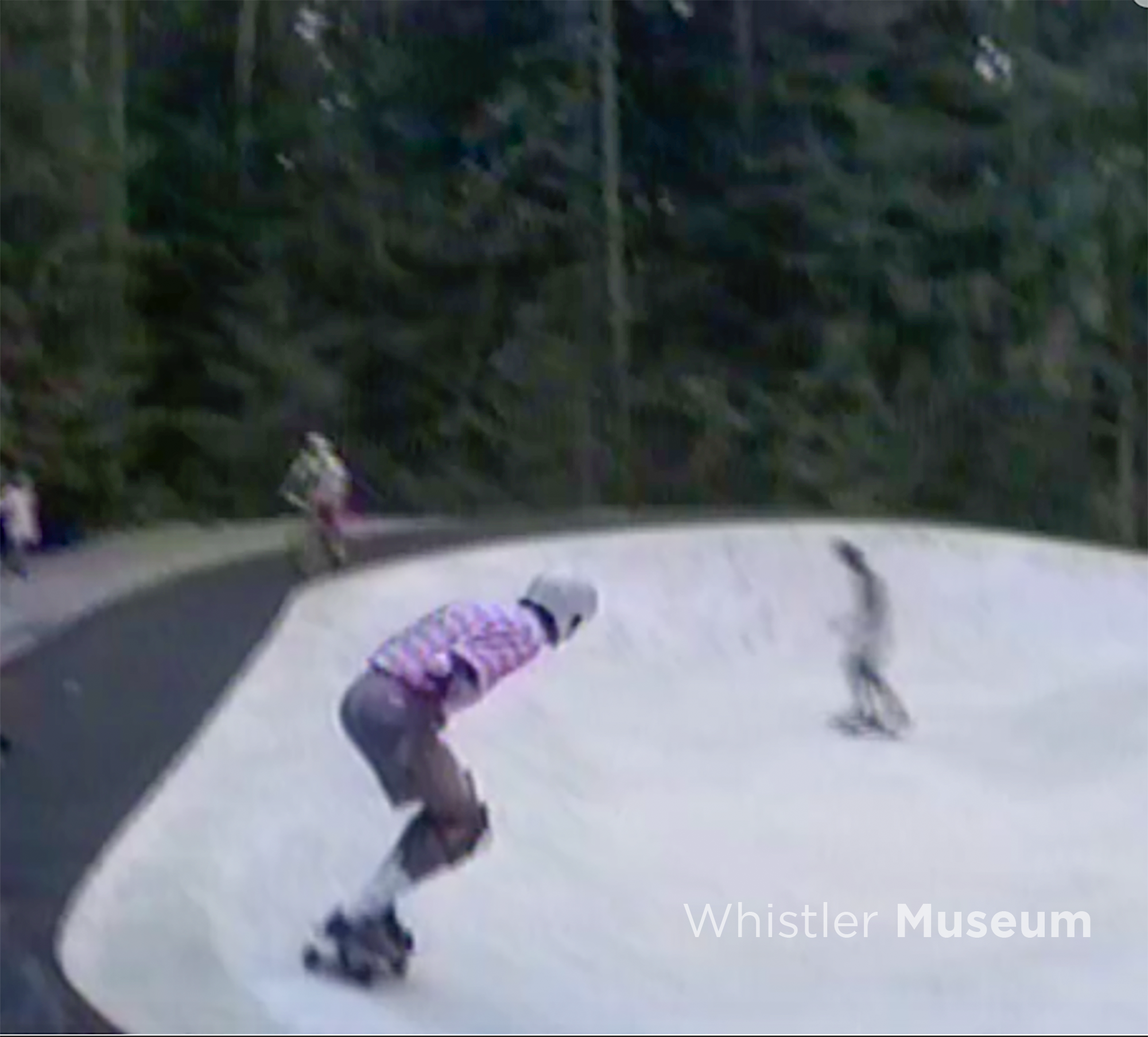
Photo: VHS screengrab of Monty Little skating the newly opened bowl. 1990. Little collection.
The 79-year-old man who designed the original Whistler Skatepark first came here when he was 17. On a motorcycle, by himself. He got run off the road by a logging truck. Rattled, but unphased, he carried on to Alta Lake, enjoyed a swim, then rode back to Vancouver.
He would return to Whistler four years later, in 1968. “I drove up to the Gondola Barn [in Creekside], as it looked like the place to go, and the first guy I ran into was Jim McConkey.” Monty Little became McConkey’s first-ever employee.
Little ran McConkey’s rental shop. “I would start early on Saturday morning at the top of Taylor Way in West Van with my thumb out hitchhiking a ride to Whistler. … After I got the rentals out, about 10:30 I would head up to the Roundhouse where I ran the little ski shop up there.”
Little usually “would go all the way back to West Vancouver, hang with my friends. On Sunday morning, I’m back out there thumbing a ride all the way back up.”
Though never a resident of Whistler, Little would later develop the Blackcomb Discount Lift Program in 1982 in conjunction with SuperValu: “a big bonus for Blackcomb who were the new guys on the block. They needed help.”
When talking mountains, Little was a skier-turned-snowboarder. In the city, he was a ‘sidewalk surfer’-turned-skateboarder – a man at the genesis of the sport. “The best compliment I’ve ever received was the United States had Frank Hawk and Canada’s got Monty Little.”
“I made my first board in 1963” with steel wheels “slapped onto a two by four.” In ‘65 he upgraded to clay ones with Chicago trucks for $12.50.
50 years ago, Little organized the first skateboarding competition in BC in Stanley Park. “CBC’s award-winning TV show W5 came out, covered the event for part of their documentary they were doing on this fad called skateboarding.” The contest was a huge success.
In 1977, Little helped form the Canadian Pro-Am Skateboard Association. That same year, Little was responsible (with the YMCA) for the creation of the “first skatepark in Canada” in West Vancouver. However, the municipality, claims Little, said there were too many interested kids showing up – so they instructed the builder to change Little’s plans from one run to two. Away at the time, when Little returned and saw the “disaster,” he almost cried. “The top of the park [wasn’t] even functional. I don’t take any credit for designing the West Van Park as they strayed from my plans.” It was buried in 1984.
Little’s reputation remained intact and subsequently co-designed the legendary Seylynn and William Griffin Parks in Greater Vancouver.
“And this is where we come to Whistler…” Little begins tearing up.

“I remember the call. … ‘We’d like to build a skate park along the banks of Fitzsimmons Creek. Would you come and take a look at it?’” Little jumped in his car, early Spring 1990, came and viewed the site covered in cottonwoods and agreed to the project.
Enlisting the help of builder Terry Snyder, on August 11th – mere months later – the first skaters were allowed in the park. “The reservoir, the snake run of the bowl all happened at once.” The official opening would happen a few weeks later. This week, the first phase of the Whistler Skatepark celebrates its 36th birthday!
Little’s design for the Whistler park was inspired by the snowboarding and skiing culture – “They’re going to come down from the snowboard camp and want to play, and they’re going to want to carve just like they’re used to. So I made it a bigger park, bigger hips, so you can go way up this wave of this hip and then across … and pump your way back up.”

Whistler’s Skatepark – and Little’s contribution – holds an important part in Canadian Skateboarding history. The park remains one of the country’s largest. It has been expanded (Phase II designed by Jim Barnum). It is also one of the featured stops of the second-oldest skateboard contest in Canada: ‘The Bowl Series’ and houses such inspiring initiatives as those facilitated by the Real Wild Kittens. Meanwhile, Monty Little “keeps on pushin’”!


