Tag: photography

Grief in archives: Handling the collection of photographer, Bruce RowlesGrief in archives: Handling the collection of photographer, Bruce Rowles

0 Comments

By Kat Hodgson

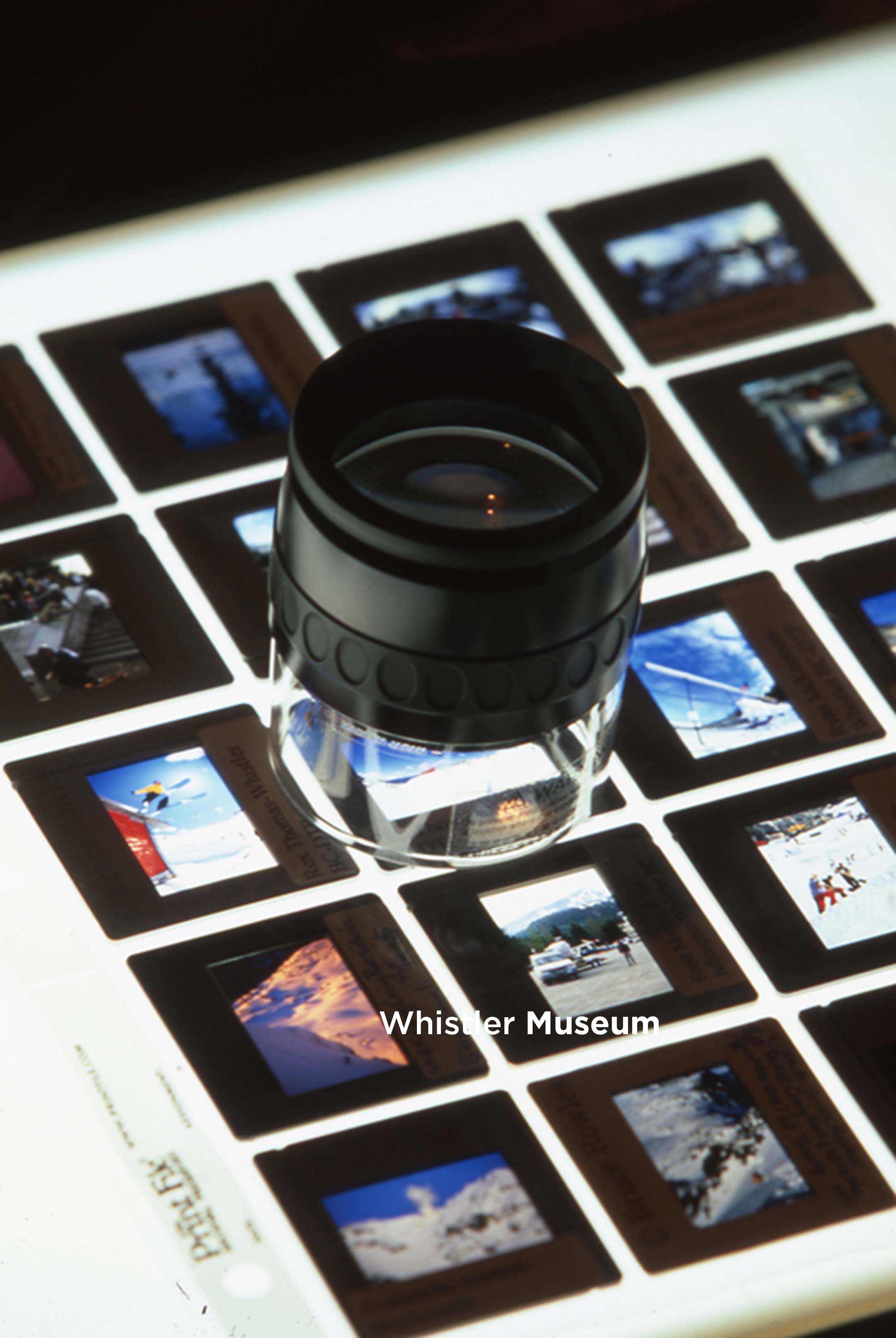
Featured Image: Bruce’s photo of his light table setup to view his slides.

Before beginning my internship at the Whistler Museum, I had never visited the town before. In October 2025, I arrived as an outsider. I also arrived grieving.

The day before I moved, my grandfather suddenly passed away, marking the fourth loss in my family in two years. As I settled into this unfamiliar place, the nerves and excitement that come with a new job and community were tinged with the constant weight of grief. 

This mindset shaped how I approached the project of organizing the Bruce Rowles Collection. This collection of 35mm slides, documents, posters, and much more was generously donated by the family of Bruce Rowles in batches from 2024 to 2026. Comprising over 70,000 slides, it is now the largest photographic collection in the Museum’s archives. Working with it offered me the chance to get to know Whistler as Bruce saw it, while also viewing glimpses of the life behind the camera.

Bruce Rowles, often called Rowlesy by friends and family, was a prolific photographer and artist who spent more than three decades in Whistler. His photographs captured action-filled competitions and wild nightlife scenes, but also contained quieter moments, such as vast landscapes, meals and trips with friends, or photos of plants and insects that he’d found beautiful. Some slides were labelled with quips that let his personality shine through, hinting at the humour and creativity that guided his work.

A wonderful example of one of Bruce’s quips with his commentary on his slides.

For me, the most striking materials in this vast collection are three binders labelled “Lost Friends”. They contain portraits, sports shots, and candid photographs of individuals Bruce had known and later mourned. Nearly every slide is labelled with names and locations, already arranged in archival-safe sleeves as an act of remembrance as much as documentation. In assembling these binders, Bruce preserved not only the images of these people, but also the memories and relationships he had with each of them.

Working with these materials, I came to understand the collection through the lens of grief, both my own and that which he was expressing in each carefully arranged page. Scholars have described this response as “empathic grief”: the emotional weight archivists may feel when encountering records shaped by loss. All records are connected to lives, and often to those who are no longer with us. That persistent connection can make it difficult not to recognize and react to the emotions held in records, requiring the archivist to carry them throughout their work, sometimes even feeling them alongside their creators. 

Bruce’s collection both captures and expresses several positive emotions – celebration, humour, excitement, and curiosity, to name a few – while also making space for absence. Over the past six months, I’ve felt all of them, allowing me to see the world through Bruce’s lens. His careful remembrance of others became, unexpectedly, a reminder that grief is part of the greater act of loving someone. In the midst of my own losses, that perspective helped shift my own grief from being purely painful into something that could also hold gratitude for the privilege of getting to carry memory forward.

Bruce wanted to ensure his life’s work would be remembered and appreciated. A selection of his photography will be exhibited at the Whistler Museum from April 24th to June 14th.

Bruce captures humour with his self-portrait.

Kat Hodgson was the Assistant Archivist at the Whistler Museum this winter through the Young Canada Works in Heritage Organizations (YCWHO) program.

Revolution: Whistler MTB in Photos & ArtRevolution: Whistler MTB in Photos & Art

0 Comments

So we’re in the final countdown leading up to our first ever Whistler Mountain Bike Heritage Week. Here we’d like to focus on one specific event that we’re especially excited about, Revolution: Whistler MTB in Photography and Art.

This is a photography and art show we’ve organized that will be on display in the Gallery at Maury Young Arts Centre (formerly known as Millennium Place) from May 16th -June 13th . The show features some of the world’s leading mountain bike photographers, artists, and athletes, including the work of Sterling Lorence, Justa Jeskova, Reuben Krabbe, and many more.

ONeill-0001-06Samurai_038-lowres
This photo by Robin O’Neill, portraying an epic climb on Whistler Mountain during the Samurai of Singletrack race, is one of more than 30 images comprising our Revolution MTB art show.

While the art on display is absolutely top-notch, the images have been selected to portray the full range of the Whistler MTB experience, including the strong sense of culture and community that exists here. Images range from alpine to valley bottom, in all weather and light conditions, with world-class pros and Average Joes, showcasing the trails, terrain, talent, and passion that makes Whistler a Mecca of the global mountain biking scene.

As with all shows in the Gallery at Maury Young, this is 100% free to check out, just head in at any time during the Arts Centre’s regular hours.

Artwork on display has been generously donated by the artists and will be available for purchase via silent auction, with all proceeds going to support mountain bike-related programming and archival work at the Whistler Museum. To check out all of the pieces, and to place a bid, simply head to: http://www.32auctions.com/mtbweek

This exhibit is produced with generous support from the Resort Municipality of Whistler, and in partnership with the Whistler Arts Council.

***

Even if you weren’t able to get one of your biking shots included in the show, we’ve devised a way for everyone to get in on the action. We’re having a mountain bike photography contest, with the chance to win a canvas print of one of the photos on display at the show.

Entry is easy, simply post your best Whistler mountain biking photos to Facebook or Instagram, tag the @WhistlerMuseum and #WhistlerMTBWeek, and you’re entered. The contest will stay open until May 31st , after which we’ll select our favourite for the grand prize. Easier than changing a flat!

We hope to see you at some of this week’s MTB Week events, kicking off Wednesday May 18th at 6pm at the Whistler Museum with “Dirt Masters: Whistler Trail-building Through the Decades” featuring panelists Eric Wight (Whistler Backroads), Jerome David (former WORCA Trails Director), and Dan Raymond (builder of Wizard Burial Ground, Lord of the Squirrels, and many more). Tickets are $10, $5 for members of WORCA and the Whistler Museum.

See you there, or on the trails!

Whistler MTB Heritage WeekWhistler MTB Heritage Week

0 Comments

Over the last three decades, mountain biking has woven itself into the fabric of our community and Whistler’s distinct biking scene has spread its influence across the world. To celebrate this proud tradition, the Whistler Museum is hosting our first ever Mountain Bike Heritage Week, a full series of daily events running from May 18-23rd.

mtbweek_full_V3_11x15_final

We will be holding three separate Speaker Series events, each focusing on different aspects of Whistler’s MTB scene, beginning with an ode to those unsung heroes of the biking world – the trailbuilders. Dirtmasters: Whistler Trailbuilding through the Decades will explore the past, present, and future of Whistler’s world class trail network.

With thousands of dedicated riders, it’s safe to classify Whistler’s biking community as a horde of raving die-hards. Find out how our local scene grew from niche to enormous at Whistler MTB: Building a Community, a panel discussion featuring local organizers, coaches, and more on Saturday May 21st. The Speaker Series trilogy concludes the following evening as we expand our view outward with Whistler MTB Gone Global, featuring local riders and entrepreneurs speaking firsthand to the worldwide influence and appeal of Whistler mountain biking.

photo: Robin O'neill
Riders climb towards Whistler Peak during the Samurai of Singletrack race. Check out this photo and many more at The Gallery at Maury Young Arts Centre, May 15-June 14th. Photo: Robin O’Neill


It is a mountain bike festival, after all, so there’s more than just panel discussions going on. May 19th, being a Thursday night, we’ll be teaming up with the leading institution of Whistler’s MTB community, WORCA’s weekly Toonie Ride. Riders will be encouraged to break out the spandex, the clunkers, and any other retro gear stashed away in storage that you just couldn’t bear to part with. The ride will begin at the bottom of Scotia Creek on Whistler’s westside.

For all the freeriders out there, we are organizing a free screening of the classic freeride film Kranked 3 on Friday May 20th at Forlise Whistler in Mountain Square. We’re especially excited to be able to include a filmmaker Q&A with special guests Bjorn Enga and Christian Begin.

A legendary rider on a legendary feature. Brett Tippie on Whistler Mountain. Check out this photo and many more at The Gallery at Maury Young Arts Centre, May 15-June 14th. Photo: Margus Riga

Underpinning the whole festival is Revolution: Whistler MTB in Photography and Art, featuring some of the world’s leading mountain bike photographers, artists, and athletes, including Sterling Lorence, Justa Jeskova, Reuben Krabbe, and many more. Running from May 15th until June 14th at The Gallery at Maury Young Arts Centre, this exhibit will showcase the trails, terrain, talent, and passion that makes Whistler a Mecca of the global mountain biking scene.

Artwork on display has been generously donated by the artists and will be available for purchase via silent auction, with all proceeds going to support mountain bike-related programming and archival work at the Whistler Museum. This exhibit is produced with generous support from the RMOW, and in partnership with the Whistler Arts Council.

Local riders enjoying the recent expansion of bike trails into the alpine. Check out this photo and many more at The Gallery at Maury Young Arts Centre, May 15-June 14th. Photo: Justa Jeskova.

The Whistler Museum will also be showcasing historic photographs and artifacts as we unveil a new display about Whistler’s mountain bike heritage in our permanent exhibit. Everyone is invited to come check it out during our regular admission hours or during one of the three evening Speaker Series events.

Everyone is encouraged to enter our Instagram contest, simply by tagging their riding shots with #WhistlerMTBWeek between now and May 23rd. Our favourite shots will be selected for great swag and prizes from our many awesome sponsors.

Of course it wouldn’t be a mountain bike festival without a ton of actual riding, so keep your ears and eyes open for a number of impromptu and informal group rides and bike park hot laps throughout the week.

Whistler Mountain Bike Heritage Week is produced by the Whistler Museum in partnership with WORCA, the Great Outdoors Festival, the Whistler Arts Council, and Forlise Whistler. It would not be possible without the generous support of the Resort Municipality of Whistler, the Province of British Columbia, Deep Cove Brewing, Chromag Cycles, Vorsprung Suspension, Whistler-Blackcomb, Whistler Bike Co., & David’s Tea.

Leonard Frank: Whistler’s First Pro PhotographerLeonard Frank: Whistler’s First Pro Photographer

0 Comments

With the incredible advances in digital photography over the last decade, it’s become a cliché that everyone is now a pro photographer. Simply attending the annual Pro Photographer’s Showdown, or browsing the catalogue of one of Whistler’s many true professional photographers, however, will quickly dispel such notions. Still, technology has levelled the playing field to a certain extent, making it quite simple to take competent, even beautiful images with minimal training.

Go back eighty or nintety years and this was most certainly not the case. Cameras were heavy, expensive, cumbersome, and complicated, not to mention the challenges of processing film (remember that stuff?) in the 1920s.

Take the couple of thousand photos we have in the Philip collection. Judging by the sheer quantity of images, it can be safe to assume that Myrtle Philip was a fairly competent amateur photographer for her time. Still, a solid majority of the images are imperfectly focused, overexposed, or awkwardly composed. As documentary artifacts they are wonderful, but for the most part they are lacking  in artfulness.

Scanning through the Philip archives, however, the occasional gem stands out. Crisp images, deliberate composition, some have even been hand-painted to add the magic of colour. These are undeniably the work of a professional.

These images are not the culmination of years of devotion to the photographic arts by Myrtle. Instead they were gifts and mementos from a friend and frequent Rainbow Lodge guest, Leonard Frank.

Leonard Frank, undated self-portrait.

Son of one of Germany’s earliest professional photographers, Leonard Frank was born in Berne, Germany in 1870. Gold fever drew Frank to San Francisco in 1892, then Vancouver Island two years later. Like so many would-be gold barons, his dreams of mineral riches never panned out. As fate would have it though, he won a camera in a raffle, sparking a lifelong passion.

While managing a general store and continuing to prospect, Frank honed his craft taking  pictures of the surrounding countryside. Eventually, in 1917, Frank moved to Vancouver and quickly became the city’s leading commercial photographer, following in his father’s professional footsteps.

North Vancouver's iconic Lions.
North Vancouver’s iconic Lions.

From then until his death in 1944, Frank ‘s diverse photographic catalogue is a crucial document of Vancouver and British Columbia’s history. Beyond his personal and commercial work, he was frequently commissioned to photograph for both the provincial and federal governments, as well as being the official photographer for the Vancouver Board of Trade.

Brandywine Falls from a now inaccessible vantage point, circa 1920s.
A boater's view of Rainbow Lodge and Rainbow Mountain.
A boater’s view of Rainbow Lodge and Rainbow Mountain.

Frank’s Alta Lake images in our collection span from the 1920s until the 1940s, indicating multiple trips to the valley. For the most part it is unclear whether the images were commissioned by the Philips to promote Rainbow Lodge, were commissioned by other parties, or were taken on his own volition.

The following image, surely one of the most beautiful in our entire collection, is accompanied by a typed note “Presented to Mr. and Mrs. Alex Philip, with my compliments, Leonard Frank, A.R.P.S.” ARPS is short for “Associate of the Royal Photographic Society.” Frank was the first British Columbian bestowed with this honour.

Alex Philip takes some Rainbow Lodge guests for a paddle down the River of Golden Dreams, 1941.

From today’s perspective, where visual media is such a crucial tourism-promotion tool, these photographs are of heightened historical interest. Leonard Frank was the first professional photographer in a town that has become known for its abundance of pro photographers.

By any standard, Frank’s images expertly portray an idyllic destination amidst a grand, inspiring landscape. In his own way, he contributed to the Whistler Valley’s development as a nature-tourism destination, and led the way for dozens of others who have made  a living capturing our valley’s natural charms.

For more information about Leonard Frank, and examples of his images, check the Vancouver Public Library‘s extensive Leonard Frank Collection, this short blog post by Miss 604,  or try to track down a copy of the 1990 book An Enterprising Life : Leonard Frank Photographs, 1895-1944 by Cyril E. Leonoff.