Tag: kayaking

Kayakers as Glacier GaugersKayakers as Glacier Gaugers

0 Comments

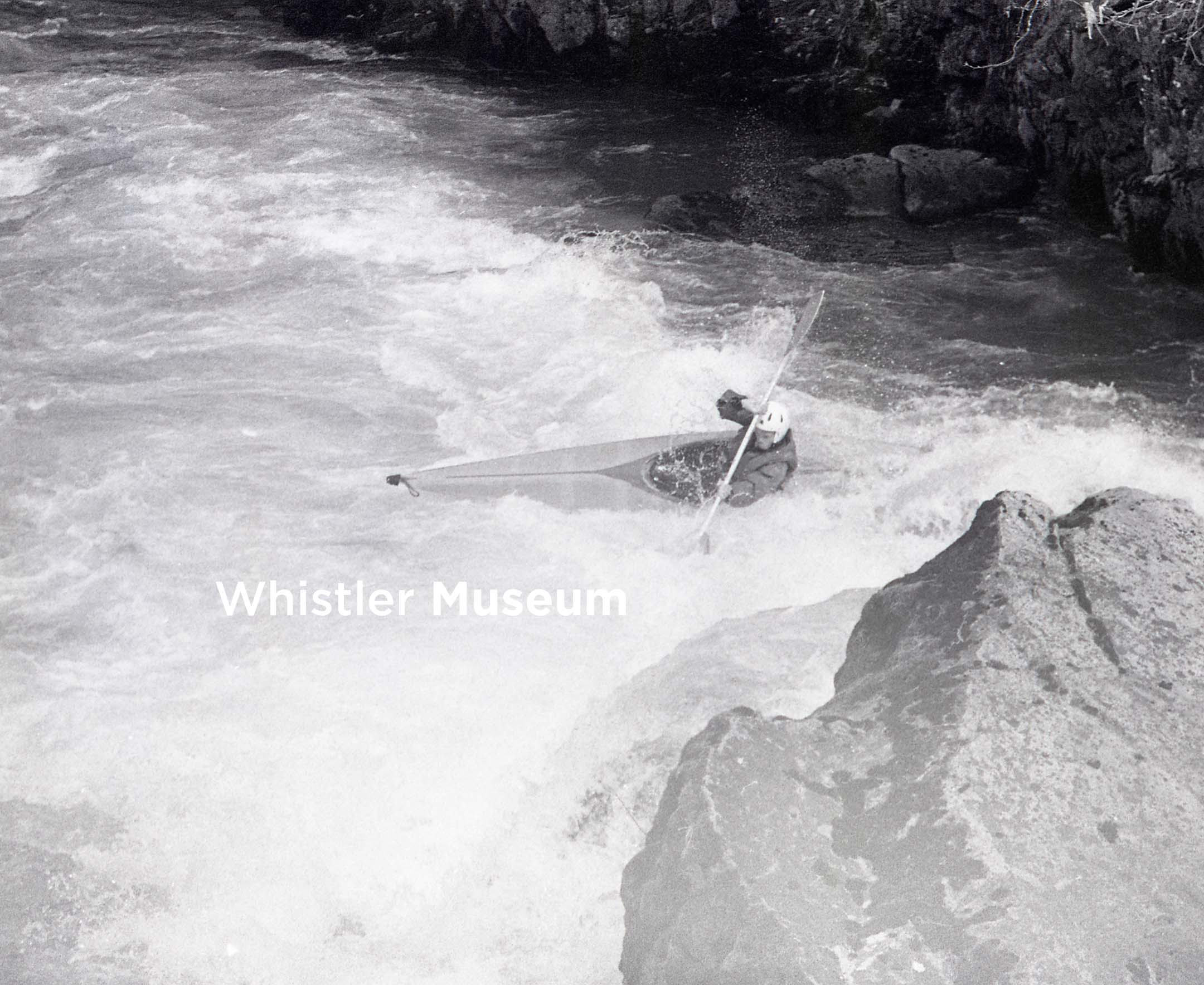
Featured Image: Lyall Featherstonehaugh paddles the Cheakamus River on May 11, 1980, during a demonstration organized for the Whistler Chamber of Commerce to showcase kayaking opportunities in the Whistler area as part of their May Day celebrations. Whistler Question Collection.

Longtime Whistler kayaker Shawn ‘Puddles’ Hughes left me with an interesting concept: he said he viewed his paddling as a way of “recycling the snow.” In the winter he skis, in the summer, he rides the snowmelt down the rivers – sporting an intimate balance with the hydrological cycle. However, the notion of balance is perhaps, now, better replaced with the term ‘dance’ or ‘positioning’…because, as Hughes has experienced firsthand, over the decades, the waterflow levels and patterns have been changing.

I was fascinated. The impact of glacial recession on local skiing and snowboarding has garnered attention with the closing of the Horstman Glacier on Blackcomb for summer camps in 2023, however this was the first time I had had reason to consider the impact on other non-on mountain sports. As the Whistler Museum actively continues to gather oral histories from a generational cross-section of local kayakers, I extended the question to Archer McLeay, a pivotal advocate within and for the paddling community: a relative newcomer on the scene, having lived in the Sea to Sky for 5 years, moving here, however, for the kayaking.

I asked McLeay, if in his handful of years here, he had witnessed the impact of glacier recession in the waters. He unequivocally answered: “It’s drastic.”

This aligns with Hughes’ deduction that “after 40 years of visually watching this, we’re in some trouble.”

McLeay elaborates “ideally … you get a huge snow base, and that’s what’s traditionally happened. […] Normally, there’s just a massive amount of snow up here. It all melts pretty consistently throughout the year, and you should get like a nice long season.” But that has been changing.

“The Cheakamus has got a way bigger glacial head bond, so that one tends to flow all year, regardless of what’s happening,” McLeay remarks. Hughes concurs, “Cheakamus is pretty safe because it does have a fairly big pack, but no, it’s still shrinking as quickly as everything else.”

McLeay continues, “But for all of our snowmelt rivers [the Callaghan is the main one], the snow will melt, and then after that, it’s just feeding on the glacier. So if you have a big heat wave, it’ll come through, and then the snow melts a lot faster than the glacial water, and then you’ll end up with just glacial melt running for the rest of the year. And so the season’s shorter. There’s less water to go along, and then if there’s a heat wave, it’ll just shorten the season just, boom, just in half.”

Hughes breaks it down simply: “when you take a big piece of ice and you keep shrinking [it] down, there’s some part of the day when it’s not going to flow as much as it did when the ice is big. So what’s happening is there’s a thing that I’ve diagnosed as looping…” Hughes premise on looping is based on discovering what the main source of the flow is. His curiosity was sparked after a section of water that he would consistently launch into a 1 pm every day, only became ‘attackable’ at 4 am. He wanted to understand the fluctuation: “Where’s the water really coming from? Cause there’s three rivers that feed this and the gauges we’re reading, it goes up at midnight and then peaks at four in the morning and then starts dropping and it’s gone by like 11.” He had noticed it going from a “concrete amount of water” to dribbles by August. “I did 31 four in the morning attacks on that to really investigate what was going on.”

Observations persist around many of our waterways, bringing a whole new meaning to rapid and rapidly (e)racing.

The Callaghan “tends to flow out”, McLeay notes. He speculates, “a few years ago, I imagine there would be a big enough glacier to feed the river, but now it’s just melted.”

The ‘Fitz’, too, is affected. “Last couple of years we’re running off the glacier.” Hughes points to its dwindling headwaters. Fitzsimmons Creek feeds the Green River. It also is the source for snowmaking – and that demand is steadily increasing. “Imagine what’s going to happen when this thing really tails out because, man, it’s not that far off…” 

Just, imagine.

For kayakers, glaciers are more than distant icefields—they’re the source of every rapid downstream. As the Whistler Museum continues documenting the history of paddling in the Sea to Sky, these oral histories are becoming more than stories about sport. They are records of a landscape changing within a single generation.

Whistler’s Whitewater River Runners:Whistler’s Whitewater River Runners:

0 Comments

Dipping our toes into the rushing waters of the local kayaking history

 
Featured Image: B.C. Kayak Championships on the Cheakamus River September 21, 1980. Whistler Question Collection.

Whistler and the Sea to Sky boast some of the best Class 4 and 5 whitewater river runs in the world. However, this facet of our local sports history/destination is often overlooked or underpublicized. Our ‘Triple Crown’ of the Callaghan, the Soo and the nucleus of it all: the Cheakamus, draw people from near and far. As do the Ashlu and Elaho. Whistler is speckled with stories of people who came here to kayak and stayed here to kayak.

The Whistler Museum has begun gathering oral histories from local kayakers and will be running several pieces related to the history of the local scene – dating back to the inception of the Whistler Kayak Club (Kayaklub) in the 1980s – to the river and water changes witnessed over the decades. Kayakers are firsthand gaugers of glacial recession… because, as Whistler’s whitewater scene grows, simultaneously, we are losing our flows….

Shawn ‘Puddles’ Hughes moved to Whistler in 1977. He has been kayaking here for 40 years, bitten, as the expression goes, “by the river vampire.” Hughes was first exposed to the sport in 1986, when the Nationals were held on the Cheakamus. Prior to that, there were a select few locals running and racing on the rivers, but not many.

Hughes was a founding member of the Kayak Club, formed in 1988 by a handful of riverrats in order to acquire the necessary funds to clear a choked-up part of the Upper Cheakamus. Hughes points to Don Butler, of Captain Holiday’s Kayak, as being one of the key instigators of the idea to clean up the “dodgy” section. As Hughes explains, riparian regulations were different then (this, pre-the BC Forest Practices Code) and logging would take place right up to the water’s edge. Logs and debris had no buffer and rolled right into the river, leaving jammed messes of snags, snarling passage. Such as was the case with the Cheakamus.

The extremely unofficial ‘official’ Club was successful: procuring $2500 from the municipality and the same amount from the logging company, to clear the river; an amount which Hughes animatedly relays “was like $20 000” today. It was more like $11 000 in the present-day economy – but suffice to say, it was enough to rent equipment, rig a Tyrolean Traverse and pay people for 10-12 days to clear the canyon (just below the MacLaurin’s Crossing Suspension Bridge, connecting the Farside and Riverside trails). “To this day, I’ve never seen anyone lowered down with a chainsaw … cutting …  off a rope in this like hostile environment,” recalls Hughes.

The excavation of the Cheakamus by river-suspended aerials, along with wild water maneuvering, undertaken by this crew not only cleared the way for the river (and prompted a subsequent flood of attention), but it also became the start of new careers for these talented few. “We all went into the movie business and ended up doing safety and rigging” and kayak stunt work. The Cheakamus would become a destination site not only for river navigators, but for Hollywood filmmakers, too.

“All of a sudden … word gets out, you know, there’s people from Washington, there’s people from all over the world that are actually honing in on this thing. And our little group would act as liaisons and people would call and that’s how we did it.”

How they did it and what they did in the late eighties, was they helped plant the seeds for a rich, supportive culture to begin to take hold in the valley. “Kayaking has a camaraderie … it’s strong,” reflects Hughes – upheld as one of the few remaining OGs still paddling and mentoring younger generations. “Like most of our crew has passed away. The ones that were kayakers, they’re just gone.”

At 68, Hughes paddles daily. At the time this piece went to press, he was on Day 90-something-and-counting of river runs this season.

Whistler’s First Adventure Film FestivalWhistler’s First Adventure Film Festival

0 Comments

In 1986, Whistler held its first Whistler Adventure Film Festival (WAFF), an event not all that different from the Whistler Film Festival’s sixth annual Adventure Film Series that takes place on the Victoria Day weekend in May as part of GO Fest. (The museum also ran some Valley of Dreams Walking Tours and a Discover Nature station as part of the festival; if you missed us, our Valley of Dreams and nature tours all start up again daily June 1 and Discover Nature will be back at Lost Lake for July and August!).

Often when films arrive at the museum, they look a bit like this.

The WAFF was co-sponsored by the Whistler Resort Association (today known as Tourism Whistler) and organized by One Step Beyond Adventure Group of Canmore, Alta., which also organized the Banff Festival of Mountain Films (today known as the Banff Mountain Film Festival) at that time.  Set to take place over the third weekend of November, WAFF was timed to excite attendees for the coming winter season and the adventures that might await them.

The films selected featured various “adventure activities” including skiing, white-water sports and climbing expeditions.  In total, the festival screened 11 films over two days, with a reception on the Friday evening featuring David Breashears.

In 1985, Breashears became the first American to summit Mount Everest more than once, having already completed the climb in 1983.  By the time he appeared at the WAFF, he had already won an Emmy for an ABC Sports special Triumph on Mt. Everest, which featured the first videotape microwave transmission from the summit.  According to the Squamish Citizen, at the opening reception Breashears was going to show a selection of his film accomplishments as well as talking about his career and the search for Mallory and Irvine, who disappeared during their 1924 Everest expedition.  Following his talk was a screening of Everest – North Wall, Laszlo Pal’s account of the 1982 American China-Everest Expedition narrated by Robert Redford.

Filmer Garry Pendygrasse, one of our “Filming Mountains” presenters from 2013, hauling gear around the Tantalus Range. Dan Milner photo.

Over the next two days, the WAFF screened more films, including three on sailing, an Irish film Beyond the North Wind about the 1981 Irish Arctic Expedition to Northern Ellesmere Island, a CBC/BBC collaboration Hell and High Water documenting a kayak and raft adventure through the Grand Canyon of the Stikine, and To the End of the Earth, a film recording the exploits of the Trans-Globe Expedition.  Two of the New Zealand ski films shown at the WAFF, Incredible Mountains and Across the Main Divide, are available for viewing today online at NZ On Screen.

The WAFF does not appear to have been long lived as we can find no evidence of it in our research binders after 1986.  Today, however, there are plenty of opportunities to view adventure films in Whistler.  The Whistler Film Festival‘s Adventure Series each spring features many of the same sports and adventures that could be seen in 1986, though some have evolved over time.

You can even catch some of the Banff Mountain Film Festival World Tour in Whistler each February, brought to town by Escape Route.  Since it began in 1976, the festival has grown to include a World Tour in which a selection of the best films from the festival go out on tour in approximately 305 cities in over 20 different countries.

This Week In Photos: July 19This Week In Photos: July 19

2 Comments

We’ve got quite a few photos for this week – that’s because we happen to have this week represented in almost every year of the Whistler Question Collection!

1978

Kayakers are dwarfed by the Daisy Lake Dam.
Werner Furrer (third place K1) explodes over waves, heading for gate 28.
The finished product – a distinctive Zurbrugg chalet.
First the chasm over the river…
… then the stringers.
Asphalt oil heater is lifted off a lowbed at Malloch & Mosley on Friday as Doug Muir looks on.

1979

The new municipal waterworks tank above the Town Centre.
FIRE on Blackcomb! The scene from Alpine Meadows at 11:30 pm on Sunday.
The Whistler Volunteer Firemen practice – John Howells up a ladder.
Architect’s drawing of the new Whistler Tri-Service Building.

1980

Parcel 16 will have a clock tower rising from the right hand side and will feature retail outlets on the first floor and residential on the second.
Most work in town centre is construction but some is destruction. These two workers pound away at steel-reinforced concrete. A day long job for sure.
The giant twin-propellor Canadian Forces Rescue helicopter used to help rescue crews get to the crash site of a small plane on Whistler Mountain.
Roof gone and the rest going, this old mill is deteriorating along the Green River north of Whistler. Only ghosts and rodents inhabit it now.

1981

Whistler Village parking! Wagon misses the parking lot on Wednesday evening, ending up in the newly landscaped garden.
Herb and Jean Hepburn of Okanagan Produce, Vernon, managed to get in a few fruit sales before being asked to leave by municipal authorities.
Bob Dawson and Neil Mawdsley unsuccessfully try to get a fly ball.
Chris Green, Laura d’Artois and J.G. Luckhurst at the Fireplace Inn opening party.
And here he is! The mysterious Mr B.A. Bell of Whistler slowly unpeels his talent – much to the giggles and appreciation of his audience at the first Jock Contest held at Mountain House, July 20. With competition from Fast Eddie and Schultz, things looked mighty tough – but then Peter Lamare took the floor and the $100 first prize.
Annette Ducharma, accompanied by Jamie Boyd, strummed out many a fine tune at JB’s July 16 – 20 while Betsy Chaba took a temporary leave to entertain folks at the Folk Festival in Vancouver.
Crews replace railroad crossing on the highway by the Whistler Industrial Park.

1982

Workers repair damage done to the Lillooet bridge, which received unwanted alterations Tuesday from a truck too tall for a bridge too small.
Hanging high, window washers polish up the Delta Mountain Inn for its July 23rd opening.
Rotarians enjoy their Bravery Luncheon July 16. They were guests of Delta Mountain Inn, which was giving its Twigs Restaurant staff a taste of the dining room in action.
Virginia Meachin enjoys an early morning cup of java with two hikers who joined her Saturday hike down Whistler Mountain.
Whistlerites enjoy some of the gourmet treats served by the Gourmet, which recently completed its patio eating area outside of the Rainbow building in Sunshine Place.
Halt! A barrier blocks the drive of an Alpine Meadows residence after the ditching crew passed by.
Fresh off the assembly line is the Municipality’s 4×4 multi-purpose truck. Among other chores the vehicle will tackle the job of plowing Whistler streets this winter.

1983

Sunny skies and the colourful show put on by the Estonian Folk Dancers of Vancouver brightened up the Whistler Village Sunday, July 17.
Paul Gibson of Selkirk Cable Vision turns a final screw to get Alpine Meadows booked into Whistler Cable Television’s system. Besides six channels, subscribers can now enjoy a host of FM radio stations.
When weekend temperatures soared to the mid-20s, sun worshippers who had been denied their pleasure for nearly six weeks flocked to Lost Lake like the swallows to Capistrano. The new forecast, after four days of sun? Get out the ark, and don’t ask again.
Isobel MacLaurin.
Thuy Read admires a shirt from Whistler Tops in her role asa shopper in “Getaway to Whistler”, a promotional film being made by Curtis Petersen of Petersen Productions.

1984

You put your knees up and you toss the cool drinks down when the sun comes out at Whistler. Temperatures climbed as high as 30.4 C in the past week. Even at the Toni Sailer Ski Camp there were hot times. On Monday at noon the temperature at Midstation on Whistler Mountain was 21 C.
Despite their best efforts, Stoney’s lost 14-1 to the Suds squad.
It was the annual Rotary Installment last Wednesday at Sid Young’s house in Alpine Meadows overlooking 19 Mile Creek. Rotarians and guests were feted with steak prepared by Rudi Hoffmann and lobster, flown in from Nova Scotia, boiled by Ted Nebbeling. District Governor Ralph Crawford also installed Sid Young as the service organization’s new president, taking over from Geoff Pearce. As well, Floyd Eclair becomes vice-president, Doug Fox secretary, Nick DiLalla sergeant-at-arms, Walter Zebrowski treasurer, Arv Pellegrin club service director, Brian Brown youth and international service director and Jon Paine vocation service director.