Tag: Fitzsimmons Creek

Kayakers as Glacier GaugersKayakers as Glacier Gaugers

0 Comments

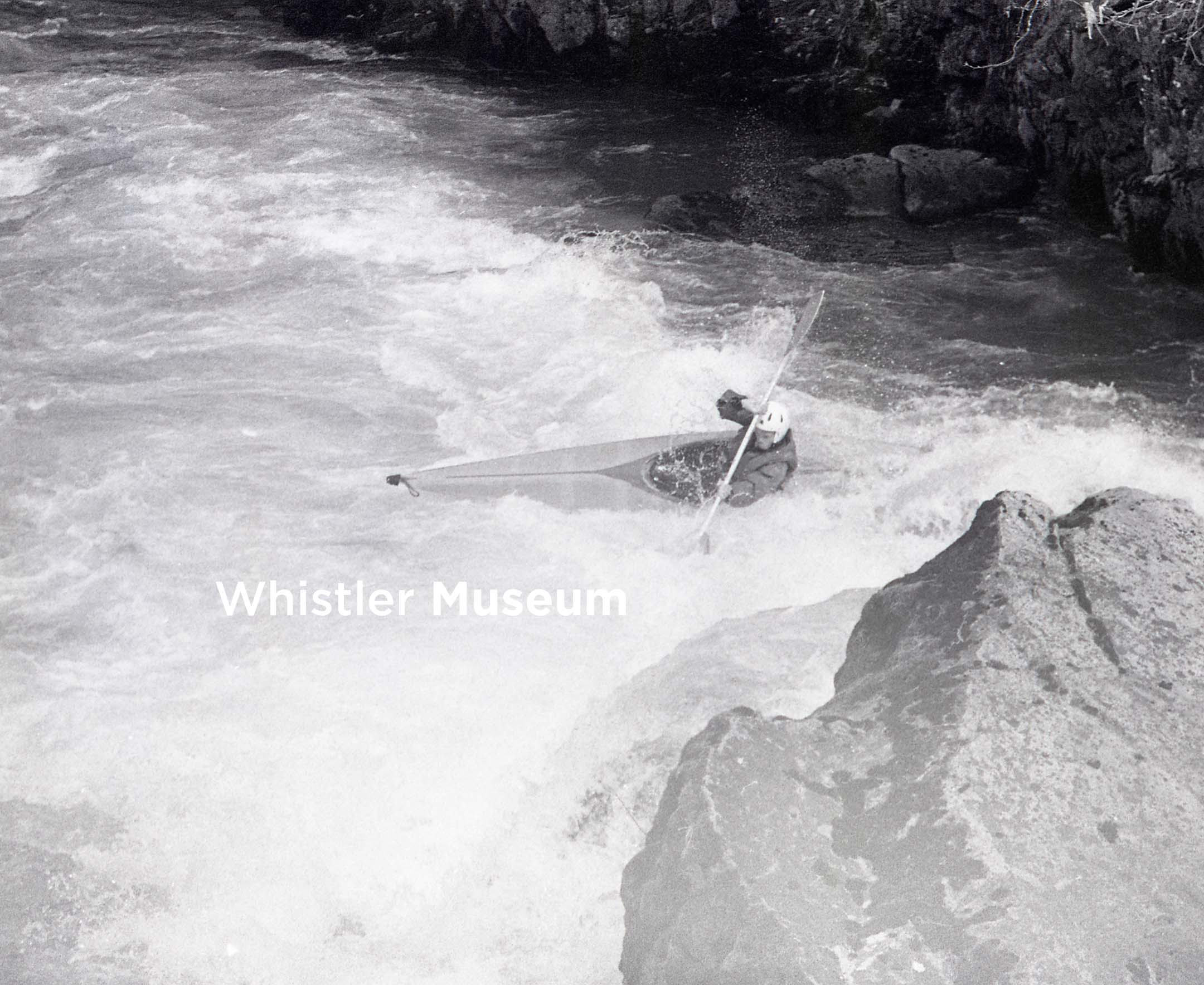
Featured Image: Lyall Featherstonehaugh paddles the Cheakamus River on May 11, 1980, during a demonstration organized for the Whistler Chamber of Commerce to showcase kayaking opportunities in the Whistler area as part of their May Day celebrations. Whistler Question Collection.

Longtime Whistler kayaker Shawn ‘Puddles’ Hughes left me with an interesting concept: he said he viewed his paddling as a way of “recycling the snow.” In the winter he skis, in the summer, he rides the snowmelt down the rivers – sporting an intimate balance with the hydrological cycle. However, the notion of balance is perhaps, now, better replaced with the term ‘dance’ or ‘positioning’…because, as Hughes has experienced firsthand, over the decades, the waterflow levels and patterns have been changing.

I was fascinated. The impact of glacial recession on local skiing and snowboarding has garnered attention with the closing of the Horstman Glacier on Blackcomb for summer camps in 2023, however this was the first time I had had reason to consider the impact on other non-on mountain sports. As the Whistler Museum actively continues to gather oral histories from a generational cross-section of local kayakers, I extended the question to Archer McLeay, a pivotal advocate within and for the paddling community: a relative newcomer on the scene, having lived in the Sea to Sky for 5 years, moving here, however, for the kayaking.

I asked McLeay, if in his handful of years here, he had witnessed the impact of glacier recession in the waters. He unequivocally answered: “It’s drastic.”

This aligns with Hughes’ deduction that “after 40 years of visually watching this, we’re in some trouble.”

McLeay elaborates “ideally … you get a huge snow base, and that’s what’s traditionally happened. […] Normally, there’s just a massive amount of snow up here. It all melts pretty consistently throughout the year, and you should get like a nice long season.” But that has been changing.

“The Cheakamus has got a way bigger glacial head bond, so that one tends to flow all year, regardless of what’s happening,” McLeay remarks. Hughes concurs, “Cheakamus is pretty safe because it does have a fairly big pack, but no, it’s still shrinking as quickly as everything else.”

McLeay continues, “But for all of our snowmelt rivers [the Callaghan is the main one], the snow will melt, and then after that, it’s just feeding on the glacier. So if you have a big heat wave, it’ll come through, and then the snow melts a lot faster than the glacial water, and then you’ll end up with just glacial melt running for the rest of the year. And so the season’s shorter. There’s less water to go along, and then if there’s a heat wave, it’ll just shorten the season just, boom, just in half.”

Hughes breaks it down simply: “when you take a big piece of ice and you keep shrinking [it] down, there’s some part of the day when it’s not going to flow as much as it did when the ice is big. So what’s happening is there’s a thing that I’ve diagnosed as looping…” Hughes premise on looping is based on discovering what the main source of the flow is. His curiosity was sparked after a section of water that he would consistently launch into a 1 pm every day, only became ‘attackable’ at 4 am. He wanted to understand the fluctuation: “Where’s the water really coming from? Cause there’s three rivers that feed this and the gauges we’re reading, it goes up at midnight and then peaks at four in the morning and then starts dropping and it’s gone by like 11.” He had noticed it going from a “concrete amount of water” to dribbles by August. “I did 31 four in the morning attacks on that to really investigate what was going on.”

Observations persist around many of our waterways, bringing a whole new meaning to rapid and rapidly (e)racing.

The Callaghan “tends to flow out”, McLeay notes. He speculates, “a few years ago, I imagine there would be a big enough glacier to feed the river, but now it’s just melted.”

The ‘Fitz’, too, is affected. “Last couple of years we’re running off the glacier.” Hughes points to its dwindling headwaters. Fitzsimmons Creek feeds the Green River. It also is the source for snowmaking – and that demand is steadily increasing. “Imagine what’s going to happen when this thing really tails out because, man, it’s not that far off…” 

Just, imagine.

For kayakers, glaciers are more than distant icefields—they’re the source of every rapid downstream. As the Whistler Museum continues documenting the history of paddling in the Sea to Sky, these oral histories are becoming more than stories about sport. They are records of a landscape changing within a single generation.

Moving HouseMoving House

0 Comments

Most people in Whistler are familiar with the process of moving house, including the packing, repacking, and unpacking.  Just about every person you meet has a story to share about moving to or within Whistler, but not many are able to tell you about the time they moved a house to Whistler.

Last week, however, we had someone do just that: Len Ritchie visited us at the museum to share his story of moving a 278 square metre (3,000 sq/ft) house from Garibaldi to White Gold in 1983.

Ritchie and his (not-yet-at-the-time) wife Patty first came to Whistler in 1975 and later moved to Whistler full-time, buying an empty lot in White Gold.  While driving Highway 99 in the fall of 1983, Len spotted a house on the side of the road with a sign proclaiming “For Sale $16,000 Delivered.”

Len and their dog pose next to the price of the house. Photo courtesy of Len Ritchie.

The unfinished house had originally been built at Garibaldi and the owner had decided to move the structure to a lot in Pinecrest.  Bob Moloughney of Squamish had been hired to move the house, but when the owner’s plans fell through Moloughney was left with the house.  He decided to sell it, including the cost of delivery in the price.

The house was sitting on the side of Highway 99, waiting to be moved. Photo courtesy of Len Ritchie.

Moving the house up the highway required some careful planning and could certainly disrupt traffic.  When Ritchie approached BC Hydro and BC Tel about dropping the lines during the move, he was told it would cost $16,000.  Instead, the decision was made to remove part of the roof from the house, bringing it down to a legal height to move under the lines, and move that piece separately.

The roof was reattached once the house reached its final resting place, and, according to Len, never leaked. Photo courtesy of Len Ritchie.

On the first day they got the house as far as Function Junction.  Ritchie recalled, “It was dark, and it was a little rainy, and we’re up on top with our poles to go under the lines.  So the logging truck, Valleau trucking, they were the driver, we had walkie-talkies, so he’d get up on the road and we’d get under a line and we’d go, ‘Hold it, hold it,’ and we’d push the line up, ‘OK, go ahead, go ahead,’ and that’s how we worked our way all of the way up the highway.”

The house waiting to cross the Fitzsimmons Creek Bridge into White Gold. Photo courtesy of Len Ritchie.

To get over the Fitzsimmons Creek Bridge, then the only access to White Gold, took more than four hours.  Lindsay Wilson, fire chief, left a truck in White Gold just in case a fire should occur while the house was occupying the bridge.  The house was jacked up using railway ties and the ends of the bridge railing were cut off, allowing the house to clear the bridge by mere centimetres.  After a while, White Gold residents came out to go to work and about their days, only to find that they couldn’t drive out.  Instead, Ritchie remembers, “If anybody needed to leave, I’d take their hand and bend down and crawl or crouch all the way.”  When the reached the other side, he had taxis waiting for them.

The house moved along the bridge just barely above the height of the railings. Photo courtesy of Len Ritchie.

The last stage of the move was up the hill to Ambassador Crescent.  After one perilous attempt at winching the house up the hill, Art Den Duyf kindly sent over a D6 Cat and a 988 loader to push and pull the house into place.  The top of the roof was then reattached and Ritchie, Patty and helpful friends took the next year and a half to fix the house up.

An excited group on the deck of the house, now on its lot and once again in one piece. Photo courtesy of Len Ritchie.

The house has since been sold a few times, but it is still standing.  In Ritchie’s opinion, the house that he first saw covered in tar paper, is now “a beautiful big house up there today,” and it has quite the story behind it.

A Wet End to August, 1991A Wet End to August, 1991

0 Comments

Recently, we were tasked with finding more information about a flood that washed out and damaged several bridges over Fitzsimmons Creek in the 1990s.  As it turned out, the flooding had happened exactly 28 years before we looked into it, with the bulk of information found in the September 5, 1991 edition of The Whistler Question.

The first mention of an unusually wet end to August appeared in the previous week’s editorial section, where editor Bob Barnett opened a piece on government money granted in the area with the thought, “The old adage it never rains, it pours, has applied to the weather this week, but also to government handouts.”  Between August 16 and 31, 155 mm of rain were reported to have fallen in Whistler, with the bulk of the rain falling between August 29 and 30.  The average rainfall for the entire month of August was historically under 50 mm; this unusually large quantity of water caused destruction throughout the Sea to Sky corridor.

An excavator removes rock and gravel carried down Fitzsimmons Creek during Labour Day weekend’s floods. Whistler Question Collection, 1991

During the five days of intense rain, water levels at the Pemberton Airport and the Golf and Country Club were recorded at over two metres and BC Rail recorded at least twelve places between Britannia Beach and Lillooet where the crushed rock that supported the rails was washed away, leaving sections suspended over the ground.

In Britannia Beach severe flooding caused Britannia Creek to change course through the lower townsite and the highway around Squamish was blocked for 36 hours.  According to the Ministry of Forests, three quarters of the forest service roads in the Squamish Forest District were closed from washouts, flooding or slides, with multiple bridges destroyed.  North of Pemberton, some residents around Skookumchuck were evacuated to Pemberton by helicopter.

Within the Pemberton Valley, a Friday afternoon community effort to shore p a dike behind the Van Loon property attempted to mitigate the damage caused by the flood.  Approximately 100 people were reported to have come out to fill sandbags.  Their success was limited as the dike was breached a few kilometres north of their work, flooding fields and homes and ruining potato crops.

An aerial view of the flood at the airport. Whistler Question Collection, 1991

Compared to other areas of the Sea to Sky, the flooding would appear to have caused relatively little destruction in Whistler, mainly due to the community effort to keep Fitzsimmons Creek in its channel.

Through the evening of Thursday and Friday, local contractors, excavators and heavy equipment crews worked to shore up the banks of Fitzsimmons Creek and keep the waters out of the village and White Gold.  According to Tony Evans, public safety director, “If we hadn’t had that we could have made Britannia Beach look like a walk in the park.”

The footbridge over Fitzsimmons Creek, 1991. Photo courtesy of Jan Jansen

As it was, the high waters and debris in the creek took out two supports of the Nancy Greene Drive bridge, partially washed out two footbridges linking the village and benchlands, and destroyed Fitzsimmons Creek Park.  The flooding also damaged sewer pipes and interrupted water supplies to White Gold.

At this time 28 years ago, Whistler and the surrounding communities were still in the midst of their clean up efforts as the water receded.  It would take weeks to clear debris, assess damages, rebuild bridges, and construct measures to prevent future flooding, such as deepening Fitzsimmons Creek.  Some of these measures can still be seen while walking across Fitzsimmons Creek today.

This Week In Photos: December 6This Week In Photos: December 6

0 Comments

If there’s one thing most of the photos from this week have in common, it’s snow!  Seeing these images, we’re hoping for some more in the valley soon.

1978

Only at Whistler – local top-hatted chimney sweep at work in the snow!
Thursday was not a good day for some! Above, Squamish Freightways truck tangles with the school sign.
Municipal 4×4 tries to get a motorist out of a ditch on Thursday.
All smiles! John Howells (left) receives the Citizen of the Year award from Paul Burrows while Drew Meredith looks on.
The Rotary Exchange students on the steps of the Roundhouse.
The new municipal skating rink recently constructed adjacent to the school.

1979

Kindergarten students build their first snowpeople of the season – left to right: Brie Minger, Joanne Den Duyf, Nonie Bredt, Beau Jarvis, Andrew Hofmann.
The gondola area showing the early arrivals in the parking lot – the Wosk lot is the empty one centre right.
Bridge abutments for the new bridge over Fitzsimmons Creek to service Blackcomb Mountain.
RCMP officer Terry Barter and Major with students at Myrtle Philip School.

1980

The giant cake prepared for the Fourth Inaugural meeting of the Resort Municipality of Whistler Council.
The Blackcomb Snowhosts: (l to r) Cathy Hansen, Shelley Phalen, Tom Kelley and Charlotte Sheriff.
The balloon shape is covering Whistler Resort & Club’s pool from Whistler’s harsh winter.
The new sign at the entrance to the Town Centre is completed.
An unidentified fireman, Chief Lindsay Wilson and Rick Crofton hose down a fire damaged cabin in Alta Vista.
Leo Lucas checks out the newly refurbished Roundhouse before the crowds arrive. New appointments include carpets, roll-away seating and various touchups.

1981

Barb Newman, of Whistler Tops, models a cap and one of the many rugby shirts available in the new Village Square store.
Jason, Harley and Dylan Stoneburgh stand proudly in front of the snowmen they built in Alpine Meadows after the first storm of the winter.
Sandy Boyd, the new Gondola Area Co-ordinator for Whistler Mountain Ski Corporation. Sandy, who has twelve years experience in the ski industry, will be responsible for the organization of all systems at the Gondola base.
Bearing gifts and a song, Susan Jacks, formerly of the Poppy Family, will be one of the stars in an upcoming CBC special partly filmed in Whistler.
Myrtle Philip students take part in a ‘Western Day’ at the school.
A sneak preview of the new Black Forest Restaurant in the former White Gold Inn.

1982

Highways crews clear up the debris left by a December 3 rock slide on Highway 99 near M. Creek.
Slim and Margaret Foughberg open a gift presented to Slim for his service to the Howe Sound School Board. Together they have served Howe Sound continuously (except for two years) since 1946.
Mayor Mark Angus is sworn into office by Municipal Clerk Kris Shoup-Robinson at Council’s inaugural meeting December 6.
A young batch of new skiers shapes up for the slopes under the rigorous command of ski shop owner Jim McConkey, who put them through their paces December 6.
Myrtle Philip School library helpers enjoy a well-earned lunch. Irene Pope, Judy Fosty, Kelly Macwell and Candy Rustad. Missing is Mrs. Demidoff.

1984

Twyla Picton and Rolf Zeller were out cross-country skiing in the sub-freezing temperatures Whistler has experienced for the previous week. Cross-country skiing in the valley is the best in years with a total of 195 cm of snow fallen in November.
Work on the Conference Centre continues with the construction of a wall partition above the second floor. The wooden frame structure behind the scaffold will be attached to a moveable partition that will allow Conference Centre organizers to divide the main hall into two separate meeting areas.
Ski instructor Stephanie Sloan from Whistler Mountain was the grand prize winner in the Beaujolais Nouveau contest. Sloan will receive a trip for two via CP Air and KLM plus two days in Burgundy hosted by Rene Pedauque. Select Wines representative Wendy Taylor, Sarah Kuhleitner from Citta’s and the WRA’s June Paley picked the winners Sunday in Whistler’s first ever Beaujolais Nouveau celebration.
BC Supreme Court Justice Samuel Toy swears in Whistler’s four new aldermen in council chambers Monday. Moments before, Judge Toy also officially authorized Mayor Terry Rodgers as the municipality’s third ever mayor. The four new aldermen are (left to right) Doug Fox, Paul Burrows, Diane Eby and Nancy Wilhelm-Morden. A reception followed the inaugural meeting of council.