Tag: farming

Dairy Delivery by Dugout: Local Cream and Cow’s Milk Carted by CanoeDairy Delivery by Dugout: Local Cream and Cow’s Milk Carted by Canoe

0 Comments

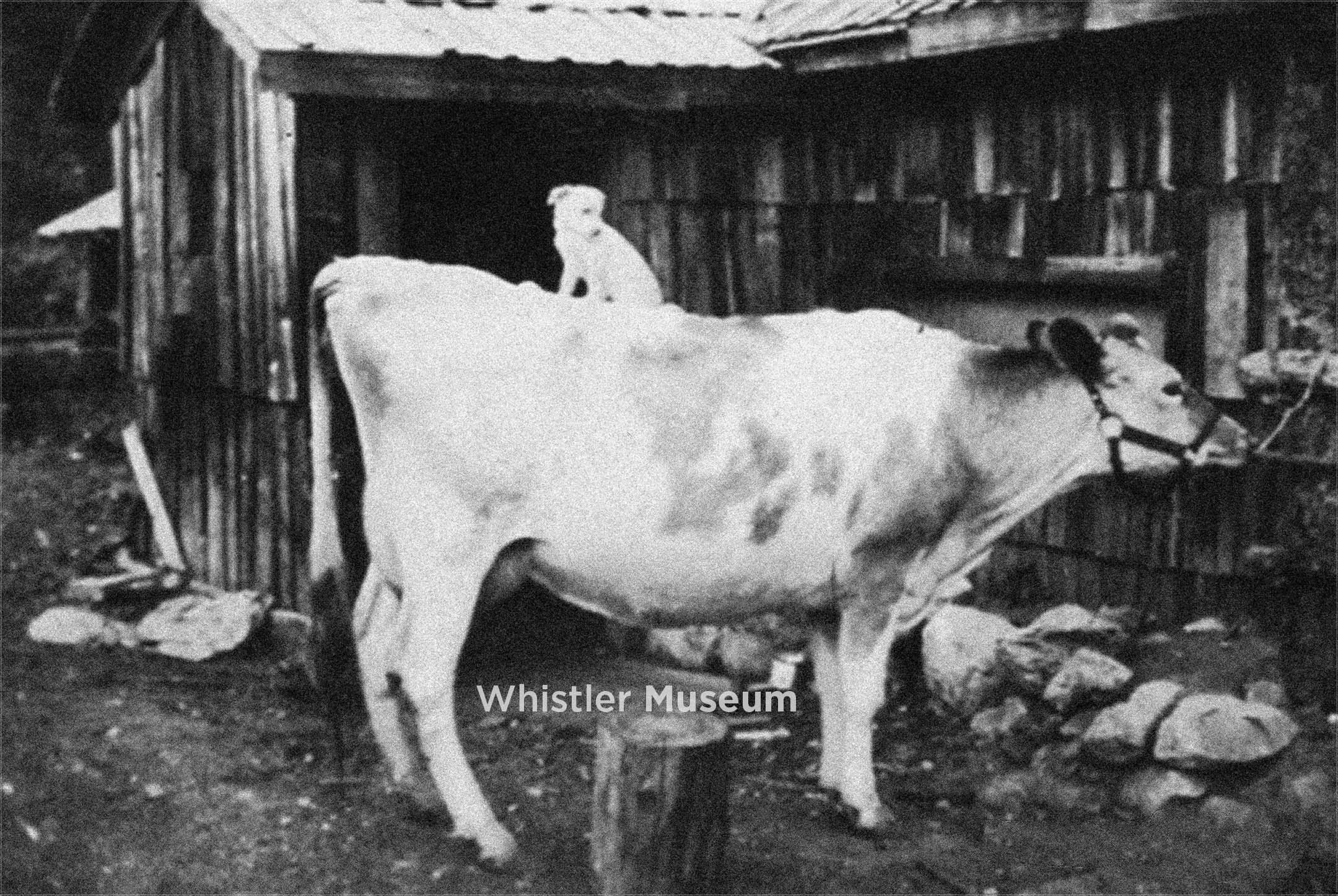
Featured Image: A dairy cow at the Barnfield Farm [1920s]. Whistler Museum Collection.

The lay of the local landscape was much different in the early 1900s. The area’s epicentre was Alta Lake. Prospecting, trapping and logging, followed by fishing and later farming dominated, giving reason and rise to the development of a small community and a handful of lodges in the valley beneath London Mountain. 

London Mountain (since renamed Whistler) likely earned the named due to a group of original prospectors who formed The London Group in 1903. One of those early prospectors was Alfred Barnfield. 

Barnfield left London, England, arriving in Squamish in 1886 or 1887. He was later hired to inspect the length of the Pemberton Trail. The rough route ran from Burrard Inlet to Squamish up through the area now known as the Whistler Valley northward to Pemberton and onto Lillooet. First developed with the intention to access the Interior’s goldrush and as a cattle trail, the route was completed in 1887. It remained the only way to access Alta Lake (then called Summit, but renamed for the purposes of mail delivery, for there were too many Summit Lakes in the province, with the establishment of the area’s first Post Office in 1915) up until the arrival of the Pacific Great Eastern Railway in 1914. It was through Barnfield’s inspection that he first came to visit the shores of the lake where he would establish a farm some years later. 

Barnfield returned to Alta Lake, pre-empting 160 acres of Crown Land on its northeast end, in 1905. Pre-emption was a practice common in British Columbia in the late 1800s to early 1900s, which allowed settlers to acquire Crown Land for development and agriculture. After improving it, the land could be purchased at a low price. As per the agreement with the government, Barnfield was required to build a cabin and clear a portion of the land. To do so, he backpacked building supplies over the Pemberton Trail from Squamish.

Barnfield continued to prospect with the London Group, staking claims in the Garibaldi/Black Tusk area.

On August 1, 1910 Alfred Barnfield married Daisy Hotchkiss. He was 42, she was 19. Despite the age difference, the marriage appeared to be a loving one and the two raised four children. 

The Barnfield Farm had 14 cows at the peak of its production, chickens and a few pigs. Alta Lake was becoming a fishing destination with the opening of Rainbow Lodge in 1915 and subsequent establishments opening up around Alta lake. The Barnfield family’s farm was able to fulfill a local much-appreciated-niche: daily fresh milk and cream delivery. They fulfilled orders by dugout canoe. Groceries and dry staples were able to be delivered by train, coming north from Vancouver; however, fresh dairy demanded local production. In a 1993 interview with the Museum, Alfred’s daughter Vera, reminiscessed about how he made his deliveries every day, even when the weather was questionable. “He never missed a morning and sometimes it would be so stormy he just couldn’t hardly make that canoe go.”  Whatever the weather, Alfred would end his deliveries with a visit to Rainbow Lodge, where he would be brought up to date on all the local gossip of the burgeoning lake community … which would then be repeated and rowed around!

Rainbow Lodge was the largest customer of the Barnfield Farm, reputedly purchasing 80 quarts of milk, four quarts of whipping cream and two quarts of table cream daily for their guests.

The Barnfields moved their farm operation to Brakendale in 1926. However, every summer, they continued to load their cows and chickens onto the Pacific Great Eastern Railway (PGE) and travel north to Alta Lake. How long they continued this practice is unconfirmed, however the Barnfields did maintain full ownership of their quarter-section up until the 1970s. 

Alfred Barnfield passed away in 1960, shortly after celebrating his 50th wedding anniversary to Daisy, who passed in 1980. 

In the early 1970s, the bulk of the property was sold for the development of the Whistler Cay subdivision and Adventures West. Small lots were left to the three remaining Barnfield children (one died in WWII). The remaining 1 ⅓ acres was sold in 1988, becoming ‘Barnfield Place’, a nod to the legacy of initial local land development.

The story of Tapley’s Farm (yes, it involves farming).The story of Tapley’s Farm (yes, it involves farming).

0 Comments

With the sun coming out and vanquishing the snow from the valley, and next week’s Green Talk all about growing your own food in Whistler, now is as good a time as ever to look into the history of agriculture in Whistler. Last fall we featured a post providing a bit of an overview of the topic, so this week we’ll take a more focused look at Whistler’s most well-known farm, Tapley’s Farm.

Yes, that Tapley’s Farm: the quiet residential neighbourhood which also holds the distinction of being the Whistler Valley’s first attempt at employee-designated housing. Although the area didn’t get it’s nickname “Mothers, Dogs, and Children” (a play on the acronym for Mountain Development Corporation, which developed the subdivision in the 1970s), there was a family with far more animals than just dogs living off the land along the northeast shore of Alta Lake.

While Alex and Myrtle Philip are widely recognized as the founders of the the community of Alta Lake (even though they were not the first settlers), fewer people are aware that Myrtle’s family, the Tapley’s were here from the beginning as well.

Myrtle's brother Phil Tapley, looking very much like a farmer.
Myrtle’s brother Phil Tapley, looking every bit the farmer that he was, July 1967.

When construction began on the Philip’s Rainbow Lodge in 1913, they were assisted by Myrtle father Sewall, and her sisters Jean and Margaret, and her brother’s Frank and Phil. Once Rainbow Lodge was completed, Sewall moved in with Alex & Myrtle, Phil returned to his home in Squamish (he had first moved there from Maine in 1912), and Jean and Margaret moved further afield, though they returned often for visits.

In 1925 Sewall purchased a large parcel of level land running along the north shore of Alta Lake, including the marshes surrounding the River of Golden Dreams, from a trapper named George Mitchell. That same year Phil Tapley married Dorothy Disney of Squamish and together they moved north to clear and settle Sewall’s land (first, Myrtle had to convince her father that he was getting too long in the tooth to try clearing his own farm).

In ensuing years Phil, Dorothy, and eventually their daughter Doreen (born in 1926) cleared, developed and managed a productive farm with various grain and veggie crops, an orchard, plenty of cows, chickens, horses, and plenty of hay. In addition to producing the majority of their own families needs, they were able to provide plenty of milk, veggies, and eggs for other settlers and lodge guests throughout the valley, as well as hay for their livestock.

What appears to be Phil Tapley (on the wagon), Alex Philip (at right) and an unidentified helper haying along the shores of Alta Lake. Note the Blackcomb Mountain backdrop, with Couloir Extreme and Chainsaw Ridge plainly visible near the righthand skyline, and a far more extensive Horstman Glacier at middle.
What appears to be Phil Tapley (on the wagon), Alex Philip (at right) and an unidentified helper haying along the shores of Alta Lake. Note the Blackcomb Mountain backdrop, with Couloir Extreme and Chainsaw Ridge plainly visible near the righthand skyline, and a far more extensive Horstman Glacier at middle.  Circa 1920s.

In every sense the Tapley’s were a model, self-sufficient pioneer family. In winter Phil also operated traplines in the surrounding mountains, and he was a keen adventurer. Dorothy was the only resident of the Whistler Valley to receive a Canadian Centennial Pioneer’s Medal in 1967.

Together they continued eking out a living through traditional means, pumping water from a well, and deriving heat and light from fire well into the 1960s, when the rest of the Valley was turning to modern conveniences such as electricity and plumbing. Dorothy passed away in 1968 at the age of 81, and Phil stayed on the farm for 3 more years until his death in 1971 at the age of 83.

Myrtle, Dorothy, and Phil in front of the Tapley farmhouse.
Myrtle, Dorothy, and Phil in front of the Tapley farmhouse, circa 1960s.

The Tapley’s exemplify perhaps better than any other Whistler Valley residents the potential to draw sustenance from the Earth, even in harsh climates such as our own. They should serve as inspiration to any Whistlerite frustrated by their inability to grow a ripe tomato, or a crisp head of lettuce.

Times certainly have changed; no doubt the Tapley’s drew from extensive farming knowledge passed on through the generations, and favourable (more precisely, non-existent) zoning–try raising chickens, let alone cattle, in Whistler today.

While waiting out changes to local agriculture by-laws (don’t hold your breath), you can beef up on your cultivation knowledge this Wednesday evening at the Whistler Museum, as AWARE hosts a series of short presentations all about overcoming the many present-day challenges of growing your own food in Whistler: from soils and sunlight, to selecting seeds, maximizing your growing space, and bear-proofing your crops. Hope to see you there!

Changing Seasons – Harvest TimeChanging Seasons – Harvest Time

3 Comments

Wow. And just like that, it’s Autumn. In a matter of days everyone went from lounging at the beach to excitedly gossiping about snow at the Roundhouse, ski-movie premieres and the upcoming La Nina redux.

For our valley’s pioneer-era residents the end of summer was an equally momentous event, but for completely different reasons.

In Alta Lake’ early days, there were no grocery stores or farmer’s markets. Shipping fresh food up from Vancouver was expensive and unreliable, so Alta Lake residents procured as much food locally as possible.

Fresh vegetables were especially hard to import, so virtually everyone had a large garden. Today fresh local produce is treated like a delicacy; back then it was the norm. All summer long residents and visitors alike dined on greens mere yards from where they were plucked from the rich valley-bottom soil.

Where Myrtle grew the greens that kept Rainbow Lodge guests happy.
The alluvial fan between Nita and Alpha Lakes, near where Nita Lake Lodge is today, was one of the best growing sites. In the 1920s Harry Horstman had a small farm there, whose produce he sold throughout the Alta Lake community. Russ Jordan bought most of this land from Horstman, building Jordan’s Lodge (pictured here) in 1931. Jordan maintained a large orderly garden to help provision his guests.

Needless to say, winter was a different story. To fend off culinary boredom (not to mention scurvy), locals spent much of the fall preparing produce to keep through the cold, deep winter.

Most year-round residents kept root cellars, something which our Pembertonian friends are familiar with. With no refrigerator, Parkhurst Mill housewife Eleanor Kitteringham depended on this vital household appliance to keep her family well fed:

There was a door cut in our floor in the kitchen, with a leather handle to lift an stairs going down under our house to put potatoes, carrots, cabbages, etc. in, as well as shelves for canned goods.

Demonstrating pioneer-era resourcefulness, Eleanor remarked how the root cellar “also made a great dark room to develop pictures in.”

Much of the canned and pickled goods were produced locally, preserving excess produce drawn from backyard gardens. The museum has a recorded interview with Myrtle Philip, describing her preferred techniques for making jams and jellies (these were made primarily with boxes of Okanagan-grown fruit).

Myrtle made jams from wild, local berries, crabapples, peaches and much more. It turns out Myrtle thought most people used too much sugar, and that she preferred jellies to jams (jellies have the seeds and pulp strained out using cheesecloth).  The most remarkable aspect of the interview is that Myrtle was making apricot jam while the interview was being recorded in 1982, at the ripe old age of 91!

Today we take such things as fresh pineapples in February for granted. Back in the day, if you didn’t work for it, you didn’t get it. With the recent “locavorian” resurgence, however, people are becoming reconnected to the hard work and dedication needed to bring nature’s abundance to our dining room table.

With our region’s agricultural renaissance in full swing, there’s no excuse for missing out. The easiest way to sample fresh, organic produce (of course, all farming was organic before the twentieth-century advent of chemical fertilizers and pesticides) and of the glorious creations by our community’s many talented culinary artisans–many of whom employ traditional food-preparation techniques–is at the Whistler Farmer’s Market. The market will keep running every Sunday until October 9th. Don’t miss out!